
There have been many issues plaguing Ohio State over these last two weeks.
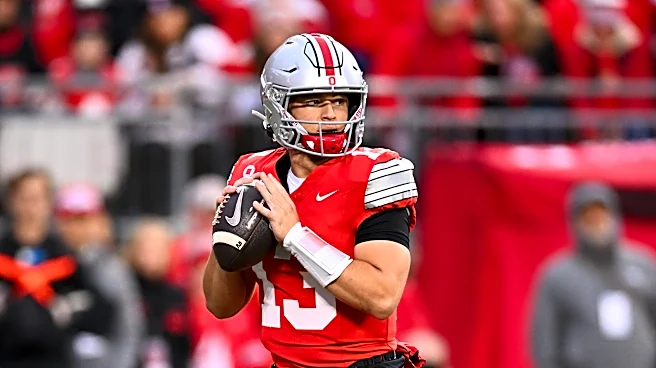
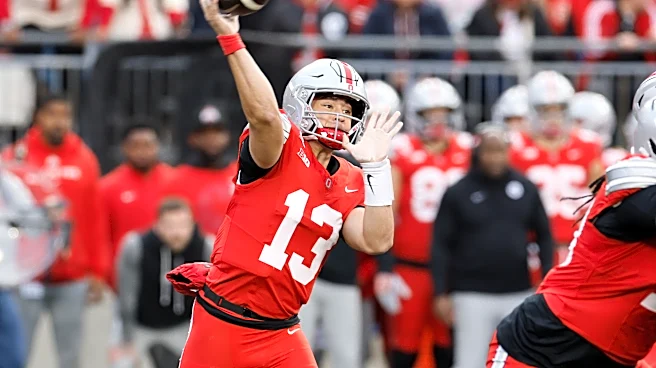
The Buckeyes have seemingly come apart at the seams, struggling mightily in all three phases of the game. While the issues on defense and special teams are incredibly concerning in their own right, the injury to Julian Sayin has also unearthed some major flaws on the offensive side of the ball.
Of course, nobody would blame Ryan Day and Arthur Smith if the Ohio State offense experienced some setbacks after losing their starting
quarterback. That said, I don’t think many would have expected the drop-off to be quite as steep as it has been these last two weeks.
It is not the fault of backup quarterback Luke Fahey. The true freshman was not expected to be starting games for the Buckeyes in year one, or possibly even at any point in his career. It is clear that the California native is not ready to lead this Ohio State offense, but it is unfair to put the blame on his shoulders.
That blame falls on the Ohio State coaching staff, who have failed to plan ahead, failed to prepare, and failed to adjust to this new era of college football.
Ohio State is not the only program to lose its starting quarterback to injury, in general, but also this season specifically. They are, however, floundering in the wake of that injury more than others at this level.
The Buckeyes just got run out of their own building by an Oregon team that lost a potential first overall pick in quarterback Dante Moore. The Ducks’ situation is a bit unique, and backup Dylan Railoa is far from perfect, but Dan Lanning and his staff had a competent quarterback ready to go in the wake of Moore’s injury.
Look at what UCLA is doing this year. The Bruins are 9-0 despite losing starting quarterback Nico Iamaleava in their victory over Oregon in Week 5.
Backup quarterback Ty Dieffenbach, who spent last season at FCS Cal Poly, has helped lead UCLA to a perfect 4-0 record in his first four starts. Dieffenbach has thrown for 943 yards with six total touchdowns and two picks in those four games.
Even as recently as last season, Ole Miss lost starting quarterback Austin Simmons in Week 2. All backup Trinidad Chambliss did from there was total nearly 4,500 yards and 30 touchdowns while leading the Rebels to the College Football Playoff Semifinal.
These three programs were all able to field more than competent backup quarterbacks through vastly different methods.
Oregon paid up to get a flawed but talented player with hopes they could develop him into a starter for next season. UCLA, in year one under Bob Chesney, found a solid backup from the FCS ranks and has found a way to make it work. Ole Miss added an athletic freak from Division II, built the offense around him, and turned him into a superstar.
If other programs across the country, who have far fewer resources than Ohio State in two of the three aforementioned cases, can piece things together without their starting QBs, why can’t the Buckeyes?
Many will try to blame the NIL era for Ohio State’s weak position group behind Sayin. It is admittedly tougher to build depth at any position when guys can get comparable money at lesser programs to start.
That said, there is no reason the Buckeyes couldn’t have gone out and found a talented QB at a lower level that would leap at the opportunity to be one snap away from starting at Ohio State.
They could have gone out and tried to find a veteran player from a lesser program with experience that could have stepped up in this exact scenario. Instead, they went out and got Justyn Martin, a guy who played six total games at UCLA and Maryland and has zero chance of ever taking a single snap in Columbus.
Ohio State could have also paid up to try and keep Lincoln Kienholz in Columbus, who has looked very solid at Louisville this season with 25 total touchdowns, and owns an ACC-best 9.8 yards gained per pass attempt. It likely would have cost them quite a bit to convince him to stay as the No. 2 guy, but he would be a massive upgrade over the current situation.
The options themselves aren’t really the point of contention. The biggest issue is that Day and his staff had a complete lack of foresight in the added risk of injury in what has now become a potentially 16-game season.
Ohio State, during a normal season, is basically playing a full NFL schedule’s worth of games. Every additional game increases the chance that you will lose a few guys to injury, and that obviously includes your starting quarterback.
The Buckeyes failed to adapt the roster to reflect this change. Even outside of not having a capable backup, Ohio State didn’t do anything this offseason in an effort to provide extra protection for Sayin.
Ohio State’s offensive line was not great last season, and they brought all of those guys back this year while not adding a single player up front via the transfer portal. Tyler Bowen, the man in charge of that position group, has done a miserable job of developing the unit — which is to be expected when you hire the Virginia Tech tight ends coach to lead your offensive line.
The Buckeyes under Day have also very rarely taken the opportunity to get their backup quarterbacks valuable reps in blowout games. Tavien St. Clair, the five-star QB on the roster who was supposed to be the heir apparent to Sayin, totaled two pass attempts in 2025, and now can’t find his way onto the field even as Fahey has struggled through his two starts.
Day had gotten lucky to this point that he never needed the backup quarterback to be ready to go, but that luck has since run out, and they are now getting exposed at the most important position on the field.
Which brings us to the final flaw in this whole process: development.
Ohio State had an incredible run of quarterback play when Ryan Day was solely in charge of the position. From Dwayne Haskins to Justin Fields to C.J. Stroud, the Buckeyes were among the best in the country at the position through Day’s first five seasons at the helm.
As Day shifted into more of a CEO role, Ohio State put a glorified intern, Corey Dennis, in charge, resulting in a down season at quarterback with Kyle McCord in 2023. The Buckeyes quickly rectified that issue by allowing Chip Kelly to take over when he got the offensive coordinator job, and Will Howard had a great campaign in 2024.
Beginning in 2025, the quarterbacks coach has been Billy Fessler, a guy whose only prior experience as a full-time QB coach is two seasons at Akron and one at UCLA. His one season with the Bruins in 2024 resulted in starter Ethan Garbers throwing a conference-worst 11 interceptions.
Clearly out of his depth, Fessler did nothing to help develop Sayin this past offseason. The Ohio State starter didn’t make any sort of improvement from year one to year two, and was basically the same exact player we saw last season. Sayin was good, but suffered the same flaws in big games as he did in the 2025 postseason.
Now, with the Buckeyes desperately needing someone else to be ready to step up, nobody is.
Ohio State has a 6-foot-5 five-star on its roster at quarterback, and he is apparently so far from being ready to play that he remains on the bench behind a 5-foot-11 true freshman who was a former three-star prospect. The Buckeyes are going to continue to roll with Fahey over St. Clair, which is a clear failure of development from both Day and Fessler.
Ohio State should never find itself in this position.
Ryan Day came to Ohio State as a quarterback guru, and now one injury at the position has completely derailed an offense that still features the best player in program history at wide receiver, a running back who ran for more than 1,000 yards as a freshman last season, and several other highly touted skill players.
There are no excuses for the Buckeyes to look this unprepared. Ohio State has far too many resources at its disposal to let things get this bad this quickly at a premier position like quarterback, especially given that it is the position that gave the head coach his reputation in the first place.