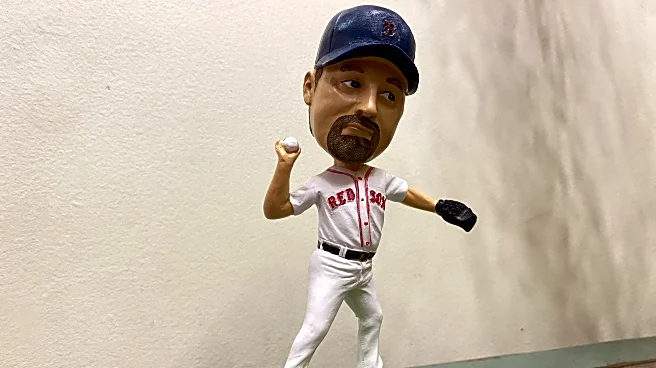

Over the holidays, my father told me he was going to send me a Tim Wakefield bobblehead that he found in a junk pile at his house. I didn’t have high hopes for this, given that description of its provenance,
but it arrived last week, and it’s beautiful. Truly awesome. Opening it, I felt moved—by remembering Wake’s accomplishments and the man he was, and by memories of seeing him pitch. I’m also appreciating the high-class packaging, the two baseball cards inside, and the first-class craftsmanship.
I told my girlfriend about it when she returned from her holiday trip. Sight unseen, she asked if I was keeping it. She’s come a long way in her baseball fandom since we got together, but I thought I detected an undercurrent of sarcasm in her voice, or at least a reluctance to see this thing of beauty in our home. I instantly assured her that I was indeed keeping it.
In defense of the bobblehead—and my bobblehead—I’m inspired to document the long, rich history of this little bit of memorabilia. Its importance across several cultures. Its beginnings as a sacred object in 17th century Chinese temples, with likenesses of Buddha and other religious figures. These statues were called “temple nodders.”
Around this same time, way back in the 17th century, a similar figure—the Thanjavur dancing doll—appeared in southeast India, in Tamil Nadu state, as decorations for the royal palace. These dolls were made of terra cotta, painted by hand, and dressed in textiles. To pay homage to the graceful movements of classical dance of the region, their “bobble” appears not only at the neck, but also at the hands and the hips. [Sidebar: Doesn’t that full-body action that originated in India really connect the dots straight to the 2024 Triston Casas yoga-in-the-grass bobblehead?]

The Thanjavur dancing dolls continue to be made by hand, and are cherished for their cultural and religious importance in that region.
In the 1760s or so, the then-Prince of Wales (later to become King George IV; his father was on the throne during the Boston Tea Party and American Revolution) visited China and returned to England with a love of Asian art, and a number of actual temple nodders. The young prince used these artifacts to decorate several of the royal residences. His royal artistic taste then became popular among British subjects, and so these early bobbleheads made their way to other parts of Europe and America.
By the mid-1800s, these bobbleheads had appeared in at least one British painting, and a Russian short story. At the turn of the 20th century, Germany was fabricating animal figurines with bobbing heads, and the figures—now typically made from porcelain—became popular throughout the US and Germany in the 1920s-30s.
In 1960, MLB decided to commission one bobblehead to represent each MLB team. They were sold at parks, not yet giveaways. The papier-mâche bobbleheads were imported from Japan, and although they wore a different team jersey, the faces were identical, with a look that probably passed for “all-American” then (think: white, cherubic, apple-cheeked). The 1960 World Series expanded a bit on this souvenir by offering bobbleheads meant to represent several star players, though each one, like the MLB-wide bobbleheads earlier in the season, featured that exact same face, even for players of color. (Ahem.) Each of the Beatles were celebrated with a bobblehead in 1964, proving that bobbleheads were firmly entrenched throughout pop culture by this time. Because they were made of fragile materials, not many of these earliest bobbleheads survive. This fragility led MLB and others to investigate sturdier types of toys and souvenirs, like action figures.
Then in 1999, bobbleheads found new life as the San Francisco Giants sought a way to commemorate their final year at Candlestick Park. The team’s Executive Vice President remembered the bobblehead souvenir from his childhood that had meant so much to him and decided this retro memorabilia was the perfect touch. Fans loved it and the trend caught on, with eight more teams offering bobbleheads in the 2000 season. And so it goes.
Why did bobbleheads take off since 2000, in a way they didn’t in the 1960s?
Yes, plastics. Easy to produce, inexpensive, durable.
There is a National Bobblehead Hall of Fame and Museum; you can bet I’m going there on my next trip to Milwaukee. From sacred religious object to beloved baseball object, let’s celebrate our bobbleheads today.