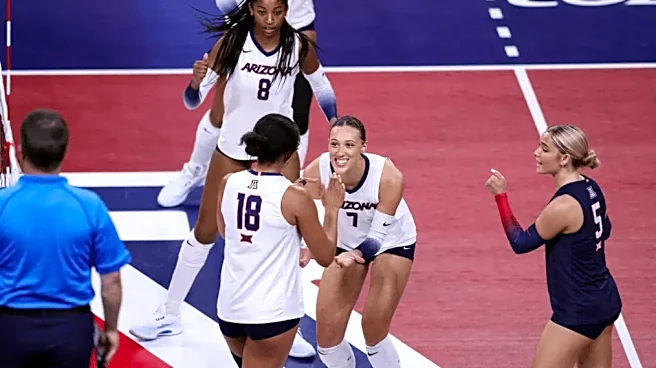









Arizona volleyball head coach Rita Stubbs
has said repeatedly that there’s no team in the conference that the Wildcats are good enough to look past. That was obvious at West Virginia.The Mountaineers have won a total of five Big 12 matches combined over the last two seasons. Their 3-1 (23-25, 25-15, 25-21, 25-17) win against Arizona on Friday night gave them their fourth conference win of 2026.
One constant for Arizona this year has been inconsistencies. The wildly different scores from one set to
another backed that up once again. The reason for that was another common story for the Wildcats.
“Passing broke down,” Stubbs said.
The issue affected even some of Arizona’s stronger passers. Junior outside hitter Carlie Cisneros received 33 serves, far outpacing everyone else on the team. The Mountaineers put a lot of pressure on her. It got to her.
“Carlie got aced six times,” Stubbs said.
Despite the difficulty in one of the stronger parts of her game, Cisneros contributed her fifth double-double of the season with 10 kills and 11 digs. She also had a block assist and two aces. Her 12.5 points were second on the team.
Destiny Ndam-Simpson led the team with 15 kills on .268 hitting. She also had a double-double with 12 digs. Her two aces gave her a team-high 17 points.
In a rare occurrence for this year’s Wildcats, they got all three pin positions into double digits in scoring. Right side hitter Kennedy Osunsanmi had 10 kills on .333 hitting. She added a block assist for 10.5 points.
“We had three players with double-digit kills,” Stubbs said. “We competed.”
The Wildcats were fairly efficient on offense despite their difficulty with serve receive. Six of the seven players who got a kill hit .250 or better.
All three of Arizona’s middle blockers hit .400 or better. That has not always been the case this season as the middles have often struggled with efficiency at a position that should be highly efficient.
Journey Tucker had a strong offensive night after several difficult matches in recent weeks. The senior hit .400, her highest hitting percentage since Oct. 2 when she hit .500 against Iowa State. She has hit below .275 in the other five matches this month.
Tucker’s frustrations were something Stubbs talked about before the team left for the trip to West Virginia.
“If you just get the ball to her at the right tempo, she’s savvy enough and she understands enough what to do with it,” Stubbs said. “But when the ball is low, I mean that’s difficult for anyone, especially when you want to score it, you know what I mean? Or if the ball is slow, that’s when her not-so-good arm swing comes to play…so it gets to be frustrating for her because she knows that it’s not just the setting, and she’ll say it in a heartbeat. She knows that she plays a role in it, as well.”
Tucker responded well with seven kills on 15 swings and just one error.
What was not as successful for the Wildcats was the block. Arizona has scored a considerable portion of its points this year on its blocking, especially by Tucker.
The team ranks in the bottom three in the Big 12 in far too many stats. They are last in six of the 13 statistical categories the conference keeps for teams. They climb out of the basement in digs, blocks, opponent blocks, and opponent aces.
The Wildcats average 2.18 blocks per set as a team. They had just three total blocks in the four-set match against the Mountaineers.
Unsurprisingly, the Wildcats were at their best in the first set, which they won 25-23. They hit .457, scoring on 16 kills without an error.
They returned to the court for the second set looking like a completely different team. West Virginia looked like a different team, too, but the Mountaineers went in a positive direction.
WVU stayed steady in the number of kills while cleaning up its errors, acing Arizona three times, and getting three total blocks. The Mountaineers put together a 9-0 run that had them in front 16-5. It effectively ended the second set.
Neither team could hold serve for long in the third set. Arizona’s biggest run was four points and West Virginia had a five-point run. The differences were the Mountaineers’ three-point run to start the set and the five straight points they won at the end.
WVU went ahead early but Arizona took a lead at 15-14. From there, the two teams spent much of the third set simply trading points.
The Wildcats went up by two at 18-16, but the Mountaineers tied it again at 19 points each. Arizona’s last lead came at 21-20. The team didn’t score another point in the set. WVU won the last five points to take a 2-1 lead in the match.
Once again, a competitive set by Arizona was followed by a thoroughly uncompetitive set. The Wildcats only scored multiple points in a row three times in the set. Their biggest run was three points.
WVU didn’t go on long runs, but it stayed steady. The Mountaineers would string together anywhere from two to four points at a time then quickly side out when Arizona won serve. Before long, the home team was up 16-10.
The closest Arizona got was three points at 18-15, but WVU squashed the Wildcats’ hopes with a 4-0 run to pull within three points of the win. That run was part of a 7-2 advantage to close out the match.
While the result wasn’t what Stubbs wanted, she didn’t feel it was for lack of competing. She was also pleased that her team didn’t have to go through a great deal of difficulty with travel this season.
Two years ago, Arizona had to fly commercial for the road trip to Cincinnati and West Virginia. That included connecting flights and long bus rides. They had to bus between the two cities between matches and fly out of Pittsburgh after playing the Mountaineers. They returned home in the early morning hours of a Monday and players still had to attend classes.
“It was a nightmare coming back because you got to be in Morgantown, you got to get to Pittsburgh, then you got to take a flight—then you got to take another flight,“ Stubbs said.
This season, the team got to charter to Morgantown. After the game against the Mountaineers, they didn’t have to climb on a bus to head for Ohio. Instead, they got on another charter to fly to Cincinnati.
They will fly commercial to Tucson after playing the Bearcats but that’s only because the first charter was not available until hours after the match in Cincinnati. The commercial flights would have them home sooner.
“I thank the administration for it,” Stubbs said.