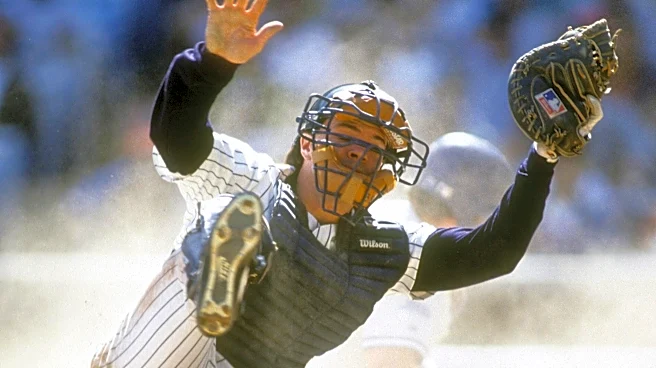



Growing up in the Southern California sunshine, Matt Nokes had the kind of baseball profile most travel-ball dads dream their sons will have: a lefty-hitting catcher. That combination eventually helped him reach the majors. Nokes’ path to the pros started when the Giants drafted him in the 20th round of the 1981 MLB Draft out of Patrick Henry High School in San Diego. A decade later, it took him to New York.
Matthew Dodge Nokes
Born: October 31, 1963 (San Diego, CA)
Yankees Tenure: 1990-94
After being
drafted, Nokes started working his way toward the show, beginning in Rookie ball while still just 17 years old. He spent the next two seasons playing in Single-A, though his first year at the level was a bit of a struggle. In his second season, Nokes broke out with Fresno, slashing .322/.410/.508 with 14 home runs. The performance was good enough to earn him a promotion.
Nokes spent the 1984 season in Double-A and returned to the level to start the 1985 season. After another solid year, the Giants gave him a September call-up. In 19 games for San Francisco, he hit .208 and launched his first two major-league home runs. The Giants used Nokes as part of a package that offseason, sending him and pitchers Eric King and Dave LaPoint to Detroit in exchange for Bob Melvin, Juan Berenguer, and a player to be named later (Scott Medvin).
Now in the Tigers organization, Nokes returned to Double-A to start the 1986 season. Detroit gave him another cup of coffee at the end of the year before moving on from longtime starting catcher Lance Parrish that offseason, opening the door for Nokes to take over behind the plate.
Nokes’ rookie year was by far the best season of his career. In 1987, he slashed .289/.345/.536 with 32 home runs and 87 RBIs. He was selected to the All-Star team and won the Silver Slugger Award, but finished third in Rookie of the Year voting behind Mark McGwire and Kevin Seitzer. It was quite a debut for the young catcher, who helped Detroit win the AL East — the Tigers’ last playoff appearance for nearly two decades.
After that amazing season, Nokes came back down to earth and saw his playing time and production slip over the next two and a half seasons in Detroit. The Tigers decided it was time to move on in 1990 and traded him to the Yankees that summer for the elder Lance McCullers and Clay Parker.

The Yankees hoped Nokes’ bat could help the struggling club, particularly against right-handed pitching. With Bob Geren and Rick Cerone also on the roster, Nokes split time behind the plate and at designated hitter. He batted .238 with eight home runs in 92 games for New York. After the season, Cerone departed, and Nokes entered 1991 as the Yankees’ primary backstop.
In his first full season in pinstripes, Nokes played 135 games. In 493 at-bats, he hit .268 with 24 home runs. Those 24 round-trippers led the team, while his 77 RBIs were good for second. Those Yankees were lousy, but it was hardly his fault.
The 1992 season saw Nokes top 20 home runs for the second straight year, finishing with 22. His average dropped to .224, and his on-base percentage fell to .293. Mike Stanley also began pushing for more playing time behind the plate.
Shifted into more of a reserve role, Nokes appeared in 56 games as a catcher and another 11 at designated hitter in 1993. He slashed .249/.303/.424 with 10 home runs. The highlight of his Yankees tenure came on September 4th, when he was behind the plate for Jim Abbott’s no-hitter against the Cleveland.
Heading into the 1994 season, Nokes was still slotted behind Stanley on the depth chart. However, a broken bone in his hand in April sidelined him for much of the season. With the players’ strike ending the season in August, Nokes was limited to just 28 games. He batted .291 with seven home runs in his final season in pinstripes. The Yankees’ last game of the season came on August 11th, bringing Nokes’ time in the Bronx to an abrupt end.
Nokes spent the 1995 season with the Orioles and Rockies, appearing in 36 games between the two clubs. That ended up being his final major league season, though he continued playing in independent leagues later in his career. He also spent time coaching and eventually returned to the San Diego area, where he has worked as a hitting instructor and consultant, doing what he can to give back to the game.
Happy Halloween to all, and happy birthday, Matt!
See more of the “Yankees Birthday of the Day” series here.