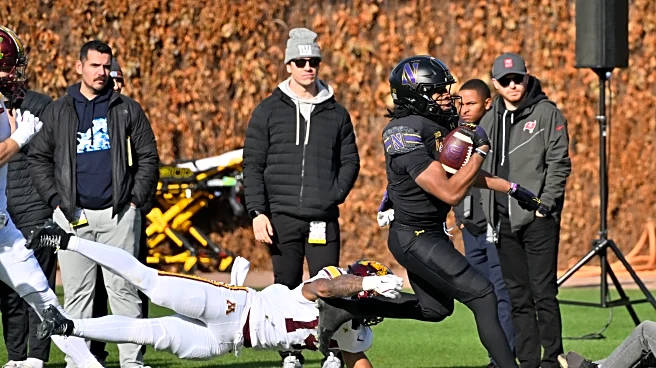




The book has closed on the Northwestern Wildcats’ 2025 football season, making way for a flurry of analysis on the GameAbove Sports Bowl Champions’ encouraging 7-6 season. Inside NU will spend the next few weeks wrapping our coverage of the 2025 football season with reviews of each position group. Today we’ll look at the running backs.
Heading into the season, there was a lot of hype surrounding the running back position after a strong junior year campaign from star running back Cam Porter and the key
offseason acquisition of journeyman running backs coach Aristotle Thompson. All the excitement was ran out the door when Porter suffered a season ending lower-body injury in the ‘Cats’ week two game against Western Illinois. However, forced to lean on a young, deep running back room, Northwestern was up to the task, turning in its best season running the football since 2019, gaining 2,082 total yards behind a strong offensive line.
Overall Grade: A-
No group experienced more adversity than the Northwestern running backs room this season, and, arguably, no group performed better. After a disappointing 2024 season that saw the ‘Cats gain just 1,182 yards and average 3.3 yards per carry, this was the bounce back that the traditionally run-heavy Northwestern offense needed. This season, Northwestern’s 2,082 rushing yards was eighth in the Big Ten while its 4.6 yards per carry was seventh. Last year they ranked 17th in both of these statistical categories.
Furthermore, Northwestern’s success in the run game was a major catalyst of success for the team all year long. Northwestern was 6-3 in games where it rushed for over 100 yards, and 1-3 in games where it rushed for less than 100 yards; being able to establish the run game was key to the ‘Cats’ offensive performance. Now, of course, a lot of the credit for the improvement also must be given to the offensive line, and a somewhat upgraded downfield passing game which opened up the field for the offense, but when watching the film, there’s no doubt that the Northwestern running backs did play a major role when the offense succeeded.
If not for the group’s inability to always replicate their success against the better defenses they faced, stumbling a bit in losses to Tulane, Michigan and Illinois, it would be a straight “A” for this persevering group. It’s incredible what the running backs were able to do this season battling not just Porter’s injury, but the week-to-week injuries of Caleb Komolafe, Joseph Himon II and Dashun Reeder. Led by Thompson, the running back room completely embraced a next-man up mentality and fought hard all season long.
Caleb Komolafe: A
Stats: 190 carries, 941 yards, 5.0 average yards per carry, 11 rushing touchdowns, 11 receptions, 60 receiving yards, one receiving touchdown
After an inconsistent season that earned him a D+ in our position reviews last season, Komolafe put together a stunning sophomore season, stepping up as the lead running back after Porter’s early season-ending injury. Komolafe was fantastic, consistently efficient running the football, while also capable of bursting free for longer gains with his speed and agility.
Just 59 yards short of a 1,000-yard rushing season, Komolafe’s 941 rushing yards were the most by a Wildcat since Evan Hull’s 1,009 yards in 2021. Carrying the ball 11 or more times in twelve games, Komolafe had just two games under 50 yards and four games over 100 yards. With 119 yards against UCLA and 129 yards against Minnesota, and touchdowns in each of those games, Komolafe was the offensive MVP behind two-major one-possession victories for the ‘Cats, slicing up opposing defenses behind the ‘Cats’ strong offensive line.
If anything, the only criticism of Komolafe this season would be his ball security: he fumbled the ball three times this season, twice in the ‘Cats’ final two games. Yet, that’s to be expected from a sophomore running back experiencing such a large jump in volume, 50 to 190 carries, from his freshman campaign.
In Porter’s absence, Komolafe stepped up to be exactly what ‘Cats fans hoped Porter would be, shattering all expectations for his performance this season. Especially exciting about Komolafe’s breakout season is that he was able to make it happen in his sophomore year. With Chip Kelly coming in to lead the offense next year, Komolafe will be at the forefront of Northwestern’s offensive strategy, as a proven workhouse back that has shown he can be a star.
Joseph Himon II: A
Stats: 99 carries, 486 yards, 4.9 average yards per carry, one rushing touchdown, 21 receptions, 118 receiving yards, one receiving touchdown
Originally second on the depth chart at the beginning of the season, Himon became the backup to Komolafe following Porter’s injury. Seeing lots of snaps as a third down receiving back, Himon turned in his biggest season yet with the ‘Cats, totaling 604 yards from scrimmage. At 5-foot-9 and 19o pounds, Himon’s small stature made him the quickest in the running back room, allowing to break off a plethora of double-digit runs and get open running routes on passing downs.
Himon’s biggest rushing game of the season was Northwestern’s upset 22-21 victory on the road against Penn State. Himon carried the ball 13 times for 65 yards, as Komolafe and Himon’s combined 137 rushing yards led the ‘Cats to a gritty victory over the Nittany Lions. However, Himon’s most consistent impact continues to be his receiving. Himon caught two or more passes in six games this season, leading all Northwestern running backs in receiving yards with 118. Complementing Komolafe’s consistency as an early-down back, Himon played the part all year long, turning in a great junior season.
Dashun Reeder: A-
Stats: 22 carries, 222 yards, 10.1 average yards per carry, one rushing touchdown
At times, of all the backs that played for Northwestern this season, Reeder was perhaps the most visibly impressive. Reeder averaged a whopping, team-leading 10.1 yards per carry, breaking free for runs of 15+ yards in three of the five games in which he received carries. The highlight of Reeder’s season was a 79-yard touchdown run against Oregon, where he hit the hole quick and turned on the jets, showing off his high-end speed as he ran away from all defenders down the sideline.
However, our judgement of Reeder is limited to a small sample size, as the South Carolina native was limited to just five games due to an injury he suffered against Purdue, limiting his ability to contribute for the Wildcats this season. Undoubtedly, considering Reeder’s efficient freshman year performance, the ‘Cats would’ve liked to see Reeder return for his sophomore campaign. However, sitting third in the depth chart behind Komolafe and Himon, Reeder chose to enter the transfer portal and seek out a more expansive opportunity elsewhere.
Robby Preckel: B
Stats: 42 carries, 149 yards, 3.5 average yards per carry, one reception, four receiving yards
Despite being listed as a tight end, it’s appropriate to grade Preckel as a running back considering he carried the ball 42 times but caught just one pass. In reality, the Missouri freshman embraced somewhat of a fullback hybrid role this season, seeing a large amount of usage in the running game due to the ‘Cats’ never-ending stream of injuries at the position.
In fact, in Northwestern’s snowy rivalry matchup against Illinois, the ‘Cats found themselves without Komolafe, Himon, or Reeder, causing Preckel to become the main back for the majority of the game. Against the Illini, Preckel carried the ball 22 times for 82 yards, averaging 3.7 yards per carry in snowy conditions. Preckel’s performance in this game was, perhaps, most exemplary of the nature of his performance this season. As the ‘Cats faced deep injuries at running back, Preckel heeded the call to serve, running strong and taking care of the football. However, Preckel was visibly somewhat out of place as a primary back, lacking the speed to break through holes and into the second level. He didn’t impress, but he did his job. Finishing the season with a surprising 150 yards, Preckel gets a “B” grade.
Cam Porter: Incomplete
Stats: 18 carries, 137 yards, 7.6 average yards per carry, one rushing touchdown, three receptions, 23 receiving yards
After five long, hard fought years in a Northwestern jersey, Porter’s sixth year tragically ended at Martin Stadium in just the second week of the season. Playing for Northwestern since the 2020 season, Porter had racked up 1.771 yards and 3.85 yards per carry. Coming off of a 501-yard junior season, Wildcat fans were hoping that this would be a big 1,000+ yard season for Porter behind a strong offensive line. And, for a week and change Porter met all expectations, following an efficient 7.7 yards per carry outing against Tulane with a bustling game against Western Illinois. At his time of injury against the Leathernecks in the third quarter, Porter had 12 carries for 91 yards and a 43-yard touchdown. Unfortunately, Porter’s poor injury luck continued, leaving his 2025 campaign incomplete.
Daniel Anderson: Incomplete
Stats: Three carries, nine yards, 3.0 average yards per carry
Anderson saw three garbage time carries this season split across Northwestern’s dominant wins over Western Illinois and ULM. Anderson, a freshman from Arkansas, will likely return to the ‘Cats this season and work to get more playing time amidst his sophomore campaign.