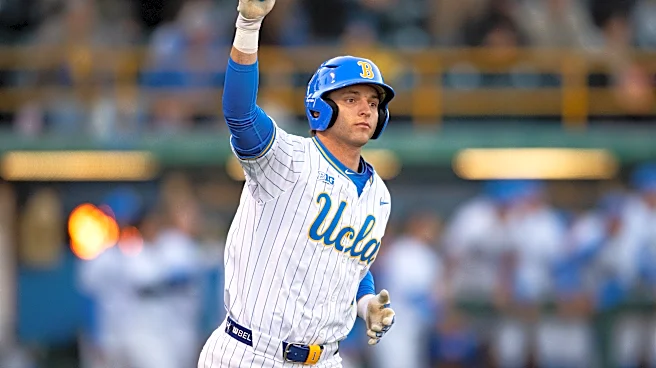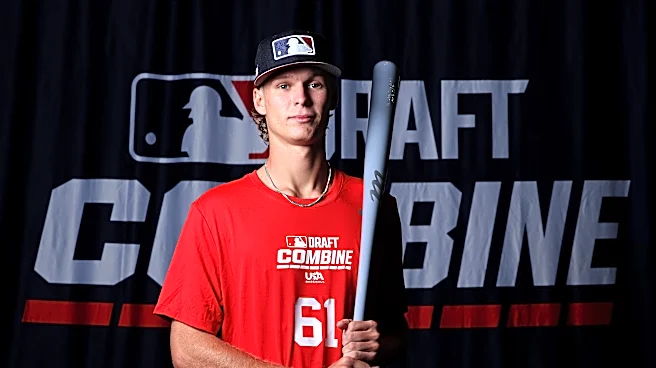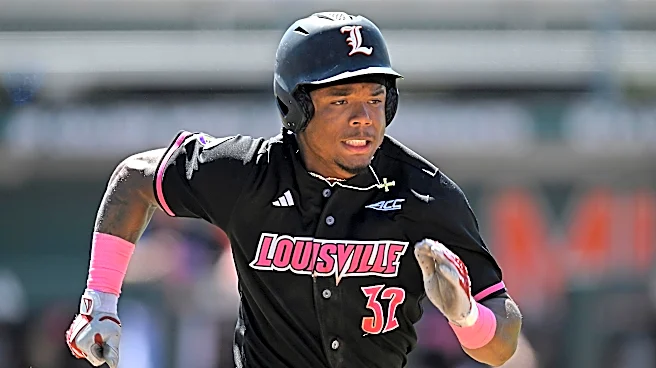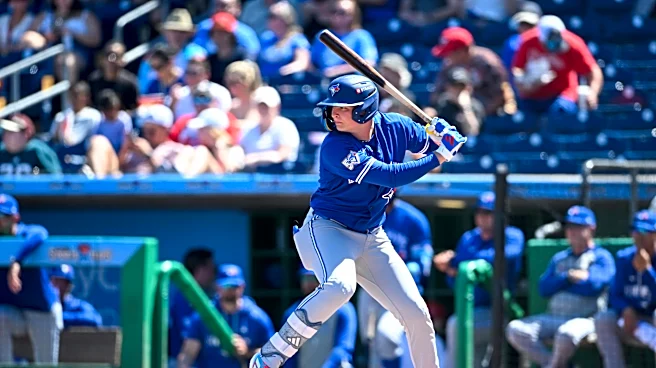





We’ve spent some time going over the first-round options for who the Mariners might pick at 24, but the Mariners also have three more picks to make on Day One: picks 65, 101, and 129. Will the Mariners play it safe with high-floor college players, or get risky and try to utilize their small bonus pool to access prep talent, balancing things out with money-saving senior signs? We’re dividing our picks for rounds 2 – 4 into two buckets: Taking Your Medicine (safe floor, lower ceiling) vs. Eating Ice
Cream (riskier, higher ceiling, might end up with tummy ache).
Take Your Medicine!
Hitters:
Caden Ferraro, OF, Texas Tech
Max informs me that both Ferraro and another choice I have for this category – Ty Head, an outfielder from NC State – are probably both gone by 65, but a girl can dream. Both are very Mariners-y type hitters who don’t strike out a lot and make a ton of contact. Head, who can stick in center, is the better defender and will probably go higher, which is why I’m focused on Ferraro here, but Max says Ferraro has also been climbing up draft boards thanks to some consistent, very loud exit velocities that make him light up models for teams. -Kate
Ferraro profiles as a corner OF that may have to move to DH in the future, but the bat is extremely good. He’ll have a better chance at being available for the Mariners in the second round than Head will, but they’ve both been popular names of late. – Max
Ryan Cooney, 2B, Oregon
Cooney feels Mariner-y to me because he does everything well but nothing super-loud; shades of Cole Young, but with less power and more speed. He’s a contact monster who hits like he has a baseball magnet in his bat; he has a career 91% contact rate in-zone, which is just obscenely good. This feels like a very safe choice, with local ties to boot. -Kate
Jake Schaffner, SS, North Carolina
This is objectively a pipe dream of a pick to get all the way to 65, but Schaffner is a damn good baseball player. Schaffner makes a ton of contact and possesses plus bat to ball skills with evident feel for the barrel. He’s keen to take his walks and struck out less than 10% of the time, doing so in his first season against ACC competition. Schaffner, a shortstop for UNC, has played all three infield positions not named first base and stole 26 bases last season while only getting caught thrice; sure, the power isn’t overwhelming, but with how often he barrels the ball, it hasn’t mattered whatsoever. He’ll likely be gone before this point, but he’d be an awesome get if he was available. – Max
Tre Phelps, 3B, Georgia
This is maybe a chalky, Flintstones dinosaur vitamin more than medicine, but an older college bat with clear limitations is the type of reasonable move the Mariners have made at times in the early-to-middle rounds. Phelps was a star on campus this year for the Bulldogs, whipping the bat through the zone with an arc geared for elevation. It showed, as he clubbed 19 homers this year, even as his profile leans bat-first. Phelps is a good athlete and a fiery competitor, whose skills could stick at 3B, 2B, or 1B depending on how he fills out, and he has experience with corner outfield as well. In a system thin on corner infielders, Phelps can likely move up the ladder fairly aggressively. –John
Pitchers:
Ethan Kleinschmidt, LHP, Oregon
Feels gross for this Husky to be picking so many Ducks but I’ll call it a tribute to staffer Becca. Kleinschmidt is a solid-safe pick for the Mariners as someone who fills up the strike zone, more of a pitchability-over-stuff profile but a solid back-end starter type whose most exciting attribute might be throwing baseballs with his left hand. -Kate
Brett Renfrow, RHP, Virginia Tech
Renfrow had a rocky start to the season, but an incredibly strong finish has put him back into the range most expected him to wind up for draft day. A physical righthander with excellent athleticism, Renfrow gets great extension and already throws four distinct pitches, two things the M’s love to see in their prospective draftees. Renfrow’s best pitch is a firm slider that sits in the mid-to-upper 80’s, though his heater, which has touched 98, is also an excellent offering for him. This seems like an arm that the Mariners will fall in love with, and they’ve turned this type of pitcher into a big leaguer several times over at this point; with proper optimization and a bit of professional development, Renfrow could be a beast of a second rounder. – Max
RHP Tate McKee, Georgia Tech
If you like ‘em big and boring, that’s McKee. An ultra-reliable, hyper-durable starter for the Yellowjackets for all three years he’s been on campus, nothing McKee does on the mound will blow you away, but he’s got the traditional college starter’s arsenal, fills up the zone, and elicits a ton of ground balls. His best whiff-getting pitch is a slider that has some sharp diving action, and for all his boring attributes on the mound, he gets pretty fired up on it when he punches someone out. McKee trains at Florida Baseball Armory, where Logan Gilbert also trains. -Kate
RHP Jason DeCaro, North Carolina
Besides allowing for some excellent, melodic hollering every time he enters the game, DeCaro is doing nothing flashy. The command-forward righty is the dictionary definition of safe and reliable, such that any thing of the ilk can be applied to a young pitcher. He’s tallied 53 starts and over 270 innings as a college arm, sitting in the low 90s with a four-pitch mix led by a solid changeup and a pair of decent breaking balls. The 6’5 righty is a strike thrower who keeps opponents off balance even in one of the best conferences in terms of quality of competition. Like with some of the other names here, you’d be hoping to see Seattle manage to unlock some extra velocity and/or bite to the breaking balls, as they’ve done successfully with command arms like Gilbert and Kirby in years past. –John
Life is Short, Eat Dessert First!
Hitters:
Will Plunkett, SS, Mamaroneck HS (NY)
6’3” and athletic, Plunkett has a beautiful right-handed swing that’s currently more line-drive oriented but should blossom into more with his frame and patient approach, and he should be able to stick at third base with his arm strength and athleticism even if he comes off shortstop. Plunkett passes the character test, as well, getting high marks both as a teammate and in the classroom. The Mariners have done well with scouting cold-weather kids and Plunkett shouldn’t be impossible to pry off a commitment to SUNY Binghamton. Bonus for him being a cold-weather kid, a type the Mariners like. Also did I mention he’s a righty? I’m so sold. -Kate
Luke Williams, SS, Franklin Regional HS (PA)
One of the fastest players in this class, Williams is a tremendous overall athlete and tests amongst the best in the country athletically. Armed with a quick, compact, right-handed swing, Williams is short to the ball and utilizes excellent hand speed to square up balls and drive them with authority. He’s not the biggest guy in the world and is somewhat of a tweener profile between CF or SS, but he’s got the tools to compete with anyone on the diamond and could be a really fun option if the M’s go safe in round one. He’s one of my favorite preps in this class. – Max
Peyton Bonds, OF, Rutgers
Rarely does the “upside hitter” profile come from the college ranks, but this is a physically impressive youngster with a pedigree. The 6’5, 230 lbs Bonds runs at a plus level and swiped a bevy of bags while swinging with abandon in the Big Ten. Yes, he is the nephew of Barry Bonds, son of longtime minor leaguer Bobby Bonds Jr., and the grandson of former All-Star Bobby Bonds Sr.. This Bonds has the electric raw power of his uncle and grandfather, but an approach at the plate that is so aggressive as to often dilute his opportunities to get into that power. Despite this, Bonds is not a whiff machine, putting the ball into play and letting his elite speed do damage. He’s a pure center fielder, with a profile that fits in 2nd-4th round range, and has the tools to be successful if he can refine his approach. –John
Kevin Roberts, OF, Jackson Prep (MS)
If you’re more keen on seeing your young power-speed prospects work up from the high school level, Roberts is one of the extremes of this draft. Coming out of the same program as his former teammate, Pirates top prospect Konnor Griffin, Roberts has a similar profile but not yet the same track record of performance. Still, a 6’5 17 year old who runs and showcases power in an elite capacity, with a strong arm to boot, makes for a surefire center fielder in need of the refinement of professional coaching to support the development of his swing. –John
Pitchers:
Hudson DeVaughan, RHP, Mooresville HS (IN)
Scott Hunter said in a predraft meeting that the bar for a prep pitcher was Ryan Sloan, and the 6’4” DeVaughan measures up both literally and metaphorically. A hard thrower already, DeVaughan’s easy arm action and projectable frame should mean there’s even more to come, and he rounds out his arsenal with a whiff-getting curve and a hard cutter, with his high school coach describing everything he throws as “electric”. Saliently for a potential Mariner draftee, he also gets high character marks as a leader and a good teammate, and has been described as very coachable. Back issues kept him off the circuit for a while and account for a wild variety in his draft rankings – Baseball America has him just outside the first round, while MLB Pipeline has him towards the back of the second round. He’s also a cold-weather/Northern kid, where the Mariners have had success drafting prepsters like Sloan (IL), Cole Young (PA), Colt Emerson (OH), and Nick Becker (NY). -Kate
Trey Rangel, RHP, The Colony (TX)
I honestly don’t think the Mariners would select Rangel, I just really like him. He’s a little undersized at 6’1” and has a high-effort delivery with a lot of moving parts, but he’s an excellent athlete – also a very good hitter – and he’s got a rich arsenal for a prep pitcher, with a fastball complemented by a power curve and a kick change, and he can really spin a slider. The thing that tips me over on Rangel – who is committed to Texas – is scouts rave about his makeup and intelligence. I’m putting his name in my back pocket for a few years down the road. -Kate
Brody Bumila, LHP, Bishop Feehan HS (MA)
Possibly the most talented prep pitcher in this draft class, Bumila has a “UCL injury” that will almost assuredly keep him out of the first round. Given he’s already received internal brace surgery on his pitching elbow back in 2025, the 6’9 southpaw is not to be viewed with great confidence. This is where Seattle is playing a game of risk and reward, however. Their past gambles on health have yielded some misses like Michael Limoncelli, but also Bryan Woo. Bumila has sat 97-99 and touched 101 this year, with a stellar changeup. There’s a real chance Bumila can’t swing starting, but could map onto a Mason Miller type of trajectory. –John
Kaden Waechter, RHP, Jesuit HS (FL)
For my money, Waechter is one of the best prep pitchers in this entire class. A projectable 6’3 190lb pitcher with clean, repeatable motions on the mound, Waechter possesses excellent metrics on both his fastball(s) and breaking balls and has already shown an ability to land a changeup when he needs to. Waechter gets good extension down the mound as well, pounding the zone with strikes and commanding his offerings better than most his age. He’s a bit older for the class and will turn 19 in early August, but there’s just nothing in this profile that is cause for overwhelming concern. He’s a second round arm that’s as close as anyone to reaching the lofty “Sloan Standard”. – Max