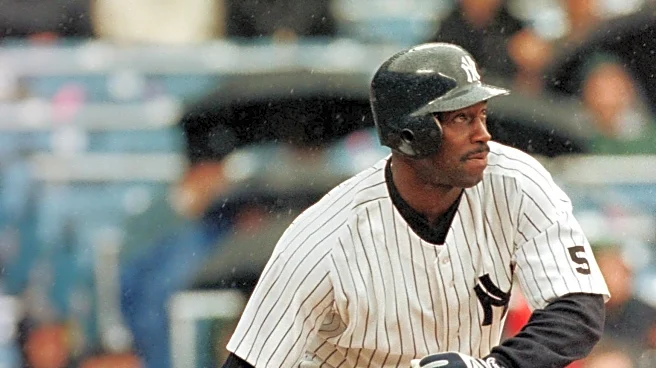

The Yankees weren’t looking for much in December of 1997. After all, they had just won the World Series over the powerhouse Braves in a six-game series a couple of seasons ago, the franchise’s first title
since their six-game victory over the Dodgers in 1978, and finished with a 96-66 record in 1997. Their roster wasn’t perfect by any means, but it was still good enough to finish only a couple of games behind the Baltimore Orioles for first place in the division.
Unfortunately, that meant a matchup with Cleveland, which, despite a worse record, could still be a pain at the time. They certainly were a thorn for the Bombers, rallying against young closer Mariano Rivera to send the Yanks packing in the American League Division Series.
Over the offseason, there didn’t need to be many changes, as the roster needed a few small tweaks. And that’s where former outfielder and designated hitter Chili Davis stepped up to the plate — from both sides, to be specific.
Charlie Theodore “Chili” Davis
Born: January 17, 1960 (Kingston, Jamaica)
Yankees Tenure: 1998-99
One of just five players in major-league history to hail from Jamaica, Davis actually moved to the United States with his brother and three sisters at the age of 10. Charlie Davis took to the baseball diamond to fit in with those in his Los Angeles schools. A catcher and a first baseman primarily at that age, he certainly proved his worth and was taken by the San Francisco Giants in the 11th round of the 1977 MLB Amateur Draft.
Davis took some time to develop in the minors before making his MLB debut on April 10, 1981 at the ripe age of 21. And after playing the first game of his career, he only played seven more in 1981, tallying just two hits across those eight games before management and the coaching staff in San Francisco had seen enough to believe the switch-hitter could be a part of the MLB roster full-time.

In 1982, Davis made the majors and didn’t look back for the rest of his career. He played 152 games and slashed .261/.308/.410 with an OPS of .719, which comes out to an OPS+ of just one point better than average at 101. In the grand scheme of things, that’s not bad at all for a 22-year-old on a Giants team that was just slightly above average. He finished fourth in the National League Rookie of the Year voting, losing out to the Dodgers’ Steve Sax, the Pirates’ Johnny Ray, and the Cardinals’ Willie McGee in a fairly competitive race.
Davis would spend the next five years of his career in San Francisco and earn two All-Star appearances in 1984 and 1986 before signing with the California Angels in the 1987 offseason. From 1988 to 1990, he stayed in California and had a few strong seasons, including 1989, when he grabbed a few down-ballot AL MVP votes. In 1990, Davis became a full-time designated hitter after back issues ailed him and prevented him from meeting the standards required in the outfield.
Davis signed with the Twins and continued to hit in 1991, slashing .277/.385/.507 for an OPS of .892 and the third-highest OPS+ of his entire career at 141, once again earning a smattering of down-ballot MVP support. He also won his first of three World Series rings while homering twice in that epic Fall Classic against Atlanta.
But, following that, he would not get any closer, despite putting up better numbers a few years later down the road when he returned to the Angels and posted almost 1.000 OPS figures in 1994 and 1995, with 1994 being the year he would make his third and final All-Star appearance.
In 1997, after his four-year (second) stint with the Angels ended, Davis made his way to Kansas City for a season before it was time for then-Yankees owner George Steinbrenner to make his splash in the 1997 free agent pool.
When the Yankees signed Davis to a two-year deal worth $9.8 million with an option for a third season, it was all that Steinbrenner could have wanted, saying to Jack Curry, who at that point was a reporter for the New York Times:
We’re very happy with this guy because he’s a tremendous hitter and a tremendous influence in the clubhouse. We thought one of our problems last year was moving from DH to DH. You look at Davis, and he’s a professional DH. That’s what we lacked last year.
Was he the most flashy player of all-time? No. Did Steinbrenner have to shower him with big money and huge guarantees in order to bring him to The Bronx? Not at all.
Regardless, Davis was a key piece of the back-to-back World Series titles in 1998 and 1999. He played only 35 games on the record-breaking ‘98 team due to an untimely ankle injury and subsequent surgery, but still posted above-average numbers in those games and hit in the postseason, when the team needed him most — especially with primary DH Darryl Strawberry missing the playoffs to fight cancer.. His finest hour came in the 1998 ALCS, when, in a crucial Game 5 in Cleveland, Davis came through with three RBI and a home run in a Game 5 that sent the Yankees back to the Bronx with a 3-2 series lead:
And in 1999, his final season in the league before retiring, Davis finished on a high note, appearing in 146 games for the Yankees and finishing the season with an OPS of .812 and an OPS+ of 108.
Davis walked away from the game as a three-time World Series champion (and a contributor to all three World Series winners) and a three-time All-Star. He retired at age 39 in December 1999 after the Yankees released him. At the time of his retirement, Davis ranked third in MLB history with 350 career homers as a switch-hitter, trailing only Hall of Famers Mickey Mantle and Eddie Murray (he now ranks seventh). He was part of the Giants’ inaugural “Wall of Fame” class in 2008 and honored with a plaque in San Francisco. Davis has been busy since hanging up his cleats, serving as the big-league hitting coach for the Oakland Athletics (2012-2014), Boston Red Sox (2015-2017), Chicago Cubs (2018), and New York Mets (2019-2021).
Happy birthday, Chili!
See more of the “Yankees Birthday of the Day” series here.