
The Seattle Seahawks rookie class combined for 160 total snaps in Week 16, a number inflated by the game going to overtime. Once again, the workload was heavily concentrated on Grey Zabel and Nick Emmanwori. Rylie Mills, Robbie Ouzts, and Nick Kallerup saw limited action, combining for just 17 total snaps.
Connor O’Toole was active — somewhat unexpectedly, filling in for Brandon Pili — but only contributed on special teams.
Let’s dive into the tape and break down some of the key rookie performances
from this game.
Grey Zabel — Offensive Guard (68 snaps)
Zabel finished the game allowing four total pressures, matching his season-high previously set against the Steelers and Colts. He also surrendered his first two sacks of the season, both coming on very similar concepts.
Despite the sacks, this was still a game I largely liked from Zabel. If sacks weigh heavily in your grading, this may look rougher on paper, but when you isolate the tape, his best reps were very good and legitimately encouraging.
Let’s start with the negative reps.
On the first sack, the Seahawks are running a half-slide protection — zone to the right, man to the left. This protection limits the need to process stunts but puts a heavy burden on the offensive linemen to defend inside, outside, and through simultaneously.
Kobie Turner (#91) threatens inside, and Zabel responds quickly with excellent footwork. However, after a swipe move to Zabel’s outside hand, Zabel leans too far forward, compromising his balance. That forward lean opens the door for a swim move, which Turner executes cleanly for the sack.
The second sack, again against Turner, comes from a different issue. Zabel appears more cautious, caught between protecting inside or outside leverage. He loses initial contact, continues battling (this was not a quick loss), but ultimately gets beaten. A wider lateral step to stay square to the defensive tackle likely prevents the sack. While Zabel’s footwork is generally one of his strengths, these reps show that when he has to rebuild his base, his feet aren’t always as quick as they usually are. That’s a correctable issue — and one he already has the tools to fix.
Now for the positives.
Zabel’s start to the game was dominant. This is a beautifully designed call from Klint Kubiak. The play initially sells wide zone, but it’s actually play-action. The goal is to stretch the defense horizontally and open space for routes coming back across the formation. Defenses naturally overreact to the flow.
Instead, Kubiak dials up a screen to Ken Walker. With the defense fully committed to the right side, the left side becomes wide open. Josh Jones, Grey Zabel, Jalen Sundell, and Anthony Bradford pull into space against just two first-level defenders. Jones and Bradford create the initial lane, while Sundell and Zabel climb. Zabel flashes his athleticism as a lead blocker, finishing with a fundamentally sound block that springs Walker for an additional 15 yards.
Two snaps later, Zabel executes a key block on the first touchdown. The run is designed to hit the B-gap on the right (between Abe Lucas and Anthony Bradford), but congestion forces Zach Charbonnet to cut back left. Zabel maintains excellent angle and leverage, showing strong footwork to stay square. Charbonnet does his part manipulating the linebacker and wins the 1-on-1 to reach the end zone.
Another strong call from Kubiak follows — a counter run, where the running back steps opposite the play-side and pullers create the gap. Instead of a guard, Kubiak uses a tight end pulling with the fullback. Zabel, Jones, and Sundell block play-side, holding their ground as the gap forms behind them. Zabel’s hand placement is clean, he stays engaged through the whistle, and finishes the rep by putting his defender on the turf. Also worth noting: an excellent second-level block by Josh Jones.
Maintaining leverage at 6’6” isn’t easy, especially against someone like Turner, who naturally wins leverage battles. Zabel anchors well here, keeps the defensive lineman out of the gap, and does his job.
Later, the offensive line slides right, with the exception of the left tackle — and the unsung hero Eric Saubert. Zabel’s hand placement is textbook, giving him full control of the rep. Even while winning, he keeps his eyes active, scanning for a possible stunt to the right. Once he confirms none is coming, he refocuses on Turner. Turner, realizing he won’t reach the quarterback, attempts to jump the passing lane. Zabel responds by dumping him to the ground.
This is the technique Zabel was trying to use on the second sack earlier. One arm is initially misplaced, but this time he successfully adjusts, stays engaged, and re-balances the defender with a strong punch.
Nick Emmanwori — Defensive Back (75 snaps)
Emmanwori posted 11 tackles, 2 run stops, and 3 pressures. In coverage, he was targeted five times, allowing five catches for 44 yards and one touchdown. Overall, another solid outing from the rookie.
Snap alignment breakdown:
- 13 snaps as a defensive lineman;
- 37 snaps in the box;
- 25 snaps in the slot;
- 0 snaps at outside corner;
One of the standout plays comes early, when Emmanwori uses his elite athleticism to save a touchdown after Coby Bryant loses both leverage and tackling angle against Puka Nacua.
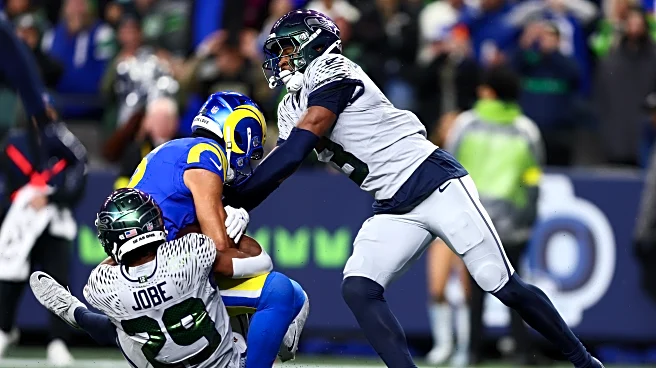
Another touchdown saver follows. Nacua beats Josh Jobe cleanly — something that happened consistently throughout the game. Emmanwori reacts instantly, passes off the first receiver to the safety, and makes the tackle immediately.
As a blitzer, Emmanwori continues to show growth. His disguise and timing — previously areas of concern — have noticeably improved. He now triggers almost at the snap, limiting the offensive line’s ability to adjust. The pressure forces a rushed throw. The improvement over the last few games is evident on tape.
That said, his next step as a pass rusher is expanding his rush move arsenal. While there have been reports of him working with outside linebackers, he still relies almost exclusively on speed and free-run opportunities. On this rep, he has the angle but is easily neutralized by the running back.
The touchdown he allowed was his first since Week 10 against Arizona, and just his second of the season. In the first half, Seattle was overcommitted to stopping the run — unsuccessfully — while failing to pressure the quarterback, leaving them exposed to play-action. Emmanwori sees Nacua coming toward him and anticipates an insert-C, a staple Rams concept using a moving receiver as an extra blocker. That hesitation freezes him just long enough for the tight end to slip free.
Rylie Mills — Defensive Lineman (6 snaps)
Mills played just six snaps — one fewer than last week — but flashed some intriguing traits. He has been lining up more frequently in the A-gap than expected. Given his struggles against double teams and lack of raw strength, this wasn’t the role I anticipated for him.
On tape, you can see how he wins with hands and first-step quickness, but also how he gets displaced simply due to lack of mass.
On another rep, he executes a beautiful counter move to escape the block, yet is again moved off his spot. This presents a real dilemma: if Mills adds weight, how much of that explosion does he lose? Or can he learn to play effectively at his current frame?
What’s undeniable is that his initial burst is special, and even when he misses the tackle, he often creates the disruption that allows the defense to win the rep.
Robbie Ouzts — Fullback (10 snaps)
The rookie returned after being inactive last week and provided solid blocking, outperforming Brady Russell in limited action
In that counter we already talked about in the Zabel thread, we have a key block by the FB. Excellent execution by the rookie.
Unfortunately, he was the last read here, but he was underestimated by the CB and was left open. Would he have had a chance to get his first TD?
Limited or No Snaps
- Elijah Arroyo (TE): Injury Reserve
- Jalen Milroe (QB): Inactive
- Tory Horton (WR): Injury Reserve
- Bryce Cabeldue (OL): Inactive
- Mason Richman (OL): Inactive
- Nick Kallerup (TE): 1 snap — effectively inactive
Final Thoughts
Rookie performances are rarely clean, and this game against the Rams was a perfect reminder of that reality. There were flashes that justify the optimism — moments where athleticism, processing, and effort jumped off the tape — but also the kinds of mistakes that surface when the speed of the NFL ramps up against a familiar, disciplined opponent.
The encouraging part, when you zoom out from the box score and into the All-22, is that most of the “bad” lives in the correctable bucket: angles, timing, eye discipline, and communication rather than effort or physical limitations. Against a Rams team that knows exactly how to stress young players, these snaps were less about winning the day and more about adding to the learning curve. For this rookie class, that’s not a setback — it’s part of the process, and one that should pay dividends moving forward.