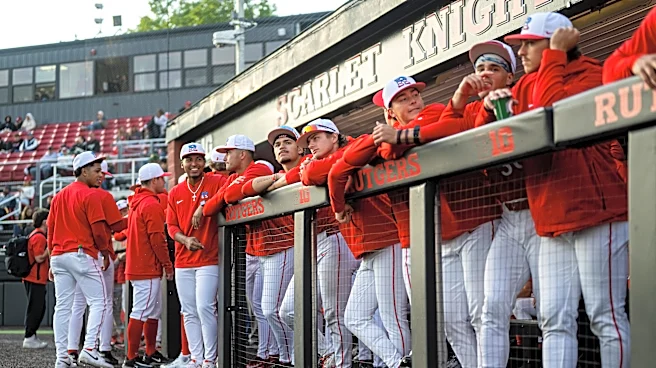



Rutgers Baseball bowed out of the Big Ten Baseball Tournament early, with two consecutive losses. That followed a must-win series win over Northwestern just to get in. The team earned the 10-seed, but left Omaha quickly.
The short time in Nebraska led to a few comments on various sites, including here, as to whether this was the end for head coach Steve Owens. It even led to reader “Zanily” saying RU should go after the recently fired coach at South Carolina.
“South Carolina just fired their head coach
after a disgraceful season. Go hire him. Maybe he can make some in roads into the South or bring some USC transfers over”.
Not necessarily a bad idea. Except I don’t think Owens is going anywhere….yet.
For the record, Paul Mainieri was fired from USC after starting the season 10-23; Monte Lee was the interim coach to finish the season. Mainieri was 40-40 (6-28) in 1 1/2 seasons; methinks that his 6-28 SEC record was the dagger. The Gamecocks wrapped up 2026 at 22-35 (7-23) in this “disgraceful” season.
Up in Piscataway, Keli Zinn has fired one coach thus far. In four seasons, Coquese Washington had a 42-84 record. Disgraceful? While there might be coaches in Piscataway doing worse than that, Zinn knows that a successful women’s basketball program gets a lot of positive attention. That along with knowing that Gary Redus could be gotten made the firing a literal no-brainer.
But Owens and baseball?
In my lifetime at Rutgers – and mind you, I officiated the first game between RU and Princeton – there have been just four head coaches of baseball. Matt Bolger was the first I saw; he was also my lightweight football coach in 1971. Such was the way coaches/physical education teachers operated at RU “in the day”. Bolger had a 290-248-7 record and won the Eastern 8 (you remember the Eastern 8, don’t you?) in 1981.
And then came Freddie Hill, who ran the ship from 1984-2014. Fred was a class act, a tough coach, and a winner. He came just short of 1,000 wins at Rutgers (he was at Montclair State before) with a 941-662-7 tally. He won the Atlantic 10 title in 1986, 1988, 1990, 1991, and 1993 and then won the Big East in 1998, 2000, and 2007. He was the last coach to get RU to the national stage in 2007.
Since that post-season NCAA trip, Rutgers really hasn’t been a factor in the Big East/American or the Big Ten. After Hill retired, Joe Litterio put up a 140-174-1 record in six years. He was replaced by Owens. And since 2020, he’s put up a 158-125 record, the highlight being the 44-15 finish in 2022. That year, Rutgers made it to the championship against Michigan and, without going into details, got screwed over and UM took the title. You can look up what happened.
He hasn’t been outstanding, but he hasn’t been a disaster, either. Excluding the Covid-shortened 2020 season, he’s had four winning seasons, and the two that weren’t, the team went 21-23 (2021) and 26-30 (2026). The big criticism of him, and I dare say most coaches at Rutgers, is the lack of success in the conference and getting into and being successful in the post-season. Owens is just 86-90 in Big Ten play, with .500 or losing records the last four. That is an issue.
The other day, Andrew wrote a piece highlighting how Keli Zinn feels that the Olympic sports have not had the support they needed to succeed; that would include baseball. Her comments came during the Scarlet Table podcast, in which it was very clear that Rutgers was better positioning coaches and athletes to be more successful in a variety of areas, including something I thought wasn’t that great an issue: scholarships.
Now, it’s possible that I’m completely wrong and that Zinn is actually waiting for the NCAA tournament to play out, a coach becomes available when his team is eliminated, and Owens is gone. But I don’t think so. I think she knows/acknowledges that RU coaches have been handcuffed and she is trying to correct that problem. As I’ve said about Schiano and Pikiell and I think every Scarlet coach, you have a pass….for now. But once you have the tools, once the money and the resources are in place, the expectations go up.
And the clock starts ticking.