

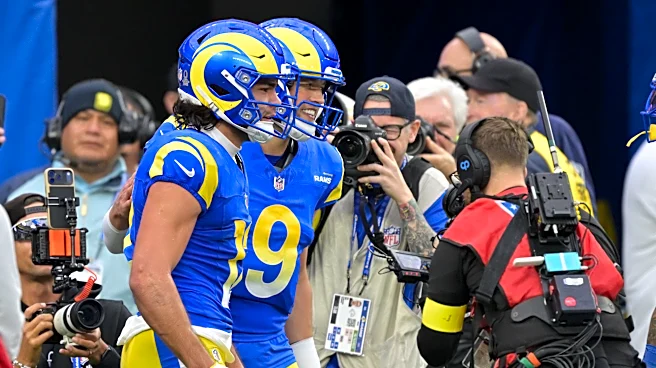

Seven weeks into the NFL regular season and we know these facts about the Los Angeles Rams’ offense:
- They are old
- They are slow
- They lack explosiveness
- They are inconsistent
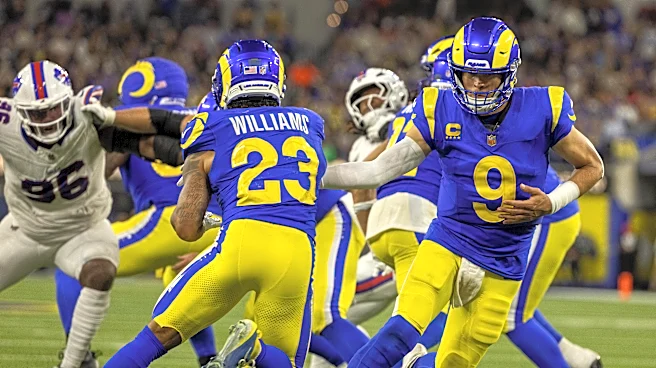
By design the Rams are looking for five to six yards each time they run the ball. The duo rushing scheme is intended to manufacture a lot of singles and doubles. It makes it harder to hit triples and home runs. To be fair, this also best suits the skillsets of Blake Corum and Kyren Williams.
But that was true regarding the Rams last year. That doesn’t expect their sudden offensive decline.
So what does?
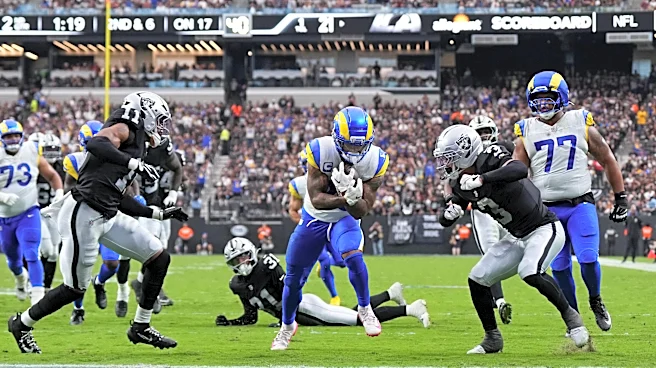
LA stayed pat at receiver with a duo of Puka Nacua and Davante Adams. Neither player are strangers to injury, and it was highly improbable that Adams would be healthy for the full season.
Even knowing that, the Rams still were stubborn about a lack of investment in a third receiver. They had a false comfortability with Konata Mumpfield and Jordan Whittington, of which neither are suitable replacements for Adams in the starting lineup.
And while Nacua has been on the field of late, he doesn’t look like his normal self.
Nacua is clearly not healthy. Early in the season he battled the early stages of a sports hernia, per reports. That injury hasn’t gone anywhere—it’s just being managed. It could likely be limiting his explosiveness. Nacua is also working through a calf injury that cropped up last week, although he was able to play and handle a large workoad.
But the wrinkle that Nacua added to his game that made him an offensive player of the year candidate a year ago was his prowess in the deep area of the field. That is gone in 2026, likely because of injuries. Nacua has regressed to a high volume of short area passes, which is how he made his initial mark on the NFL. That is good. It’s not star-level production.
Nacua’s change in role has shown symptoms across the offensive ecosystem. The deep passing attack has disappeared for the Rams.
On passes that traveled at least 20 yards through the air, Matthew Stafford has completed just 7 of 25 attempts (28%) for 244 yards with one touchdown and four interceptions. This comprises just 9% of his total throws. Nacua accounts for nine of these plays (14.5% of total targets) with two receptions for 60 yards and no scores. 54.8% of his targets are coming within nine yards of the line of scrimmage.
During his MVP season, Stafford targeted the deep area of the field at a 14.8% clip. He completed 48 of 106 attempts (45.3%) for 1,532 yards with 12 touchdowns and a single interception. Nacua accounted for 32 of these plays (16% of total targets) with 17 receptions, 514 yards, and four scores. 52.5% of his targets came within nine yards of the line of scrimmage.
That’s a major step back for both players.
But just as the Rams were comfortable running it back with an aging Adams, they did the same with Stafford.
Stafford won his first MVP award nearly 20 years into his NFL career. He had never seriously been considered for the honors up to that point.
A wise betting man would have said that year was an outlier and expect regression to the mean the following season. That is exactly what is happening. Stafford was operating at the best level we had ever seen from him a year ago. The hot streak is now over.
Applying a 50% drop back threshold in the Pro Football Focus (PFF) database, Stafford currently ranks as the 18th quarterback in the NFL. Last season he was solidly in first place. While PFF attempts to separate individuals from the overall offensive ecosystem, quarterbacks are subject to how often they are under pressure, how well their receivers separate, and how the play caller pulls the strings in conjunction with the running game. Stafford’s regression is not entirely his fault. The receiving corps struggles have played a role in this consequence.
But at the same time Stafford is not immune from criticism. He’s clearly not performing at the level we saw from him a year ago.
Stafford’s ability to generate big-time throws has fallen off a cliff. He has declined from a 7.7% rate in 2025 to 3.1% this season. He’s putting the ball in harm’s way more often with a slight uptick in turnover-worthy plays from 3.3% to 3.8% and in negatively graded plays from 8.0% to 10.1%. Positively graded plays are also happening less frequently and have fallen from 17.2% to 14.2%.
Whether Stafford can get back on track individually remains to be seen. He has his work cut out for him without Adams, and the Rams must remain committed to the run game in order to build a supporting offensive ecosystem.
But the lack of receiver depth is an issue of the Rams’ own making. In some ways Stafford is paying the price for the team’s lack of investment in the position, although he’s contributing to the offensive decline in his own performance.
If the Rams are going to go on a run and make the playoffs, they will need to find different ways to win. That might place a heavier burden on the defense to keep games within reach. The offense may not be capable of carrying them deep into the postseason this time around.