


At the conclusion of the 2014 season, Brian Cashman certainly knew his team was approaching a pivot point. After missing the postseason for the first time since 2008, the Yankees GM was tasked with replacing a franchise icon — Derek Jeter, whose retirement represented the end of an era. To this end, Cashman swung a three-team trade for Arizona’s Didi Gregorius, a little-known shortstop who the team hoped could fill the captain’s shoes. Much of the narrative around the team that offseason revolved
around this crucial decision. But another offseason acquisition would prove nearly as exemplary.
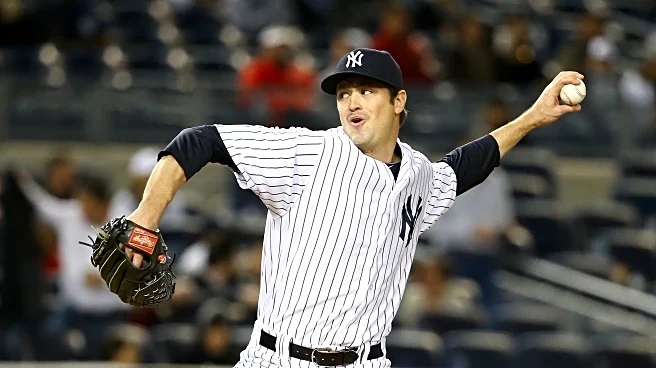
Andrew Miller
Signing Date: December 5, 2014
Contract: Four years, $36 million
After a historic run at the University of North Carolina, Andrew Miller was as close to a sure-thing prospect as they come. The Tigers took the 6-foot-7 lefty sixth overall in the 2006 MLB Draft. After he made just three outings at Class-A, Detroit could wait no longer to see their phenom in the midst of a pennant race, calling him up to the bigs for an eight-game stint to end the year, with his debut coming on August 30th at Yankee Stadium.
Perhaps due in part to this meteoric rise, Baseball America ranked Miller as the 10th-best prospect in baseball entering the 2007 season. He struggled in 13 starts that year but, at the age of 22, still appeared destined for success.
That’s when the Tigers made him available as the centerpiece of an all-time blockbuster that would alter the fortunes of two franchises. In the deal that netted them Miguel Cabrera and Dontrelle Willis, Detroit shipped their former top prospect off to the Marlins. But, after he posted a 5.89 ERA in 220 innings across three seasons, Florida threw in the towel too, pawning Miller off on the Red Sox. When he fared no better in his first season in Boston, the former can’t-miss prospect appeared to be a textbook bust.
That’s when the Red Sox made a decision that would resurrect Miller’s career. As he approached his 27th birthday, Boston converted their failed starter into a full-time reliever. The lanky lefty excelled in his new role, leveraging his arm talent into nearly-doubled strikeout rates from his days in the rotation. After two-and-a-half years as a key cog in Boston’s bullpen, they flipped him once again at the 2014 trade deadline, this time to the Orioles in a trade that brought back Eduardo Rodríguez. He quickly became a Baltimore folk hero of sorts, allowing just three runs in 20 innings as the Orioles took the division before holding opponents to just one hit and no runs in 7.1 playoff innings.
A free agent after this remarkable campaign, the player who’d nearly pitched his way out of baseball was now a hot commodity once again. With the Yankees losing their incumbent closer David Robertson to free agency, they were in the market for a top bullpen arm to pair with Dellin Betances. With Robertson commanding $46 million from the White Sox, Cashman instead made a savvy pivot to a slightly more cost-effective option, signing Miller to a four-year, $36 million contract. He revealed after the fact that his new fireman had an offer on the table elsewhere for $40 million that he eschewed for the chance to pitch in the pinstripes.
In addition to the money differential, the ability to pair Miller with the even-taller Betances — who stood six-foot-eight — may have driven Cashman’s decision. “I was taught the bigger, the better,” Cashman said. “It doesn’t always play out that way, but I like big power pitchers, so I do have a lot of those types, and I’ve always gravitated to those types.”
Cashman initially demurred when asked which of his two bullpen giants would close upon the signing. “I’m not in that mode,” the GM said. “I’m actually in the mode of, well, this was an opportunity too good to pass up, especially without a draft pick attached to it. It protects us and gives us diversification and reinforces our efforts to continue to have a strong bullpen.”
Manager Joe Girardi reinforced this, indicating the team would begin the year alternating between Miller and Betances in the ninth based on matchups. But Miller put this tandem to rest quickly, tearing off a 17.2-inning scoreless streak to begin his Yankees tenure. By the time he allowed his first run, he’d saved 13 games and was firmly entrenched as the team’s closer. He’d finish the season with a 2.04 ERA in 61.2 innings en route to the Mariano Rivera Relief Pitcher of the Year Award, the first Yankee to take home the honor since it was renamed for their franchise’s icon.
The following offseason, the Yankees somewhat surprisingly unseated their newly feted closer, trading for Aroldis Chapman from the Reds and installing the Cuban Missile in the ninth. Miller was even more effective in a setup role, pitching to a 1.39 ERA through July as he earned his first All-Star berth. Along with Chapman and Betances, Miller formed a trio known as “No Runs DMC,” a fearsome late-game combination that struck out 41.8 percent of opponents during their time together.
“I had the best seat in the house for probably the two most electric pitchers in baseball,“ Miller later said humbly of his partnership with Chapman and Betances.
Unfortunately, the team’s fortunes did not follow their bullpen’s. At the Trade Deadline, sitting at .500 and seven games back of the division lead, the Yankees commenced a fire sale that included trades of Miller, Chapman, Carlos Beltrán, and Ivan Nova. The rare rebuild allowed the Yankees to import a bevy of talent, headlined by Gleyber Torres in the Chapman trade.
For Miller, their haul from Cleveland included Clint Frazier, Justus Sheffield, Ben Heller, and J.P. Feyereisen, a king’s ransom in the context of how well-regarded Frazier and Sheffield were at the time. The talented Frazier would spend a frustrating and controversial five years with New York, while Sheffield ended up getting flipped for James Paxton, who struggled with injuries during his two years in pinstripes but was mostly effective when healthy, including a memorable six-inning, one-run start in Game 5 of the 2019 ALCS to keep the Yankees’ season alive.
For his part, Miller continued his run of dominance, pitching to a 1.48 ERA through his first year-and-a-half in Cleveland. He was a rubber-armed playoff hero during their run to the 2016 AL pennant, winning ALCS MVP honors and recording a 1.40 ERA across 10 games and 19.1 innings, pitching in just about any scenario and not running out of steam until the climactic World Series Game 7 against the Cubs. Back for more playoff action the following October, he was matched up against his old Yankees teammates in a memorable ALDS. The veteran allowed just one run in five innings, but it was an iconic lefty-on-lefty solo homer off the bat of Greg Bird that broke a scoreless tie in the seventh inning of Game 3 to key the Yankees’ series comeback from down 2-0.
After parts of three seasons in Cleveland, Miller pitched for three more years in St. Louis before retiring at the age of 36. In a testament to his determination, the former bust took a circuitous route to finally realizing his vast potential. And, while his time in New York was brief, it ranks among the most dominant runs of relief work in the franchise’s history.
See more of the “50 Most Notable Yankees Free Agent Signings in 50 Years” series here.