





To prepare for Sunderland’s return to the Premier League, Kyril Louis-Dreyfus embarked upon a summer of sweeping changes which saw the arrival of a new director of football, fourteen new players recruited and a shakeup of the backroom staff undertaken.
As part of the latter, the club announced in early July the arrival of Luciano Vulcano as assistant head coach, Isidre Ramón Madir as a first team coach (with a specific responsibility of overseeing opposition analysis) and Neil Cutler as the club’s
new goalkeeping coach, with Ali Barcherini’s permanent promotion to first team coach also confirmed.
In August, the club subsequently announced the appointment of James Brayne, formerly of Charlton, as the new set-piece coach. Almost every single department of the backroom staff was also enhanced, with analysts, masseurs, academy coaches, and more hired from the end of the 2025/2026 Championship promotion season onward.
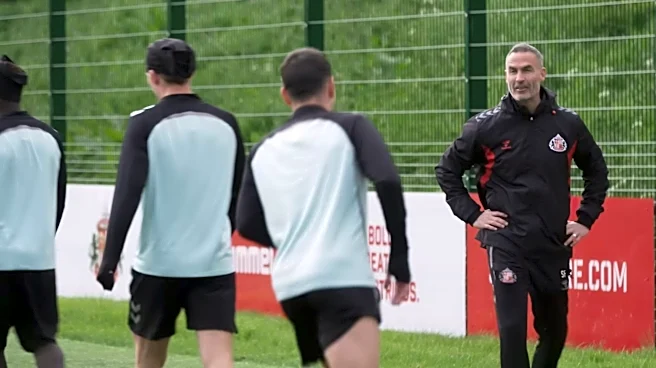
However, one face appeared on the sidelines and in pre-game fitness sessions very early in pre-season, one which hadn’t been announced at all at the time — the face of the American performance coach, Shad Forsythe.
His arrival wasn’t announced by the club until 30 September, in a joint “performance domain update” statement confirming his arrival as the head of first team performance alongside senior performance coach Luke Cooper, lead performance nutritionist Liam Howells (in partnership with INTRA), and Colette Miller as soft-tissue therapist.
Forsythe can be seen featured in pre-season training footage from early August; he arrived in Sunderland between the trip to Augsburg and the West Ham game on the opening day, but this announcement wasn’t made until six weeks later.
Forsythe worked as a performance manager for the US Olympic Team before moving private to work for EXOS in San Diego, a sporting-adjacent company providing “performance culture enhancement”.
Jürgen Klinsmann brought him into the German national team fold when he took over as manager in 2004. There, he remained in the same role until he moved to Arsenal after being part of the backroom staff that oversaw their triumph at the 2014 World Cup. Forsythe then later moved to Borussia Dortmund in 2022 and won trophies in both tenures.
Now his job title may be somewhat ambivalent but to all intents and purposes, he’s tasked with composing the training and fitness regime and is responsible for implementing rehabilitation, rest, and recovery programs at the club.
He doesn’t do all of this himself but he leads a large team and is ultimately responsible for the success of the strength and conditioning specialists, physiotherapists, masseuses and all others responsible for assisting with the players’ fitness levels.
Essentially, the title of the role is no longer vague — his job is to lead the team which ensures peak performance levels are attained and maintained, and the easiest starting point is to evaluate his impact at Arsenal.
Forsythe arrived at Colney in the summer of 2014.
In the 2013/2014 season, Arsenal lost 2472 days to injury, suffering a total of eighty six separate injury incidents. Over 50% of these injuries were muscular in nature — entirely avoidable injuries but also a repetition of such injuries often suggests issues with the methods in training.

In 2014/15, there was immediate improvement; Arsenal lost 1834 days to injury, total injuries suffered dropped to sixty eight, while muscular injuries dropped by 20%. After six months at Arsenal, Forsythe had reduced the club’s injury record to its lowest half-season total for five years.
Forsythe’s business partner at EXOS, Mark Verstegen, claimed that “About 65 percent of injuries — both athletic and lifestyle-related — come from overuse, which is repetitive use of joints that are rendered dysfunctional by muscular imbalances.”
Forsythe therefore introduced different methods of training and recovery.
In place of repeated use of the same equipment, rehabilitation would focus on rapid muscle stretch and subsequent contraction, along with agility training, to attempt to recreate the issues faced and scenarios experienced by a player in an actual match.
Movement training was preferred to static muscle growth and holistic approaches were preferred and honed during his time with Klinsmann. Nutrition, neuroscience, and mental health were given the same level of importance as physical therapy and performance gains. Verstegen again outlined this:
To play Löw’s system, each position has specific demands they need to be tuned for. Each player has an individual responsibility to show up, on and off the field, and meet the demands of their player profile.
We want to make sure every player is precisely tuned for what they need to do to have success, so that when they are plugged into the system, everyone is capable of doing what they need to do when called on.
We try to break down the walls and have people understand that this isn’t a medical department or a physio department, or a fuelling and culinary department, or football operations, or analytics.
Forget about your box. Look at your department as being part of one team on the pitch moving the ball forward in this style of play.
To analyse his impact at Sunderland, the obvious place to start is with our 2025/2026 injury record. Sunderland endured the fourth-least domestic injury days missed in the Premier League season with just 446. Incidences occurred 4.2 times every 1000 minutes.
This is a basic calculation of counting up all injuries missed (approximately from game week to game week due to availability of information) compared to the total playing time across the season.
Domestic Injury Days Missed
What does this mean in isolation, though?
To determine that, the fairest metric is to compare to the five previous seasons at the club. Using Transfermarkt and Premier Injuries to review former seasons, 2025/2026 resulted in the least number of muscle injuries accrued and the lowest total by some distance.
It must be noted, however, that the League One years figures aren’t entirely accurate due to the lack of information recorded on the types of injuries suffered.
However, I’m confident that the numbers are accurate — just not about what each player suffered specifically. Thus, in place of using days as before to analyse his time at Arsenal, the truest representation would be to record these numbers in “games missed”.
In the second season in the Championship under Tony Mowbray, Mike Dodds, Mick Beale, and Mike Dodds again, the entire squad missed a cumulative total of 236 games (all players’ injuries + games missed).
Last season, we missed a cumulative total of just 113 games. Thirty of these were as a result of muscle issues, eleven were ligament/tendon related, sixty six were attributed to impact-related and often unavoidable. In just two years, the overall total is a 53% decrease.
All players — league games missed through injury
The bare numbers are impressive; however, forty two of these games alone are the recurrence of Romaine Mundle’s hamstring injury and Bertrand Traoré’s double knee-related absence. Repeat injuries are a bad sign but both players have suffered these throughout their entire careers, suggesting a genuine weakness in the respective areas affected by each player.
A further thirty three are pre-existing injuries that Luke O’Nien, Leo Hjelde, Dennis Cirkin and Mundle carried into the season from before Forsythe took up his role.
Another obvious way of evaluating the success of the new performance team is to look at the over-performance of the squad later on in games — last season, Sunderland recorded the highest percentage of second-half goals compared to the team’s overall total in the Premier League this century.
Percentage of second half goals
Additionally, we accrued the second-best league-wide record of gaining points from losing positions – which was annoyingly eclipsed by Aston Villa’s unexpected comeback on the final day of the season at the Etihad.
Points gained from losing positions
Sunderland haven’t just scored or won late in games – we also achieved the second-best league-wide percentage of goals conceded from the ninetieth minute onwards in games, again being eclipsed by Aston Villa.
Goals conceded 90+ minutes
There’s an interesting trend occurring here.
Sunderland and Villa recorded the highest level of ‘over performance’ and the biggest deviation from xG in the entire Premier League last season.
People who rely on xG suck all of the joy out of the sport, and these unrecordable variables are massive determinators in the result of a match. Such was our second half over-performance that if only the second half of games counted in the league table, we would currently be busy preparing for Champions League football next season.


Forsythe’s impact was immediate, and during an interview with L’Equipe, Wilson Isidor admitted as much.
The intensity is crazy.
We’re coming off a tough pre-season with few wins, then we beat West Ham. The turning point was that the coach brought us a performance manager [Forsythe], who had been at Arsenal and Dortmund.
He arrived just before the first league match, and he changed a lot of things in training.We’re doing a lot more physical training, which the coach integrated into his sessions.
We immediately understood that this was what we needed.
This, of course, is not the only reason for these trends.
Tactically, Régis Le Bris often prefers Sunderland to take time to figure out their opponent in the first half before upping the tempo dramatically in the second.
Mentally, the players thrive off the atmosphere at the Stadium of Light, which sometimes just gives them the energy they need when their legs may otherwise fail them.
Of course, the players themselves were selected and targeted for their physical attributes, and Florent Ghisolfi himself has mentioned in meetings at the club in the past that we targeted bigger, faster, stronger and fitter players in the summer to deal with the rigorous demands of Premier League football.
For years, even the club’s marketing has been centred around the ‘Til the End mantra, with so many late goals and comebacks featuring in both Wembley playoff promotions achieved by those who did the hard yards in the lower leagues to get us here in the first place.
Only twice last season did an opponent outrun us in the second half: Wolves at Molineux and Villa at home — two instances where we suffered an early red card.
I know I’d trust these people to have this squad ready to face all the physical and mental fatigue that they’ll endure during our European adventure next season.