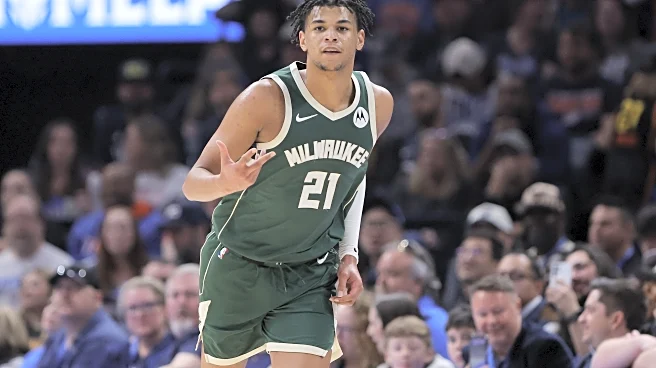




In a three-team trade with the Suns and the Bulls at the NBA trade deadline, the Milwaukee Bucks acquired forward Ousmane Dieng, jettisoning Amir Coffey and Cole Anthony. It was the third time in 24 hours before the deadline that Dieng had been traded. He was sent to Charlotte for Mason Plumlee, before being shipped off to Chicago, along with other assets, for Coby White. After that deal was completed, the Bulls were added as a third team to the Suns and Bucks trade, in which Nick Richards was traded from
Phoenix to Chicago, and the Bucks snagged Dieng. The French export’s time in Milwaukee could be limited, though, as he will enter the offseason as a restricted free agent, with a qualifying offer worth $8.7m.
While the Bucks were linked to a couple of notable names, including Ja Morant and Cam Thomas (eventually signing Thomas), this was the type of move that lined up with what Jamal Collier of ESPN said in an article on the morning of deadline day:
“Milwaukee has still scoured the market for a potential upgrade to its roster, sources told ESPN, hoping to benefit from a team looking to offload salary in the future.”
We’ve already seen Dieng in action in three games for the Bucks, so what can we take away from those performances about who he is as a player?
Player History
Coming out of the National Basketball League (in Australia and New Zealand), he was selected one spot ahead of Jalen Williams in the 2022 draft. The Thunder acquired Dieng’s draft rights from the Knicks at no. 11 overall for three protected first-round picks. In 23 games (11 starts) for the New Zealand Breakers, he averaged 8.9 points, 3.2 rebounds, and 1.1 assists in 20.3 minutes per contest. There, he flashed high-level potential, with NBADraft.net’s Stefanos Makris saying the following:
“Dieng is the definition of a high ceiling/low floor prospect … The sky is the limit, but if taken too high, he can just as easily fall through the floorboards. The French wing surely passes the eye test, being a smooth point forward with nice size and length.”
Dieng fell through the floorboards in his four seasons with OKC. He never eclipsed more than 39 games in a season and never averaged more than 14.6 MPG. On top of that, he’s only played 20+ minutes 21 times in 136 career games. Part of that has been because Chet Holmgren, Williams, and the other Jaylin Williams have developed faster, eating into any role he could’ve had. In games where he’s gotten more minutes, Dieng showed flashes of the tools he possesses. One of his best games came against the Bucks last season (albeit without Giannis and Dame), as he scored 21 points on 9/13 shooting, grabbed eight rebounds, and dished out five assists.
Offense
The first thing that stands out about Dieng is his silky-smooth jump shot. There aren’t any weird hitches in his shooting form, and it might be the most refined part of his game. Last Wednesday’s game against the Magic was a great display of that.
His shooting numbers didn’t look great in his first two seasons, with an effective field goal percentage of 50% (the league-wide average in those years was 54.6%) and a 28% three-point percentage. Yet, the last two seasons have shown steady growth, with his EFG% up to 52.1% and 3P% up to 34.2%.
While he was never featured in OKC’s offense, he did get that chance with the Thunder’s G League team. In 26 games during the 2023–24 season, Dieng averaged 17.3 PPG, 7.8 RPG, and 6.0 APG, with shooting splits of .482/.301/.702. He helped lead the OKC Blue to their first G League title by winning Finals MVP in a three-game series, averaging 17.3 points, 5.3 rebounds, 4.0 assists, 1.7 blocks, and just 1.7 turnovers per game. He shot the ball incredibly well, hitting 44.2% of his shots from the field, 53.3% from three-point range (5.0 3PA), and 100% from the charity stripe, albeit on three total attempts. In that finals series against the Maine Celtics, there were noticeable playmaking skills in the half-court, in pick-and-roll scenarios, and even in transition. That’s translated in his short stint with the Bucks so far, as he made several good reads against his former team, including a lob to Jericho Sims in the P&R.
Dieng has on-ball creation skills, with a tight handle on the perimeter. He’s been able to pull up from three, drain step-back threes, and even get to the rim with regularity. He does look a little awkward at times, especially when he tries to Euro step, but that might be a product of his patience to get the right look at the rim.
Another standout skill is Dieng’s ability to run the pick-and-roll. With his height, he’s able to read the defense and find open players. Even when he drives into the lane, and the defense collapses, he finds shooters open on the perimeter. He does an excellent job of using ball and head fakes to manipulate defenses and open passing lanes. He has great control of the ball, with very few passes I watched that were errant. Dieng knows when it’s his time to take the shot in these situations and attack the roll man in drop coverage. His favorite scoring moves are the floater and the Euro step, but he also has a mid-range jumper he likes to pull out from time to time.
Overall, there’s a lot to like about Dieng’s offensive potential. The one drawback right now is his frame, weighing 185 pounds at 6’9”, and that has caused problems on drives to the rim against bigger defenders. He is quick enough and long enough to get by some players in the G League and the NBL, but I can foresee issues against bigger NBA bodies. Imagine if he tried to drive on a player like OG Anunoby or even his own teammate, Kyle Kuzma—bigger guys who are just as athletic as him. While he hasn’t run into that problem with the Bucks so far, it’s happened quite a few times over the course of his career.
That is something that Dieng can change, as he is still growing into his body. Again, he is only 22 years old. How many of us had fully grown into our adult bodies by then? That’s not to say he’s going to grow to the same level as a player like Brandon Ingram, but some tools should excite Bucks fans.
Defense
Dieng’s best defensive tool by far is his IQ. There were multiple plays in his days overseas and in the G League where he would come over from his help position to block shots and deflect the ball, creating fast-break chances. The way he blocks shots is like how Giannis operates on defense: he defends the rim off the help side rather than a traditional rim protector like Rudy Gobert. This isn’t to say Dieng is as good a defender as Giannis; it’s more to show that they work in similar ways in the half-court.
His length and athleticism make him a versatile defender who guards 1–3 on the perimeter. His 7’1” wingspan is ideal for disrupting ball handlers, generating steals, and deflections. In three games with the Bucks, players are shooting 41.9% when guarded by Dieng (13/31), and in last Wednesday’s game against Orlando, Franz Wagner went 0/4 from the field when Dieng was the closest defender.
His smaller build also causes issues at the defensive end. It leaves him unable to guard power forwards and centers in the post. The bigger issue comes on the perimeter, where he gets overpowered by bigger players looking to drive into the paint. This made it much harder for him to navigate screens at times, as he got stuck on the screen or even made the wrong read on the ball handler. He seems to have gotten marginally better in this area with NBA coaching, but there isn’t enough of a sample size to say that for sure.
It also leaves him liable to give up rebounds on both ends of the court. Looking over his film, most of his rebounds in the limited time he has spent on the floor at the NBA level are uncontested. The only example I found of him having to box out someone was in a preseason game against the Nuggets this season. It’s not the end of the world, but it shows that his lack of strength could be a problem if he ever must box out bigs. He should only be boxing out players of his size or smaller.
Dieng has a chance to be a solid defender and could address the Bucks’ defensive deficiencies, especially off the bench. Having a help-side defender with his instincts next to Bobby Portis would cover up his issues on that end.
How does he fit down the stretch?
Overall, Dieng will have a much better opportunity for consistent minutes with this Bucks team. As of now, he could get playing time to spell Kuzma as a small forward/power forward. His size and defensive versatility make him a good fit for the Bucks’ defense, both in man-to-man and zone coverage.
Offensively, he can run P&R effectively, so I see a two-man game of him and Sims continuing to work quite well. He doesn’t need the ball to contribute, as he has a dependable jumper in catch-and-shoot situations. With his improving three-point shot, he would be an ideal floor spacer alongside Giannis, either off the bench or potentially in the starting lineup. Kuzma has come off the bench at times, and I would rather use the rest of this season to see how Dieng fits.
Beyond that, it’s hard to tell how short a leash Doc will have on Dieng, given his propensity to favor veterans over young players. With the limited time Dieng could be with Milwaukee, given his contract situation, it would be imperative for the coaching staff to give him significant minutes, around 18–25 MPG. I know the Bucks didn’t give up much to get him, but this team has been starving for young talent for quite some time. They need to see what they have in him so they can decide whether he should stay in Milwaukee for at least one more season.