
It seems to me as a parent that for just about every moment of pride you take in your child, there is at least one corresponding moment of frustration.
I’m not talking about that first part, where the child
has limited mobility and agency, and frankly, control over any of their orifices.
No, I’m talking about the parts that come after, when the walking and talking have become second nature, and the will begins to assert itself, tentatively at first, and then in increasing leaps of audacity.
I’ve always thought of myself as lucky when it came to my daughter. For all the usual reasons of course, but also because I had such a naturally compliant and attentive child. Every child comes with their own individual degree of willfulness, but for a while there I thought I’d well and truly ducked it.
That’s the thing about agency, though. It’s the ouroboros of parenting. The more that independence gradually increases, the more you find yourself teaching and reteaching the various elements of personhood to an entity that now has the capacity for both doubt and defiance.
In that way, I’ve always compared it to coaching. You spend countless hours drilling the fundamentals, the most basic components of the game — elementary approaches at first, then gradually moving on to weightier and weightier concepts, until you start to see progress. And then, a little at a time, more and more, players begin to independently apply those skills and strategies within the confines of a game-plan and game flow.
The wins start to stack up. You chart and measure progress, but at this point things start to feel like they’re on autopilot and that combination of training and natural inclination starts to take over.
And then, boom, suddenly, out of nowhere, someone doesn’t want to eat their vegetables anymore.
(It occurs to me that I may have mixed my metaphors a bit here, but bear with me.)
I imagine that’s what the end (or near end) of a winning streak feels like. You’ve gotten past all the developmental stuff. The engine is firing on all cylinders. You’re facing a team that you not only *should* beat, but that you have in fact just recently beaten the snot out of, and they’re hanging around at the end of the game because all of the sudden you’ve got players who’ve lost their enthusiasm for consuming their metaphorical vegetables.
You look out at the court, and you can see it. Defensive rotations are just little bit sloppier, help defense is getting there just a little later than usual, passes aren’t quite as snappy, and the worst team in the NBA is outscoring you in the second half because your players are coasting on the remainder of a twenty-point lead they earned back in the 2nd quarter.
You know it’s not just hot shooting, because the Wizards are only shooting 44% from the field, and just 24% from long-distance. It’s got to be the execution (or lack thereof).
What do you do in that situation? You’re responsible for one of the most intelligent, motivated, thoughtful, and promising groups of young players in the league.
Do you call a timeout and roast them all over an open flame? Do you let them just play it out in the hopes that the decreasing margin will eventually spur their sense of pride, or their fear of failure? Do you simply trust them to know when to flick the switch, take it up a notch, and stop playing with their food?
Parenting and coaching in the NBA are a long haul. You’ve got to be able to play the long game. And, to paraphrase the eternally philosophical Kenneth Ray Rodgers, you’ve got to know when to hold them and fold them.
You can’t blame your players for wanting to conserve some of their energy during one of the most condensed parts of the schedule (and a FOGASINI, no less), and you can’t reasonably expect the same level of motivation for the entirety of 82 games.
And yet, every game matters. In coaching, as in life, you never really know which games and lessons are going to prove to be foundational. You can’t cede ground, especially when it’s ground you’ve already covered. But how do you keep your cool?
I wonder, if sometimes, for Mitch Johnson, it’s as simple at looking over at the other sidelines. After a season of chaos and losing, perspective matters.
I suspect it’s not unlike randomly catching the eye of another parent in the restaurant, as their toddler launches a broccolini the length of the table and onto the floor, and suddenly you’re finding room for gratitude for the place that you’re at with your kid, even as you’re locked into a 45 minute contest of wills over a mound of green peas.
And just as suddenly, you turn back around to find half of the vegetables gone, and the pleading eyes and mouth of a four-year-old asking: “Did I eat enough, Daddy?”
“Yeah, you ate enough. Let’s go home.”
Takeaways
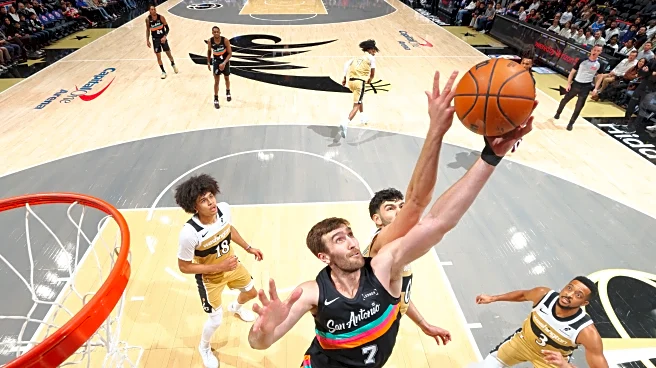
- The Spurs don’t win this game without Luke Kornet. I’ll admit to some repression of enthusiasm when he was signed in the off-season, mostly due to a lack of minutes for Kornet in Boston, but he’s proven to be every bit the per-36 maestro that was promised, even playing 25 minutes per game for the first time in his career. He was everywhere in this one, showcasing his offensive utility in the post in addition to his usual brand of rim protection. Not unlike Wemby, his block totals don’t do justice to how many shots his presence diverts, and he;s proven that he can hang against most starters in a pinch, which has been an unspoken linchpin of this current win streak. The contract was already a net positive, but now it’s looking like an absolute steal Kornet is already more than halfway to becoming the first backup big for the Spurs to clear 4 Win Shares in a season since Jakob Poeltl, who is currently making 27 million a year in Toronto. Just outstanding work by both Kornet and San Antonio’s front office.
- Likewise, the Spurs aren’t sitting at 2nd in the West without the exploits of De’Aaron Fox, who kept them afloat when Wemby and the young legion of guards were out for an extended stretch. Most impressive though has been Fox’s shooting, especially from three. Fox is currently matching his career high in True Shooting Percentage (.598), is just shy of his career high in Effective Field Goal Percentage (.552), and converting a career-high (.395) on seven three-point attempts per game. This has been absolutely critical when it comes to spacing and keeping the lanes clear for his more long-distance challenged (ie: streaky) back-court partners, and has helped alleviate concerns about being able to surround Wemby with enough long-distance shooters, as well as long-term team fit. Additionally, don’t let anyone try to tell you that he’s not pulling his weight defensively, as he’s currently on pace for the second most Defensive Win Shares of his career.
- And what a stretch of play for Stephon Castle. Not only was he a defensive menace for most of the NBA Cup, he’s very quietly having the best month of his career, averaging 20/6/5 on 51% shooting, to just 3.5 turnovers, after starting the season averaging just shy of 6 turnovers a game. He’s been glove-like on defense, and refused to give longtime Spurs killer CJ McCollum an ounce of breathing room any time he was matched up on him. The team has been missing a perimeter defensive leader for quite some time, and they seem to have found one. Castle’s effect on the defensive end is visible from the moment he checks in, except in his case the doctor is never out. He’s become almost as anchoring as Victor’s shadow around the rim. Man this team is fun!
Playing You Out – The Theme Song of the Evening:
Teach Your Children by Crosby, Still, Nash, and Young