




For more than a decade, Dirk Nowitzki provided the Dallas Mavericks with a high floor when it came to wins and losses. Nowitzki was drafted by the Milwaukee Bucks ninth overall and immediately traded to Dallas for Robert “Tractor” Traylor. For the next decade and a half, the Mavericks wouldn’t select higher than 12th in the draft, thanks to Nowitzki’s hall of fame presence on the roster.
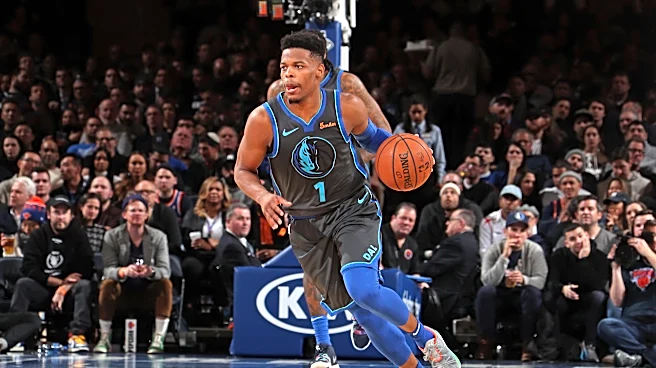
Eighteen years later, the Mavericks would select ninth in the NBA draft again. This time they chose Dennis Smith
Jr.
In 2016-17, Nowitzki finally looked his age. He only played in 54 games, and hampered by injuries, only scored 14.2 points per game. The Mavericks finished 33-49 and missed the playoffs for just the second time in 17 years. By this point, fans had given up on the idea of forming a team around Nowitzki that could get him one more championship. Now the focus was on a rebuild, with Nowitzki around to shepherd in the next generation of franchise players.
The Mavericks thought Smith could be the first step toward that.
“Before anybody asks, I think, at this point and time, I would project him as a starter,” Carlisle said. “I’d project him as a starter, but he’s going to have to earn it and he understands that.”
The Mavericks hadn’t drafted a rookie who started since Devin Harris in 2004-05.
Smith said all the right things. “The Mavs can expect to get a point guard who’s trying to win every game,” Smith said. “Not selfish at all. Not caring about stats, but I do want to make my teammates better and I think that’s very important in winning games and having a great effort, and I can bring that to the team,” he said in his first remarks to reporters after being drafted.
“I’m going to go out and be Dennis Smith and nothing can stop that,” he said.
At the time, the Mavericks needed some youth, and more importantly, some hope for the future. Since 2011, the goal for the franchise, and the wish for the fans, was to get Dirk Nowitzki another ring before he retired. For myriad reasons, it never worked out, never even got close. The most memorable playoff moment for Dallas from 2012 to 2017 was a Vince Carter buzzer beater that pushed the Mavericks into a game seven in a first round series they’d lose to the San Antonio Spurs. By the time the Mavericks finally bottomed out and ended up in the lottery, everyone was ready for a new young player to root for, rather than a recently signed free agent over the age of 30.
Smith was a breath of fresh air, to say the least. The Mavericks didn’t win many games in 2017-18, but that was fine. They were no longer on the treadmill of mediocrity. Now they were building something new, something exciting, and even better, Nowitzki was still on the team to help shepherd the next generation of Mavericks.
Early on, it was obvious Smith was pretty raw. But there was plenty of athleticism in his game, a quickness, and that was such a stark contrast to the type of players the Mavericks put on the floor in the early 2010s. The Mavericks no longer had to plod up the floor. They could run.
Maybe it was a mirage, though. Watching Smith’s Mavericks highlights now, almost ten years later, I’m surprised by his lack of explosion. There are times he gets a clear runway to the hoop and just gets a basic two-hand dunk, barely getting it above the rim. That’s not how I remember him playing. It shows you how starved Dallas was for young, athletic players, that Smith was fast and could jump a little, and that made him stand out so much for the Mavericks. It also shows you how faulty your memory can be.
The Mavericks finished the years 24-58, worse than the year prior. The rebuild was in full bloom. Smith finished the year averaging 15.2 points and 5.2 assists per game. It was a solid season for Smith and everyone was hopeful that he would continue to get better, especially when partnered with whoever the Mavericks would draft that summer. Smith was becoming the face of the franchise. Unfortunately, it would only be for a year. The Mavericks would soon be in position to draft even higher, and a franchise player was within their grasp.
Dallas zeroed in on Luka Doncic pretty quickly, from what we can parse years later. For various reasons and excuses they would employ over the years, three teams—Phoenix, Sacramento, and Atlanta—chose to pass on Doncic, and the Mavericks pounced. There were initial concerns about whether two dominant ball handlers and scorers like Doncic and Smith could coexist with just the one basketball.
That was always overthinking, despite how things turned out. The Mavericks were in a talent deficit, a severe one at that, and just needed the best players they could get. If that meant some growing pains while they figured out how to coexist, that was fine. Dallas was rebuilding. “…when you have Luka Doncic and Dennis Smith Jr. on the floor together, I mean, you have two certified NBA attackers,” Carlisle said at the time. “It’s a great advantage to have.”
And there was some pain, on the court at least. Off the court, Doncic and Smith got along just fine, bonding over video games and basketball. When the Mavericks tried to score, though, there was friction. The Dallas offense was in quicksand when the two shared the court. Maybe in time they could have figured it out.
But it was obvious how talented Doncic was, and that the team would eventually be built around him. It led to Smith becoming frustrated, and eventually taking some time away from the team due to the “business” of the NBA, as Carlisle said.
Later on that year, the Mavericks had the opportunity to add Kristaps Porzingis via trade, and Smith was included in the deal. In less than two years, Smith had gone from the future to the past. That’s life in the Association.
Things got messy toward the end of his tenure in Dallas, but Smith is still remembered fondly by fans. He played hard and was fun to watch. That will always win people over. The Mavericks signed Smith to a one-year, non-guaranteed deal in the 2025 offseason, but waived him before the season started. There was hope he could latch onto the roster somehow. It didn’t work out, obviously, but there was that hope again.
That’s what Smith came to represent. The idea that something new was on the horizon. That new era of Mavericks basketball has had its highs and extreme lows. It’s how basketball goes sometimes, for teams and players. There’s no way to know how things will turn out. It’s something on my mind as we creep closer to the draft.