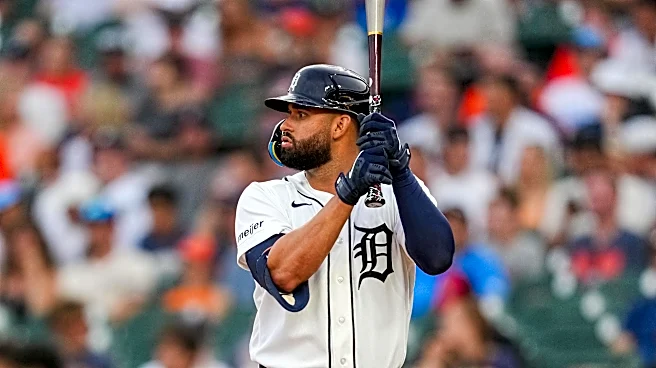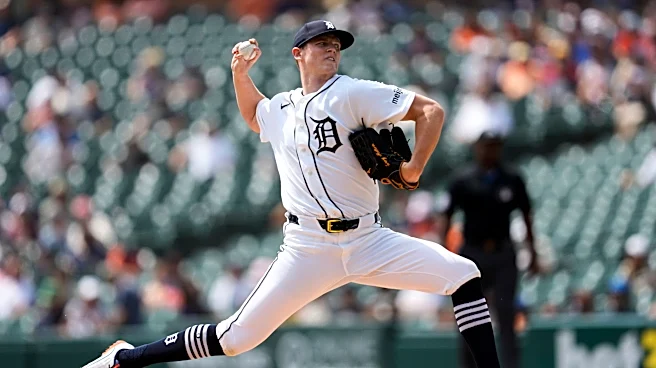


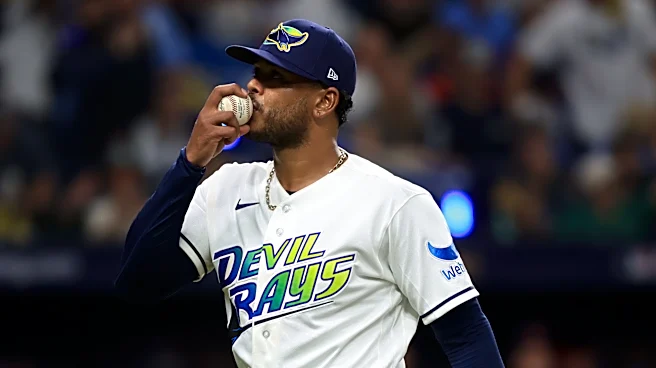

While the deal isn’t fully official until the medicals are completed, the Detroit Tigers have come to terms with right-handed starting pitcher Troy Melton on a long-term extension offer. The deal reportedly guarantees Melton six years and $46.5 million, with incentives and a club option for the 2033 season that could take the contract to a total of $80 million over seven years.
This is a pretty smart decision from both the Tigers and the 25-year-old Melton. Our thoughts quickly turned to potential
extensions for talented youngsters like Jackson Jobe and Max Clark. The club already has AL Rookie of the Year Kevin McGonigle, as well as infielder Colt Keith signed to long-term extensions. It will be interesting to see if the Tigers pursue extensions with their other talented young players prior to the December 1 lockout of the players by MLB owners. They don’t want to get stuck with too much guaranteed money on the books for the long haul, but at the same time these contracts are certainly very team friendly as long as the players involved produce as expected.
Our next thought was how this sets up the Tigers payroll for 2027. The Tigers entered the 2026 season with a payroll that was pushing towards the $244 million luxury tax threshold. However, after trading away three of their most expensive players in Tarik Skubal, Casey Mize, and Jake Rogers, all of whom were in their final year of arbitration eligibility prior to free agency, the final estimated Tigers payroll for 2026 came down to $195 million according to FanGraphs.
FanGraphs’ Roster Resource now estimates the Tigers’ 2027 Opening Day payroll at $169 million in the wake of Melton’s extension. That total would’ve put the Tigers 15th most in payroll in the major leagues in 2026, right in the middle. These are the salaries for their free agent deals and extensions on the books for 2027.
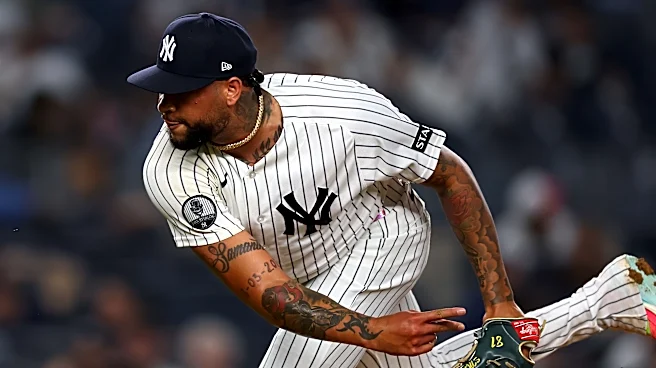
Framber Valdez – $47.5M
Javier Báez – $24M
Emilio Pagán – $11.5M
Kyle Finnegan – $10M
Drew Anderson – $8M
Troy Melton – $7.75M
Colt Keith – $4.77M
Kevin McGonigle – $2.75M
Jacob Waguespack – $1.3M
In addition, the Tigers do have a few arbitration eligible players estimated to make over $5 million in 2027. Riley Greene is estimated to earn $9.3 million, while Spencer Torkelson is estimated at $7.7 million for the 2027 season. Those two players are under team control for 2027-2028, and will then be free agents in 2029.
Zach McKinstry is estimated to make $5 million next season, while both Will Vest and Kerry Carpenter are estimated to make $4.4 million and $4.1 million, respectively.
So, looking forward to the rest of the offseason, the Tigers are still in fine shape to go make a big signing or just continue to build up their pitching staff and possibly hunt for a better bat in a part-time role. Ihey were willing to spend something like $240 million in 2026. That doesn’t mean they’re planning on keeping payroll that high year after year, but it seems likely they could add another $30-40 million in payroll this offseason and still be well short of their 2026 Opening Day payroll projection.
There’s room to spend. It’s more a question of a lack of major impact players that fit this offseason. Presumably there’s also some trepidation about signing any big free agent deals with so much up in the air this offseason. With the CBA negotiations and lockout coming, most teams would prefer certainty as to what the sports rules and payrolls are going to look like under the next CBA before making any huge commitments. Some teams will obviously make exceptions for Tarik Skubal and a handful of other top free agents, but the Tigers don’t seem like they’re going to be involved with those players.
Still it’s interesting to consider the Tigers payroll situation in light of the possibility that the owners do get their way and there’s a cap and floor instituted for 2028 as proposed. Under the owners’ most recent proposal, the floor would be $180.2 million against a hard cap of $258.2 million. Part of that would involve smaller market teams like the Tigers getting more in revenue sharing money, but actually being required to spend up to that $180.2 million level. Since the Tigers were willing to spend roughly $240 million for the 2026 season, with additional league revenue coming in they would likely be in a position to spend close to that level on a yearly basis going forward.
The Tigers have their second biggest annual salary coming off the books after 2027 as Javier Báez reaches free agency. That takes $24 million off the payroll heading into 2028. And, should Framber Valdez bounce back in year two in Detroit with a good season, there’s a fair chance he would choose to decline his 2028 player option with the Tigers, worth $35 million, and head back to free agency. A cap and floor system might have some impact on Valdez’s desire to return to free agency a year early as well. Even so, while the Tigers’ expenses will increase elsewhere as players get raises and then reach arbitration, there is plenty of money bound to come off the books in the next few seasons as well.
Obviously, this is speculative as there’s nothing to suggest the players are going to give the owners what they want in the CBA negotiations. Still, thinking through the general possibilities shows the Tigers in pretty good shape going forward whether a cap and floor system is put in place or not. They could clearly afford even a $400 million offer to Tarik Skubal if they thought that was the best way to allocate their payroll. With several talented younger players already locked up on long-term deals, minimal major commitments to older players, and with a still good farm system brewing up more major league talent to come, the Tigers future looks pretty bright if the front office can finally make the right moves to put them seriously into contention on a yearly basis.