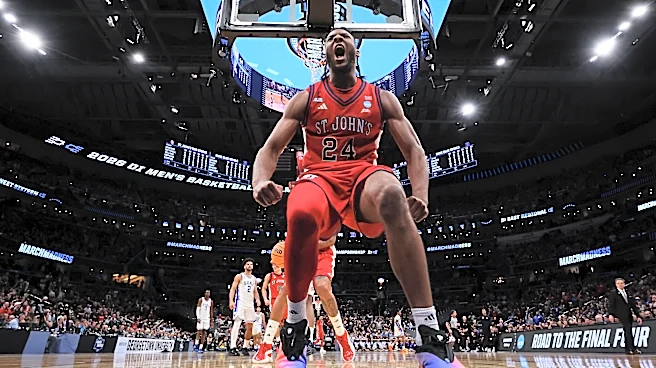







For the next month before the 2026 NBA Draft, we’ll take an in-depth look at different prospects here at Liberty Ballers and try to figure out which players would be the best fit for the Sixers at No. 22. Next up in this series is St Johns’ Zuby Ejiofor.
Ejiofor quietly put together one of the more impressive senior seasons in the country at St. John’s, emerging as one of the better defensive anchors in college basketball and a legitimate NBA prospect in the process. He was not a household name heading
into the year, but his combination of length, motor and playmaking ability for a big made him impossible to ignore by the end of it. Most mocks have him going somewhere in the late first to early second round, but for a Sixers team that needs physicality, rebounding and energy off the bench, he is worth keeping a close eye on as the draft approaches.
Profile
2023-24 Stats: 37 games, 30 minutes, 16.3 points, 7.3 rebounds, 3.5 assists, 1.2 steals, 2.1 blocks, 53.6% FG, 30.5% 3P, 71.8% FT
Team: St Johns
Year: Senior
Position: PF/C
Height & Weight: 6’7.5” | 245 lbs
Born: April 20, 2004 (22 years old)
Hometown: Garland, Texas
Strengths
Ejiofor’s calling card is his defense, and it is not close. His combination of lateral quickness and a 7’2″ wingspan allows him to credibly guard one through five, switching onto guards on the perimeter without getting eaten alive and protecting the rim against bigger bodies. That kind of positional versatility is exactly what modern NBA rosters are built around. He anchored the St. John’s defense this past season, averaging 2.1 blocks per game and posting a 4.9 Defensive Box Plus/Minus, numbers that reflect just how disruptive he is as a rotational shot-alterer on and off the ball.
His rebounding is equally impressive. He crashes the glass with an elite offensive rebounding rate driven by instincts, motor and length rather than size alone. The effort and instincts are there regardless of the matchup.
Despite boasting impressive defensive intangibles, his playmaking ability is what really sets Ejiofor apart from other athletic, high-energy bigs. His comfort putting the ball on the floor and finding open teammates is a genuine differentiator. He averaged a career-best 3.5 assists per game as a senior, functioning well in dribble-handoff actions and short-roll situations, reading the floor and finding cutters reliably. Most players in his archetype are catch-and-finish guys. Ejiofor has shown flashes of something more, even leading St. John’s in assists for the season.
As a finisher, he is efficient and decisive. He converts around 54% of his field goals overall, operates at 97% accuracy on dunks, and finishes close-range attempts at a 59% clip. He does not need plays drawn up for him to be productive.
His combine showing in Chicago helped his cause. He shot the ball well enough to plant a seed of doubt in scouts who had written off his offensive range, and his athletic testing backed up everything the tape suggested about his mobility and explosiveness.
Weaknesses
At 6’7.5″ barefoot, Ejiofor lives in the tweener space that might make NBA teams nervous. He is not a true center against physical fives, and his wingspan only covers so much ground when a bigger body has established post position. That size gap shows up most in heavy traffic rebounding situations where length alone cannot compensate.
As a four, the questions shift to whether he can consistently guard faster perimeter players away from the basket without losing his defensive edge. His versatility is his calling card, but tweener bigs can be exposed quickly at the NBA level when matchups get uncomfortable or a team runs a switch-heavy scheme. That said, the league has been trending bigger and longer for years now, which makes the tweener label at least somewhat subjective depending on who you ask.
One of the bigger focal points offensively is his lack of floor spacing. He shot around 31% from three on low volume in college, making him a reluctant shooter that defenses can afford to sag off. Without that perimeter threat, his presence in the half-court can tighten the paint for teammates and limit offensive flow around him when the ball isn’t in his hands.
He is best used as a finisher off rolls, cuts, and put-backs rather than someone you can run plays for when things slow down. He tends to back defenders down and work out of the post rather than operating as a vertical threat, which means longer and more athletic rim protectors can give him trouble when he is trying to generate his own look. That is a fine role, but it puts a ceiling on how much he can be asked to do. Teams drafting Ejiofor need to be clear-eyed about what they are getting: a high-floor, ready-now backup big who can impact winning immediately, but likely within a defined lane.
Positional Fit
Ejiofor projects most naturally as a backup center or small-ball five, though his tweener size ensures the positional conversation will follow him into draft night. The jumper is ultimately the variable that determines how the position question gets answered. If it develops into even a passable perimeter threat, defenses have to respect him on the floor and the positional limitations become far less relevant. If it does not, he risks getting squeezed out of the four by more switchable wings and out of the five by bigger, more physical bodies. How his skills translate are a real question, but his physical tools, athleticism and motor might make up for a lot of his deficiencies early on. In the right system, Ejiofor can carve out a role from day one with room to grow.
Draft Projection
Ejiofor’s draft projection ranges quite a bit, with the higher end sitting in the mid-to-late first round, putting him right in line with where the Sixers are selecting at 22. Most mock drafts have him going in the late first round to a handful of contenders such as the Celtics, Cavaliers, Timberwolves and Nuggets. Ejiofor would slot in nicely with any of these teams, who are all in need of a versatile defensive big alongside their established talent.