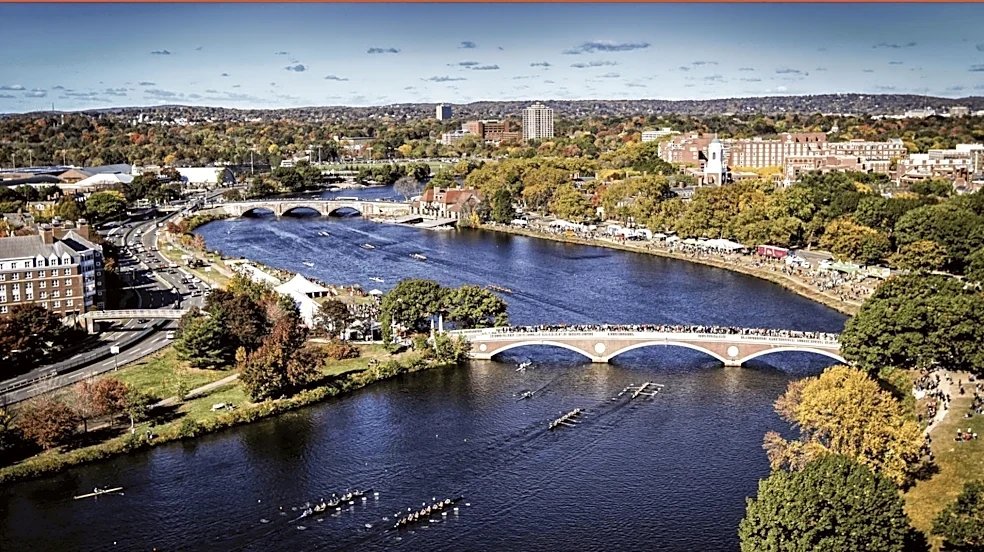



Four months ago, Virginia women’s rowing finished fourth at the NCAA Championships, its best national finish in a decade. On Sunday afternoon in Cambridge, the Cavaliers showed that result may have been a sign of things to come.
Virginia’s top eight finished third in the Women’s Championship Eights at the 2026 Head of the Charles Regatta, crossing in 15:02.791. The only crews faster were USTC Princeton and USTC Boston, the two USRowing Training Center boats stocked with post-collegiate national team
hopefuls for LA 2028. Every other crew in the 32-boat field finished behind the Hoos, including Princeton, Yale, Brown, and both Oxford and Cambridge.
For a program trying to build on last spring’s breakthrough with a national title push, it’s hard to ask for a better start to the year.
The fastest college crew on the Charles
Princeton was the closest college boat, finishing fourth in 15:06.987, 4.2 seconds behind Virginia. After that, the gap opened up quickly. British club Leander was fifth, nearly 20 seconds back, followed by Cambridge in sixth and Yale in seventh. Brown finished ninth and Oxford (OUBC) 10th, more than 28 seconds behind the Cavaliers. Rutgers and Dartmouth rounded out the top 12, and Harvard-Radcliffe finished 16th.
Yale and Brown were each assessed five-second penalties, but even on their raw times they were more than 17 and 20 seconds behind Virginia, respectively.
A dive into the individual splits down the course shows that Virginia demonstrated remarkable poise despite having to weave through a multitude of boats due to its sub-optimal bow 25 start position. Virginia was third at every timing point on the course and led Princeton by 3.6 seconds through the Riverside split. Princeton pushed back after the Weld Boathouse and cut the gap to just under two seconds by the Cambridge Boat Club. Then Virginia pulled away again. Over the final stretch to the finish, the Cavaliers were 2.2 seconds faster than Princeton and nearly three seconds faster than USTC Boston. Only USTC Princeton covered that final stretch faster.
That is reminiscent of last spring’s NCAA final. At Lake Lanier in May, Virginia’s Varsity Eight closed hard over the final 500 meters to overtake Yale and chase down Tennessee. The Hoos finished strong again on the Charles.
What it means for the spring
The usual caveats apply. The Head of the Charles is a three-mile fall head race, not a 2,000-meter sprint, and lineups will change plenty between now and May. Texas, Stanford, and Tennessee, the three teams that finished ahead of Virginia at NCAAs, did not race in this event.
But the crews Virginia did beat matter. Princeton and Yale both made the six-boat NCAA Varsity Eight grand final last spring, where Virginia finished ahead of both, and the Cavaliers beat them again on Sunday. Add in wins over Oxford, Cambridge, and Leander, and Virginia’s showing on the Charles is about as strong a fall result as a college program can post.
Virginia was five points off the NCAA podium last spring. After this weekend, the Cavaliers are knocking on the door.
A couple of weeks ago I highlighted the relative struggles of many of Virginia’s fall sports and outlined potential opportunities for national championships (namely men’s tennis and women’s swimming and diving). After these results, women’s rowing may be Virginia’s third-best shot at a national title this year.
The men’s club team holds its own against varsity programs
Virginia’s men’s team, which competes as a club program in the American Collegiate Rowing Association (ACRA), had a strong weekend of its own, with both of its fours finishing second among ACRA crews.
In the Men’s Club Fours on Saturday, Virginia finished seventh in 17:57.092, just 0.9 seconds behind Purdue, last year’s ACRA national champion. The crews ahead of the Hoos were Purdue, varsity programs from Harvard, Boston University, and Dartmouth, and two of the country’s top elite clubs in Riverside and Vesper. Virginia finished directly ahead of UC Davis and also beat New York Athletic Club and Potomac Boat Club, finishing second among ACRA crews.
The Men’s Collegiate Four matched that result on Sunday. Virginia finished ninth in 16:50.408, second among ACRA crews behind Texas, with varsity programs filling out the rest of the spots ahead of them. The Hoos edged Georgia Tech by just over a second and beat Clemson, UCLA, and UNC by between four and six seconds. Bucknell, Michigan, and Notre Dame finished more than 17 seconds back.
The Men’s Collegiate Eight posted the 17th-fastest raw time, 14:57.871, fourth among ACRA crews and 2.7 seconds behind Fordham. The Hoos were two seconds faster than Michigan and three seconds faster than Notre Dame, both regular ACRA grand finalists. (The unofficial results show an 85-second penalty against Virginia that drops it to 36th, so all times and places for this race are raw.)
That result came despite a costly hold-up. Virginia was heavily impeded by the Coast Guard Academy boat it was trying to pass, a common hazard on the narrow, winding Charles. Without it, the Hoos likely would have posted around the 12th-fastest raw time, where Bucknell crossed in 14:50.158, and been in the fight for second among ACRA crews. For context on how tight the top of this race was, Purdue tied Marist for the second-fastest raw time, just 0.2 seconds behind Tufts.
Virginia’s alumni add to the haul
Virginia’s former rowers also made the trip to Cambridge on Saturday.
In the Women’s Alumni Fours, Virginia finished third in 19:54.822, behind Brown and Notre Dame’s alumni crews and 3.7 seconds ahead of MIT Grad.
In the Women’s Alumni Eights, Virginia finished ninth in 17:49.038, ahead of alumni crews from Brown, Penn, and Duke, along with Washington’s B boat.
A fast start to year three
This weekend marks the start of Wes Ng’s third season in Charlottesville. In his first two, Virginia went from 10th at NCAAs to fourth, with all three NCAA-scoring boats reaching the grand final. On Sunday, in the biggest race of the fall season, his top boat finished ahead of all comparable competition.
Fall results don’t win national championships. But they do show where a program stands heading into the winter, and right now Virginia stands at the front of the college field.