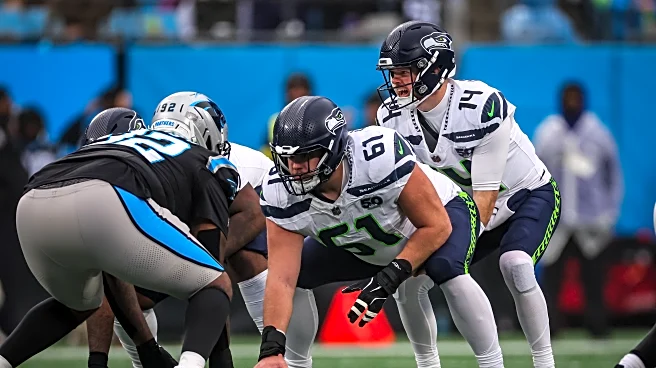

The Seattle Seahawks have won six games in a row, averaging almost 30 points per game in the process, and are a win away from securing a franchise record 14th win and the NFC’s number one seed. And yet,
something feels off about the offense. An offense that was lighting up the NFL through most of the early portion of the season.
It sounds silly to nitpick a team that hasn’t lost since mid-November and is looking like one of the greatest Seahawks teams ever assembled, but with heightened expectations of a Super Bowl given the way this season has gone, there’s always going to be reason to worry when something feels off.
The decline of the Seahawks offense is not a feel. It’s real.
Seahawks offense has declined since the Rams loss
Maybe it’s a coincidence, maybe it’s not, but the Week 11 loss to the Los Angeles Rams marked a turning point in this offense that has not been exclusively negative, but it’s conclusive that the hot streak to start the year did not sustain itself beyond November.
Seahawks offense ranks from Weeks 1-10 vs. Weeks 11-17
The sack rate is actually worse if I take out the Rams loss, in which Darnold wasn’t sacked but turned it over four times. Darnold has been sacked at an above average rate during Seattle’s winning streak. Turnovers also can harshly impact EPA numbers, and the Seahawks have had a season-long issue with giving the ball away. Even if I excluded all turnovers, the Seahawks have still been a middling offense for several weeks.
Where have all the explosive passes gone?
One of these days we will find a consensus opinion on what constitutes an explosive play. Today is not that day. It is logical to me to consider an explosive pass to be 20+ yards and an explosive run to be 10+ yards. In the Seahawks’ first nine games, they were not good at generating explosive runs, but they were far and away the best at creating explosive passes.

The y-axis shows the Seahawks turned roughly one out of every six passes into a 20+ yard gain, something no other team was even close to doing. Then the Los Angeles Rams loss happened, and the Seahawks had only three 20+ yard passes on 44 Sam Darnold attempts. That has been the clear shift in the Seahawks passing game, which is now below-average at creating explosives, but… above-average in explosive runs?

The Seahawks notably did not have a single explosive pass against the Carolina Panthers, only one versus the Minnesota Vikings, and three on 36 attempts versus the Indianapolis Colts.
Jaxon Smith-Njigba’s average depth of target was over 10 yards in each of Seattle’s first nine games. Over the last seven, he’s only climbed above 10 twice, and the deep shots his way have reduced significantly. After JSN caught 12 of 16 passes over 20+ air yards through the first nine games, he’s only caught 4 of 9 dating back to Week 11. No wonder the Calvin Johnson receiving yards record is no longer attainable.
The Seahawks run game has improved
It may not seem like it because the Seahawks are still prone to negative or no gain runs, but Seattle’s rushing attack has performed better throughout the winning streak. Zach Charbonnet and Kenneth Walker just put up 100-yard games in consecutive weeks, something the Seahawks hadn’t managed in three years. They’re 10th in rush EPA from Week 11 onward but 19th in success rate, so there are still issues to fix, but this is way better than Weeks 1-10 when they were 26th in rush EPA and 23rd in success rate.
A tale of two halves and a lot of help
The Seahawks have won six straight games despite an offense that has put up a grand total of two 1st half offensive touchdowns in that span. Through Week 10, the Seahawks ranked 1st in EPA/play on offense in the 1st half. Post-Rams game, it’s a completely different story.
Seahawks 1st half vs. 2nd half offense stats (Week 12-17)
Thankfully, the Seahawks defense ranks top 10 in all the meaningful advanced metrics in either half, so Seattle’s offense can be out to lunch for 30 minutes and not have to rally from a significant halftime deficit. It’s Week 18 and the Seahawks still haven’t trailed by more than 16 points all season.
I included average starting field position in this statistic because, well, that’s where the “help” comes in. Seattle has lived off of short fields created by turnovers and special teams. They have scored 5 of their 12 second half touchdowns from inside midfield, which leads the NFL since Week 12. Add in a bad punt and a kickoff out of bounds and more than half of their touchdown drives have traveled 60 yards or less. I’m not going to knock the Seahawks offense for taking advantage of short fields, but how sustainable is that?
From Weeks 1-11, the Seahawks scored touchdowns on about 25% of their drives when starting inside their own 300. Since Week 12, they’ve scored touchdowns less than 10% of the time (among the worst in the NFL) when backed up, yet kick field goals at the highest rate.
This sort of offensive performance requires the Seahawks defense to have virtually zero slip-ups against playoff opposition, and they’ve only allowed two 1st half touchdowns and 38 total points over the past six weeks. Anything less than that and I think the Seahawks would’ve been out of the division race by now.
Along the lines of help, while it’s true that the Seahawks have the second-most points in the league and the most points in franchise history, they’ve also benefited from a league-high seven non-offensive touchdowns. Seattle is 2nd in points scored yet 10th in points per drive, the biggest gap between points scored and points per drive among the top 10 teams in points scored.
How teams are playing the Seahawks differently
We don’t have data from Week 17 (or at least none that I could find), but the Seahawks are seeing extra DBs at a higher clip since the bye week. Shoutout to John Gilbert for pulling this info down.
Seattle’s stacked box rate is still high compared to the rest of the NFL, but the point is that teams are not going to worry about the Seahawks rushing attack if it means limiting the explosive passing game. And while Seattle’s run game has improved, elite it is not. The Seahawks are seeing more run-friendly looks against defenses not willing to get beaten by the pass. Of Sam Darnold’s seven shortest air yards per attempt, six have occurred from Week 11 onward. He has not completed a pass of 30+ air yards since the Titans game and only attempted five during that span.
It’s also notable that Darnold, who’s one of the most blitzed quarterbacks in the NFL anyway, has seen his highest blitz rates come in four of the last six weeks. Minnesota sent an extra rusher on over 60% of his dropbacks, while the Panthers, who blitz at a league average rate of about 27%, broke tendency and blitz Darnold nearly 55% of the time. Klint Kubiak’s love of play-action boots was certainly tested by the Panthers sending free rushers at will, and Sam’s efficiency was one of his poorest all season.
This isn’t to say Darnold is poor against the blitz; he’s 11th in EPA/dropback per NextGenStats and actually better when defenses don’t blitz, but the blitzing is steadily increasing at a time when Seattle’s explosive passing game has dissipated. The Rams are an exception and have preferred to not send extra pressure at Darnold.
I’ve heard the absence of Tory Horton as a factor in the downturn in Seattle’s passing game. While Horton lit up the Washington Commanders with four catches for 48 yards and a pair of touchdowns, he was also coming off two pre-bye week games in which he had no catches and four combined targets. I’m high on Horton’s long-term prospects but the passing attack shouldn’t sink this much because of a rookie who’s had 22 targets and 13 catches in eight games. Any perceived vertical threat has to have way more productivity than Horton (and Rashid Shaheed) have shown.
The elephant in the room
Seattle’s pure dropback passing game is not good. It just isn’t. Darnold is the best QB in the league by EPA/play on play-action throws. Use straight dropbacks and he sinks to 23rd by EPA/play, and 10 of his 14 interceptions have come this route. Of the QBs who are in the top 10 in EPA on play action passing, only Lamar Jackson has a worse decline in performance on non-play action passes.
While this looks like I’m beating up on Darnold as a PA merchant (maybe he is, but I don’t know and think he’s otherwise had a very good year), I think it’s worth examining whether or not Klint Kubiak is effective at developing a non-PA offense. I’m not sure he is, but that’s hardly a reason to call for his firing or anything close to that suggestion. Seattle has, however, been incredibly fortunate that very rarely has it been forced into scenarios where play-action and running the ball are functionally impractical. No team has run fewer plays and fewer drives while trailing than the Seahawks, so the potentially glaring weaknesses have been hidden. It seems wildly unrealistic to believe the Seahawks will always avoid disadvantageous positions on offense, and the playoffs can often most expose what you either can’t do or don’t do well.
Seattle is still an excellent team and looking at the entire season, the offense has been above average and is generally good. The wins and the favorable field position have papered over a lot of cracks showing in the Seahawks offense. If there’s an expectation that the Seahawks defense will have the offense’s back all the time, fans needn’t look further than the 20-0 and 31-0 halftime postseason holes in Pete Carroll’s Legion of Boom days to see what happens when that plan blows up like Acme dynamite.
As Week 18 approaches and the Seahawks face a banged up San Francisco 49ers defense that is nowhere near its previous excellence, the onus is on the offense to get out of its relative funk and not wait until the 2nd half begins to figure things out. This has already been a magical season for Seattle, but with the NFC West and No. 1 seed on the line, now would be a good time for the offense to find a way recapture some of its early season magic. The current method of winning is seemingly sustainable in the regular season and a very tenuous way to live in the playoffs.
(All stats provided by rbsdm.com, Stathead, SFdata9ers, and NFL Pro)