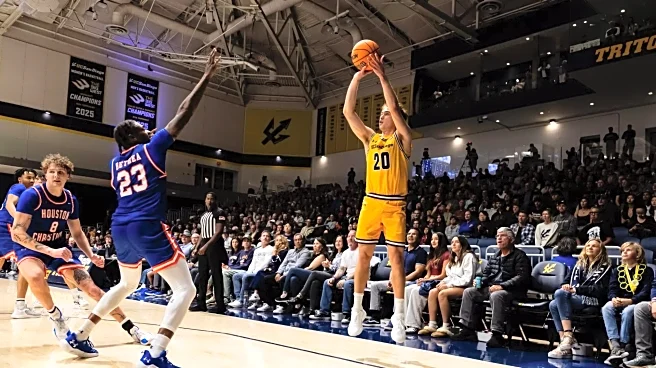



The Tritons won 30 games last season and pushed Michigan to the brink in the Round of 64 of the NCAA Tournament. Eric Olen led UC San Diego on a magical run, ultimately parlaying that performance into the New Mexico job.
In the offseason, UC San Diego lost almost every significant rotation player from that Big West Championship team, returning just 9% of total minutes played.
Before the roster could be rebuilt, the Tritons filled the head coaching vacancy in-house by promoting assistant head coach Clint
Allard.
Allard’s been with the program for 11 years. So, at least he could keep the system and winning culture in place, given his institutional knowledge. But it was tough to imagine the Tritons repeating last year’s success with an entirely new roster.
So, coach Allard, how have your first few months in the big chair been?
“It’s gone better than I could have expected,” Allard told Mid-Major Madness in a recent interview. “I’m having a good time, and I give credit to a great group that’s getting us off to a good start.”
UC San Diego is awesome, again. At 11-2 heading into Jan. 1, 2026, the Tritons have already exceeded any realistic preseason expectation, and they once again look like the class of the Big West. I have them power rated as the best team in the conference by a full three points (per 100 possessions).
Personally, I’m shocked. I thought there’d be some learning curve for this fresh-faced roster. But this team looks nearly identical to last year.
“In the process of building this roster, the staff did well in identifying new guys who give us what we need and play the way we play,” Allard said. “Because we had that buy-in on the front end, it’s helped us have success right away.”
Allard does shout out some of the key returners from last year’s squad — guys like Aidan Burke, Cade Pendleton, Ryder Elisaldez, Jasen Brooks, and Yaqub Mir — for helping him install the program’s mentality.
As he puts it, they are “just playing that team style of basketball.”
The best way to describe TritonBall is as the epitome of team basketball. Almost no program plays better as a group than these guys do.
TritonBall: The Offense
“Offensively, we like to share the ball,” Allard said. “We spread the floor, and with all our weapons, anybody that the ball lands on is a threat to shoot, pass, or drive, which is a fun style to play and very hard to prepare against.”
While there are some more intricate parts to the offense (which I’ll get to), UC San Diego’s attack mostly comes down to player movement, ball movement, and shooting. It’s a lot of spread rim-attack-and-kick actions — whether through dribble-drive, post-kicks, or cut-and-kick — which create an analytically-friendly shot profile (26th nationally in rim-and-3 rate, 91%) and a metric ton of catch-and-shoot opportunities (24 per game, 47th nationally).
“We literally call it ‘running the other team around’ when getting to the next action,” Allard said. “We keep the defense behind the pace that we’re playing offensively. Guys have leaned into moving the ball, not settling for the first shot, and having confidence that we’re going to make the right play, amplifying our advantages through our ball movement.”
Obviously, the crux of this scheme comes down to shooters. Allard needs guys who can rip it from deep on high volume.
Burke has always been an elite shooter (career 38% from 3), and Lafayette transfer Alex Chaikin was a perfect portal pick-up (career 46% from 3). However, I want to shout out Leo Beath and Tom Beattie, two transfers who have shot way better in SoCal than at their previous spots.
“You shoot it better when you realize where the shots are coming from,” Allard said. “A strength of ours is anticipating the shot that’s coming because it’s coming out of structure and scheme. It mostly relies on the talented guys and their capability of making shots, but hopefully, we’re getting them the right ones.”
Given the team’s shooting 38% from deep, it seems like they’re getting the right shots.
The Tritons are an eminently watchable team because of their unselfish style of play — it’s always enjoyable to watch ball movement and shot making. However, my favorite part of the offense is their unique ball-screen sets.
Beath (Lynn) and Emanuel Prospere (Missouri-St. Louis) are two transfers out of Division-II who played similar roles at their previous spots — point forwards in spread pick-and-roll offenses. Throw in Hawaii transfer Tom Beattie, and Allard has three lengthy ball-screen initiators to scheme around.
So, as Olen did with Aniwaniwa Tait-Jones last season, Allard inverts the court and lets his “forwards” navigate ball screens — as he mentioned, every player can drive, pass, and shoot.
“When you have skill at every position, you might as well try to take advantage of it the best you can,” Allard said. “Leo is a real matchup problem because he’s got a big frame. You have to put a bigger body on him, but a lot of those people aren’t used to navigating ball screens.”
“He’s also made some real growth in how to use ball screens, how to put his feet in the paint, and how to anticipate how defenders might react,” he added. “If they switch this big-to-big ball screen, then we can slip out of that and drive to the space it creates.”
This is a good time to shout out Bol Dengdit, the primary screener in UC San Diego’s big-to-big (and guard-to-big) actions. The Portland transfer is an excellent screener, a solid roller, fantastic in short-roll actions (two assists per game), and a threat in the pick-and-pop game. He gives up a lot on the defensive end (more on that later), but he’s an excellent fit for Allard’s offense.
I love this play below. Dengdit sets the ball-screen for Beattie, rolls to the rim and draws two Toreros down, before calmly popping out and stepping back behind the line for a triple. Of course, Beattie hits him at the perfect time.
I love this play more. Dengdit sets a screen, pops, ball-fakes and drives, sets another screen, pops again, hits the 3.
I love myself a versatile, mobile, smart stretch five.
“Bol has some real instincts as a screener of when to exit, when to set it, and does a great job in his timing of everything,” Allard said. “It’s nice to have bigger guys who are really mobile who can get from one action to the next action to the next action.”
All in all, UC San Diego’s offense looks the same as it did last year, both in scheme and efficiency. It’s also just as tough to prep against. Given the roster turnover, it’s almost impossible to fathom.
TritonBall: The Defense
All that said, most of the year-over-year changes for the program come on the other end of the court, even with the same scheme in place.
“Defensively, we also lean into the team style,” Allard said. “We try to cover for the guy next to us, making sure we’re dictating where the offense goes and what to expect defensively. We try to win in rotation.”
Two of the core principles, as described by Allard:
- “We try to protect the paint first and make them shoot contested shots over us.”
- “We try to keep it out of the middle as much as we can. If we can funnel the ball to the outside, our defense is more built to stop that.”
Essentially, the Tritons run an extremely help-reliant defense. They bring early and extra help on the dribble, against ball-screens, from the baseline, and in the paint (Allard pointed out that post-doubling is a big part of the defense when the opponent has a more traditional big man).
This does a couple of things.
First, and obviously, it’s tough to score on the interior against UC San Diego. The Tritons are going to blitz anyone who gets their feet in the paint, which is why they allow just 28 paint points per game (79th percentile).
Second, switching forces a high rate of isolation, which is inherently inefficient offensively.
Third, it baits defenses into long, difficult cross-court passes against double-teams and corner traps. However, it simultaneously allows a high rate of catch-and-shoot 3-point opportunities (44% 3-point rate allowed, 65th-highest nationally), which leaves them vulnerable to offenses that can space, pass, and shoot at a high level — although the Tritons are excellent when closing out (66% of opponents’ catch-and-shoot opportunities are guarded, 39th nationally).
It’s an infuriating style to play against.
It mostly looks the same, and it’s still relatively effective, but some key differences explain the change from last year’s top-30 defense and this year’s borderline top-100 defense.
The most significant difference is that the Tritons aren’t nearly as athletic as they were last season.
“Last year’s group featured high-IQ defenders,” Allard said. “Most of the time, I was just trying to get out of their way, showing them what was coming, and letting them make plays.”
This year’s group doesn’t feature as many high-caliber individual defenders. While they still force a high rate of isolation, the perimeter defenders are having a far tougher time staying in front of their man (1.03 ISO PPP allowed, seventh percentile). At the same time, last year’s squad would pick off so many of those tough cross-court passes (23% turnover rate, third nationally), and this year’s squad can’t come close to that level of disruptiveness (17% turnover rate, 187th nationally).
That cooked them in the Tritons’ loss to San Diego, as Ty-Laur Johnson and Co. destroyed them in isolation (23 points on 20 possessions, 1.15 PPP) and on catch-and-shoot creation (33 points on 29 shots, 1.14 PPP).
At the same time, Dengdit is a tremendous offensive piece, but he’s not so effective as an interior anchor. He doesn’t offer much rim protection or rebounding, so he fails to clean up any mess on the interior.
That cooked them in the Tritons’ loss to Nevada, as the Pack bullied them on the boards, winning the rebounding battle 45-36.
(Also worth mentioning that San Diego grabbed 15 offensive rebounds in its game against the Tritons. The Toreros are a terrible rebounding team. You can’t let them do that.)
“We’re still trying to improve on that end,” Allard said. “We want to be disruptive and not have them shoot it every time. Emanuel has been doing a great job of being disruptive; he has great timing and heavy hands.”
I will shout out Prospere as the best defender on the team. He’s posted the team’s highest steal rate (5%) and DBPR (+2.22) as an excellent dribble defender (.14 pick-and-roll ball-handler PPP allowed, 99th percentile).
But, ultimately, the 2026 Tritons are over-helping primarily to account for their severe lack of athleticism. They’re still effective because they switch, rotate, and communicate so well. But the flaws in this year’s unit are evident: they can’t put pressure on opponents as effectively, they don’t force as much havoc, and they’re a tad soft.
TritonBall: It’s Still Great
Yeah, I’ve poured some cold water on UC San Diego over the past few paragraphs. But I need you to understand this:
The Tritons are still awesome. They are so much better than expected, and the way Allard has brought this entirely new group together under the UC San Diego umbrella so quickly is a testament to his coaching acumen.
My favorite UC San Diego stat? All five starters are averaging over nine points and 1.5 assists per game.
Team. Basketball.
The Big West is among my favorite conferences in college hoops. After a nearly perfect non-conference slate, UC San Diego is the runaway favorite to repeat as champs. (And they’re fun to watch!)
Watch out if this team makes some shots in the NCAA Tournament.