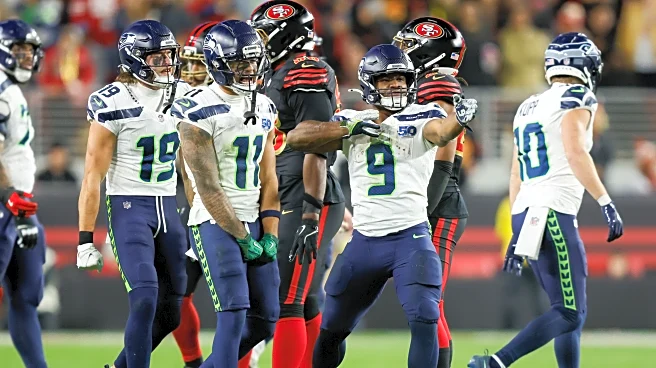

The Seattle Seahawks managed to win the NFC West and also earned a bye in the first week of the playoffs, becoming the number one seed for the first time since 2014. The defense’s performance was near perfect. I confess I don’t remember a game so well planned and executed from beginning to end.
Jason Myers’ missed field goals and the offense’s performance left the game more open than it should have been, considering the score. However, the offense had a fantastic display of the running game and didn’t
commit any turnovers, something that will be crucial in the playoffs.
The Good
Klint Kubiak helping his case for head coach
Klint Kubiak built the plan around outside zone as the foundation, with complementary calls designed to punish defensive adjustments. Early in the game, Seattle leaned heavily on wide zone, forcing San Francisco’s edge defenders to widen and hesitate. Tackles focused on gaining width rather than quick wins, creating vertical lanes for decisive “bang” cuts (Ken Walker loves it).
Several first-quarter runs show 49ers linebackers aggressively flowing play-side. The running back reads the overpursuit, plants, and attacks the B gap, exploiting the lack of second-level integrity. When San Francisco adjusted with scrape exchanges, Kubiak countered with split zone, using tight end motion to seal the backside end. That prevented the defense from gaining numbers advantages and kept the read clean for the RB.
Seattle also leaned on duo concepts in predictable situations, particularly 2nd & medium. Duo allowed extended double teams inside, displacing defensive tackles and forcing the linebackers to commit early. On multiple snaps, the All-22 shows him stepping downhill just before the cut — too late to recover.
Here we have the play that led to the only touchdown of the game. The 49ers defend a short down situation with a Cover 1. Cooper Kupp’s motion at the start of the play confirms the coverage. This leaves the Seahawks with 3 receivers on the right side, forcing the safety deep downfield to pay closer attention to the pass.
This formation also leaves the 49ers with few options on the left side. There’s only the safety against AJ Barner on that side of the defense. The play begins, Anthony Bradford and Jalen Sundell get good blocks, but Zach Charbonnet sees the cutback opportunity. He makes the cut, and the 49ers safety Ji’Ayir Brown makes the mistake of not maintaining outside leverage, leaving the running back with a clear path to face the safety deep downfield. Charb simply uses a hesitation move on Malik Mustapha and scores the touchdown.
Kubiak consistently put the 49ers in conflict without resorting to reckless aggression. Efficient early-down runs opened up frequent under-center play-action, especially boot action away from the base run. Even when the ball wasn’t thrown, the movement froze linebackers and safeties.
The Seahawks’ poor run game performance during the season makes the defenses to use lighter packages even against their heavy formations. This significantly impacted the success of the Seahawks’ passing game after the mid-season. Having an efficient running game will be crucial for playoff success.
Run defense: A perfect execution
Defensively, this was one of Seattle’s cleanest performances against a Kyle Shanahan scheme. The priority was clear: eliminate cutbacks. Defensive linemen played with low pad level and strict gap responsibility, avoiding the reckless penetration that often fuels Shanahan’s outside zone game.
Seattle mixed over fronts and reduced fronts, frequently presenting five-man looks on early downs. That forced runs away from San Francisco’s preferred structures. Linebackers were patient and disciplined. On both inside and outside zone, they held the mesh point, reading the back’s hips before triggering. When the cut came, there was simply nowhere to go. The result was a run game with no rhythm and no explosives — exactly what Shanahan tries to avoid.
DeMarcus Lawrence didn’t record any stats on this play, but he’s fundamental to the scheme’s operation. The EDGE rushers need to force runs inside, which forces the RBs to face the Seahawks’ DTs, who are having an incredible season. This involves either beating double teams or creating space for the LBs to come down and make plays.
Pressure and coverage: Shutting down the pass without exposure
Seattle controlled the passing game without heavy blitzing. Most pressure came from four-man rushes, using simple stunts to attack protection rules. T-E games were especially effective, collapsing the pocket from the inside. Even when the quarterback had initial time, there was no room to step up, forcing off-platform throws.
Most importantly, defensive backs did not bite on play-action. Safeties maintained depth, corners played with patience, and San Francisco’s trademark YAC production disappeared. Also a great communication on secondary, basically without any blow coverage to be exploited.
The Bad
Missed vertical opportunities on offense
Despite the control, the tape shows a few missed chances. With linebackers aggressively reacting to run fakes, vertical concepts like post-dig or deep over were available more often than Seattle attacked. It didn’t hurt them here, but it caps the offensive ceiling against more physically matched opponents. However, as I wrote in the preview, that’s the secret to overcoming the Niners’ defense: patience.
Of Darnold’s 26 pass attempts, only 1 went for 20+ yards. 6 went for somewhere between 10-19 yards, and the rest went for 9 yards or less.
That was a serious mistake by Darnold. Some people complained about the call, but I don’t see any problem with calling a play action here. In fact, Zach Charbonnet was open, so the play design was successful. Darnold had time in the pocket, he looked at the running back, who looked back at him, but for some reason he didn’t throw the pass and even retreated to get sacked and lose more than 10 yards.
Here we have a basic accuracy error. Darnold is in motion, but without pressure, and Smith-Njigba isn’t in a tight window. He misses the pass and nearly gets intercepted. It’s these kinds of decisions by Darnold that make me not trust him. It’s better to win the game than to try to be the hero and almost end up as the villain.
One of the few times the Seahawks attempted a vertical play. The play design is good, and JSN runs an excellent route. Darnold is locked onto JSN from the start of the snap, but the pass seems a little late, allowing the safety (who was reading his eyes) to get there and still attempt an interception.
Darnold wasn’t brilliant, but he had a turnover-free game (even though he almost lost a fumble when Sundell stepped on his foot after the snap). He was a calm player, didn’t force anything, and accepted what the defense presented to him. He even escaped some pressure, showing himself to be more mobile than at the beginning of the season, including that great play that basically sealed our victory.
Final Thoughts
This victory allows us to recover injured players, regain momentum, and also shows what the Seahawks are capable of. A few weeks ago, the defense, despite having the tools to do so, had no answers in the first half against the Rams. This time, the planning was again well done, but the execution, as I said in the introduction, bordered on perfection.
Most likely, what will decide the Seahawks’ fate will be their offense. Despite moving the ball well during the game, the team went 0 for 3 in the red zone, and this has been a recurring problem, especially since the middle of the season. Kubiak has a week to think (while he’s not in head coach interviews) about ways to improve this and how to keep Sam Darnold on script.