

On May 21, 1880, a strange thing happened in upstate New York. While playing at Riverside Park in Albany, Lip Pike — playing for the National Association team in Albany in between stints at the professional/semi-professional level — hit a fly ball over the fence in right field and into the nearby river. Outfielder Lon Knight, playing for the visiting Worcester Ruby Legs, hopped in a boat to chase the ball — because, despite the fact that the ball went over the wall, it was still technically a live
ball!
These days, when the ball goes over the fence, it is out of play, and depending on whether it gets there on the fly or on a bounce determines whether it’s a home run or a ground-rule double (yes, it’s officially called an automatic double, but, well, old habits die hard). However—like everything in baseball—this rule wasn’t written down on golden tablets handed to Abner Doubleday/Alexander Cartwright/whichever semi-mythological figure you consider to be the founder of baseball, but one that evolved throughout the history of the game. Unfortunately, the Baseball Almanac’s list of rules changes does not give us an exact moment that this rule was created, but we can surmise that it came into existence prior to the National League’s creation in 1876, as on May 2nd of that year, Chicago White Stockings second baseman Ross Barnes hit the first home run in what would become Major League history. But even then, its story was not so simple.
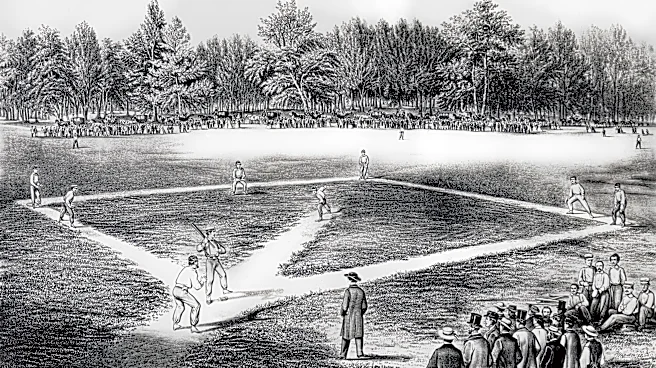
If you have followed my history-of-early-baseball posts over the past few years, you already know that 19th-century baseball was organized very differently than the baseball of today. Rather than a centralized league imposing a particular ruleset, the home team determined the particular rule set the game was played under, with convention dictating the most basic rules, up until the creation of the NL. Indeed, even after the Senior Circuit came into existence, the home teams still had quite a bit of say in how the game was played, as the NL office in its early years focused less on the product on the field and more on bullying other leagues out of existence to ensure a monopoly over the sport (but that’s a story for another day).
We see hints of this still today, where individual ballparks have rules to determine home run/ground rule double/foul ball when the ball hits a catwalk, or gets stuck in the ivy, or any other random thing occurs that is unique to that ballpark. But in the 1800s, even fundamental rules, such as what happened when a ball went over the fence, depended on where the game was played.

Did Lon Knight actually grab a boat and chase down a ball in the river in order to get the ball and try to make a play? In truth, it sounds a bit ridiculous. How slow must the batter have been where hopping the fence, heading into a boat, and setting sail on the river seemed a perfectly reasonable solution? It’s not for nothing that the SABR biography of Knight says “there is undoubtedly some fictitious element to the story.” Since the teams had a limited amount of balls back in those days, it seems more likely to me that Knight hopped in the river not to continue the play, but to continue the game, and that over time, the story grew in its telling. What this story does reinforce, though, is the fact that these rules depended by and large on the ballpark; if a ball over the fence was always a home run, after all, this story could not have come into existence in the version described.
Naturally, some teams took advantage of this. In the early 1880s, the Chicago White Stockings played on a field with short fences (some sources place them less than 200 feet from home plate), and according to convention at the time, batted balls hit over a fence that was less than 250 feet were treated as doubles, not home runs. According to SABR, however, in 1884, Chicago changed their own ground rule so that everything that went over the fence was considered a homer, not a double, resulting in a season in which Ned Williamson hit 27 home runs, a record that would stand until Babe Ruth’s 29-homer season in 1920.
In time, to stop shenanigans such as this, rules surrounding batted balls hit over the fence were ultimately standardized. Originally, in addition to all fly balls that went over the wall being considered home runs, all balls that bounced just once before going over fell into this category, neatly paralleling the fact that, up until 1864 for fair balls and 1883 for foul balls, batted balls caught on one bounce were considered an out; only in 1931 was this rule changed, and the modern-day ground-rule double brought into existence. As such, these days, shenanigans about long fly balls are limited to non-professional games, such as your local little leagues or bar softball games — or, apparently, the Saarikenttä in Finland.