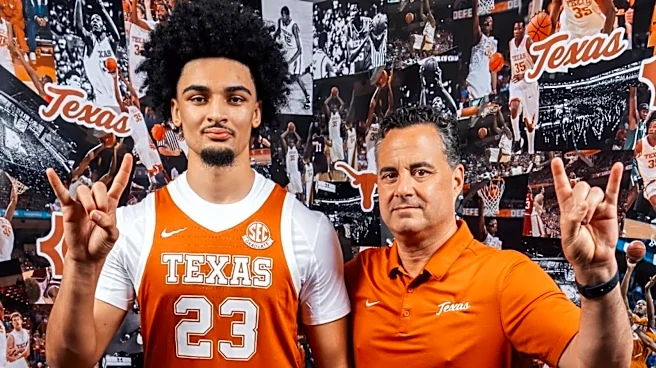








As the Texas Longhorns went 21-15 during Sean Miller’s first season on the Forty Acres, the longtime head coach came away with a major takeaway from the 18-game gauntlet of the SEC schedule.
“One thing that I learned is I think to be the best team in this league, to compete for the top prizes, you have to have a physicality and size at the four position. It’s tough to just do it with one big on the court,” Miller said in an interview with On Texas Basketball.
So in an attempt to bolster the No. 95
defense in adjusted efficiency, Miller decided the Longhorns needed some Punch.
When the transfer portal opened, improving the power forward position was a top priority for Miller and his staff, who quickly honed in on TCU transfer David Punch to bolster the team’s frontcourt next to returning center Matas Vokietaitis.
Ranked as the No. 9 overall player in the transfer portal and the No. 3 power forward, Punch committed to Texas on April 12, providing a key piece to the portal class for the Longhorns as a two-way player with the size and athleticism to compete in the rugged SEC.
“Incredible driver, rebounder, he’s also very good defender, obviously played for an excellent coach in Jamie Dixon,” Miller said.
While Punch doesn’t have prototypical height at 6’7, he’s 245 pounds and posted some elite numbers defensively. As a sophomore, Punch’s block rate of 7.4 percent was more than twice the rate posted by Vokietaitis at 3.4 percent, and his steal rate of 2.6 percent was comparable to Dailyn Swain’s steal rate. In defensive box plus/minus, Punch posted a 5.2, doubled from his freshman season and significantly higher than the 3.6 recorded by Swain, the most impactful defender for the Horns last season.
In 2025-26, Texas didn’t really have the capability to play big. Miller started the season with 6’8, 220-pound Nic Codie as the starter, but Codie quickly fell out of the rotation entirely as the Horns turned to 6’7, 215-pound Cam Heide at the four. Heide struggled to defend bigger players and posted the lowest DBPM of his career by a wide margin as Texas was forced to play heavy minutes with a smaller lineup.
Now Texas can play bigger with Punch next to Vokietaitis or use Punch at the five in a smaller lineup to get more athleticism on the floor.
“I think the teams in college basketball and in our league that are at the top can play both big and quick, big and small. David Punch gives us the ability to do that,” Miller said.
At times last season, Codie was able to effectively run high-low sets with Vokietaitis, a likely area of emphasis next season because of Punch’s driving ability and strong mid-range game — he shot 44.8 percent on far twos and got to the rim for 34 of TCU’s 84 dunks. Because Vokieaitis is only a roll threat on ball screens, Punch makes Texas more dangerous in that facet of the game as Vokietaitis works from the dunker spot.
Texas was able to win the high-profile portal recruitment because the staff was able to capitalize on its pre-existing relationship with Punch. When Miller was at Xavier, his staff prioritized Punch out of Harker Heights when he was a fringe top-100 prospect nationally with only a handful of offers from high-major programs.
“We knew David and his family when we were at Xavier. We actually recruited him for a large part of the offseason, and then he ended up committing to TCU, and we were kind of moving in a different direction, but we came down to do a home visit, watched him all summer, thought he was being very under recruited. So once he entered the portal, we had a built-in credibility, and we had a built-in relationship from the perspective of they knew that we respected him because we recruited him out of high school, and there was some familiarity that I thought helped us be able to get him to come to Texas,” Miller said.
Now the strong evaluation of Punch will pay off for Miller and the Longhorns after addressing one of the team’s biggest needs to make Texas competitive in the SEC.