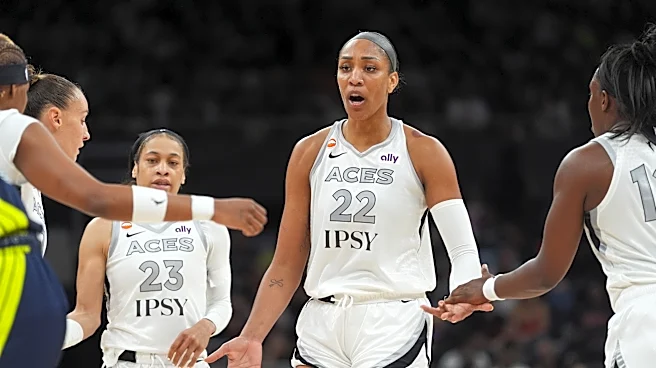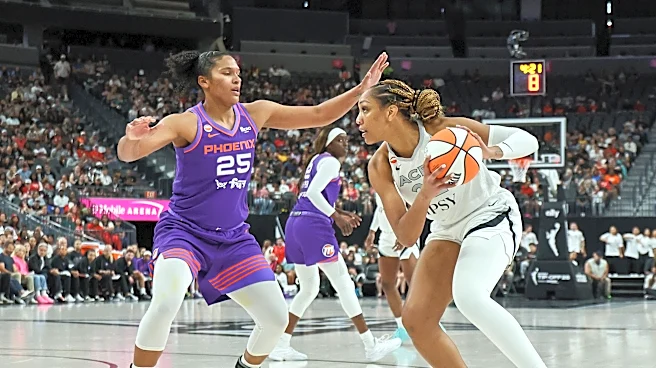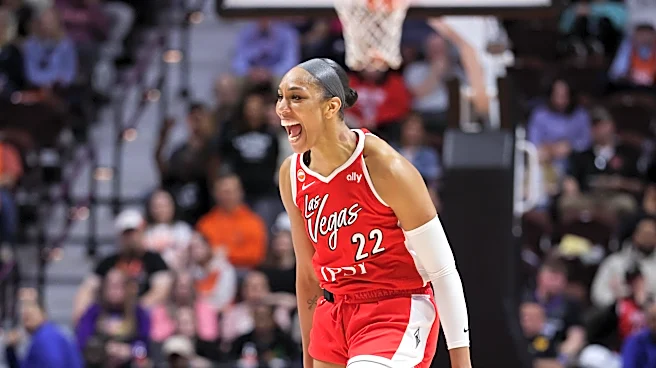







On Friday night, A’ja Wilson reminded why she’s the four-time MVP, dropping 45 points on better than 83 percent shooting as the Las Vegas Aces won the second of two-straight matchups against the Connecticut Sun, 101-94.
Wilson is the epitome of an MVP because of how her raw production translates to winning impact. Scour the all-in-one advanced statistics designed to capture
a player’s value, and A’ja consistently is the A’One.
Last season, when she claimed her record fourth MVP award behind a second-half statistical surge, Wilson lead the league in the following advanced metrics:
- Player efficiency rating (PER): 33.4 (Basketball Reference)
- Player impact estimate (PIE): 22.0 (WNBA Stats)
- Estimated contribution: 5.3 (Positive Residual)
- Win shares: 9.5 (Basketball Reference)
- Wins over replacement (WAR): 7.0 (ESPN Analytics)
Now, add regularized adjusted plus-minus (RAPM) to list.
Over at Sports Illustrated, Dan Falkenheim introduced some of the results from his WNBA RAPM model, where he tweaked the RAPM formula used for the NBA for WNBA data. Compared to traditional plus-minus, found in most WNBA box scores, RAPM attempts to better account for context and credit. In short, who truly contributed the most to winning.
Falkenheim uses the following example to illustrate why RAPM is superior to traditional plus-minus, writing:
On July 27, the Aces beat the Wings 106–80. Wilson was a +25; Las Vegas bench player Aaliyah Nye was a +20. Plus-minus would suggest both players had a similar impact on the game. Plus-minus would be wrong. Wilson had 14 points, 10 rebounds, seven assists, four blocks and two steals, largely against Dallas’s starters. Nye had three points and three rebounds, largely against the Wings’ bench. Plus-minus is blind to the teammates a player shares the floor with and the quality of opponents faced, which are both key factors for assessing a player’s impact.
RAPM also strives to be predictive, using past performance to forecast which players can be expected to continue to play positive basketball. In his thorough explanation of his methodology, Falkenheim makes clear that he understands that RAPM is far from gospel; rather, the metric he has generated is another tool to be used in the effort to capture and communicate which players consistently make their team better when they’re on the court.
Of course, one could retort that no fancy stats are need to render a judgement on A’ja’s impact. Just watch the game or peak at the old-fashioned box score. It’s obvious A’ja’s amazing!
Yet, Falkenheim’s RAPM results from the 2025 season point to the value of a somewhat convoluted metric, revealing the players who may not post a large volume of traditional stats or make loud plays, yet silently and consistently help their teams win games, and, on the other end of the spectrum, those players whose stats, while stuffing the box score, ultimately are empty when it comes to their impact on winning.
Here’s Falkenheim’s top-10 and bottom-10 RAPM results for last season:
WNBA RAPM Top 10 (2025)
- A’ja Wilson (Las Vegas Aces): +3.25
- Naz Hillmon (Atlanta Dream): +2.86
- Skylar Diggins (Seattle Storm): +2.45
- Breanna Stewart (New York Liberty): +2.41
- Leïla Lacan (Connecticut Sun): +2.39
- Napheesa Collier (Minnesota Lynx): +2.39
- Alyssa Thomas (Phoenix Mercury): +2.18
- Veronica Burton (Golden State Valkyries): +2.08
- Jackie Young (Las Vegas Aces): +2.03
- Kayla McBride (Minnesota Lynx): +1.95
WNBA RAPM Bottom 10 (2025)
- Diamond Miller (Minnesota Lynx/Dallas Wings): -2.76
- Kiah Stokes (Las Vegas Aces): -2.24
- Alysha Clark (Seattle Storm/Washington Mystics): -2.19
- Julie Vanloo (Golden State Valkyries/Los Angeles Sparks): -2.18
- Jacy Sheldon (Washington Mystics/Connecticut Sun): -2.13
- Tina Charles (Connecticut Sun): -2.07
- Kitija Laksa (Phoenix Mercury): -2.00
- Kia Nurse (Chicago Sky): -1.80
- Aziaha James (Dallas Wings): -1.75
- DiJonai Carrington (Dallas Wings/Minnesota Lynx): -1.74
While he suggests the inclusion of Naz Hillmon and Leïla Lacan within the top 10 is “weird,” both the 2025 Atlanta Dream and 2025 Connecticut Sun were transformed when Hillmon and Lacan, respectively, began to occupy bigger roles.
A rarely used reserve at the very beginning of the 2025 season, Hillmon quickly forced her way into the rotation and, eventually, the starting lineup. However, it is fair to suggest that Hillmon’s strong metric is still reflective of her context, as she often shared the court with the likes of Allisha Gray, Rhyne Howard and Brionna Jones (another RAPM darling), even if she deserves credit for making that context come together.
The Sun, in contrast, were quite sad to start 2025, recording only two wins until Lacan arrived around midseason, when she helped the team finish a more respectable 9-13 after the All-Star break.
She, therefore, deserves a lot of credit for elevating a less-than-ideal context. There’s a good reason that head coach Rachid Meziane hasn’t been shy about expressing how much the 2026 version of his team needs Lacan. If the Sun are still winless when she arrives, don’t expect them to stay that way for long.
Quite possibly, the bottom 10 is more informative, as RAPM strips away a player’s seemingly solid counting stats and occasional exciting plays to lay bare their lack of impact on winning.
While it might seem a bit cruel to kick a recently-retired WNBA legend, Tina Charles’ spot on the list hints at why contending teams were uninterested in giving her a call this offseason. Likewise, despite the hustle of Jacy Sheldon, the pizzaz of Julie Vanloo and the reputation of Kia Nurse, the trio might have bounced from team to team for good reason.
Sure, there are dangers of diving too deep into advanced data and drowning in the theoretical over appreciating the actual. Furthermore, the randomness of small sample sizes can ruin fine-tuned projections in often delightful ways.
For example, Dana Evans pops up on Falkenheim’s bottom-10 three-year RAPM list. Yet, Evans was critical in helping the Aces win the 2025 championship . No, she didn’t provide the consistent winning contributions of A’ja, but Wilson might not have another ring if it wasn’t for Evans.
So much of the joy of sports come from the unexpected—all those ephemeral, unsustainable, outlier and emotional moments that transcend stats. Advanced stats aim to tell us what is mostly likely to happen; the best moments in sports are those that are most unlikely.
And yet, it’s also irresistible to indulge in trying to know it all. And WNBA RAPM (both Falkenheim’s findings and those presented by Help the Helper) give basketball nerds another resource to explore.
But, whether you dismiss all the stats or want to dig even deeper, one thing stands: You can’t deny the excellence of A’ja.