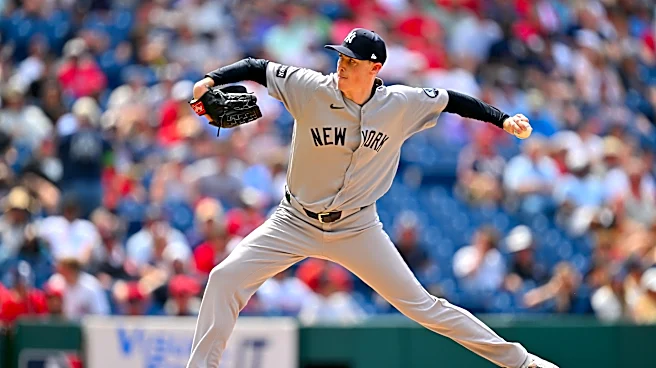




As the Yankees’ bullpen has come under fire over the past few months and emerged as arguably the team’s biggest weakness*, they have continued to carry both Paul Blackburn and Ryan Yarbrough — two pitchers who have spent most of their career as starters (or, well, in Yarbrough’s case, starter-adjacent, thanks to the Rays frequently pairing him with an opener) in their bullpen since Opening Day.
*At least before two-thirds of the starting outfield hit the shelf at the same time.
While not, at the start
of the season, a bad move — veteran depth capable of starting is hardly ever a bad thing, and having multiple pitchers capable of going multiple innings while starters are still ramping up early in the season can help teams get through the early season without overusing their bullpen — this decision has frustrated fans over the last month or so. As the high-leverage arms have been overworked, does the team really need to have two low-leverage long men?
Last week, we took a look at Blackburn’s season, breaking down how the Yankees have tried to convert him into a middle reliever, with some success. This week, though, I want to take a dive into Yarbrough’s metrics, and see if he might be a better choice for those medium-leverage innings that Blackburn has been getting. Because, well, Yarbrough’s metrics have been…pulling in different directions, to say the least.

Out of pitchers with at least 20 innings pitched this season, only dominant San Diego closer Mason Miller has allowed less hard contact than Yarbrough, 17.6 to 14.0 percent (these numbers come from FanGraphs’ Statcast heading, which has different values than the ones in the chart above, but the percentiles are the same). His average exit velocity is better than any pitcher except Philadelphia’s Orion Kerkering. The only way his batted-ball profile would be better is if he generated more groundballs — he ranks 214th out of the 375 pitchers that we’re looking at — but at the end of the day, soft contact is soft contact.
At the same time, though, thanks to a fastball that tops out at 87.5 mph, Yarbrough struggles to get strikeouts. He does not get batters to chase pitches out of the zone, he does not generate whiffs inside of the zone, and on top of it, his walk rate is up three percentage points from last year (7.2 to 10.2 percent). While, as we saw last week with Blackburn, pitchers don’t need to have high strikeout rates to be relatively successful, even as relievers, it does leave less room for error.
What we need to remember when looking at Yarbrough’s performance, however, is the fact that he has only made 14 appearances this season, mostly in low-leverage situations; in fact, in 11 of those games, his primary task was “eat the final one to three innings so the rest of the bullpen can get some rest.”*
*This was all written before last night, when Yarbrough made yet another low-leverage appearance, pitching three scoreless innings to close out a 12-2 blowout of the White Sox.
In these situations, regardless of whether you’re up or down big, the primary goal is to just throw the ball over the plate and try to get some (ideally soft) contact in order to reach the finish line as quickly and painlessly as possible. As such, much of this data can be a bit skewed; therefore, it we want to see whether or not Yarbrough can be used in more high-leverage spots, we need to look a bit deeper.
So far this season, Yarbrough has been much better against lefties than he has against righties: right-handed bats have slashed .245/.333/.321 in 60 plate appearances, while lefties have slashed .091/.211/.182 in 38. These are, admittedly, extremely small sample sizes, but this does reflect a pattern. Last year, left-handed bats managed just a .198/.216/.360 line against Yarbrough, compared to a .263/.341/.481 line against righties. To put it another way, over the last two years, Yarbrough turns all righties into 2026 Cody Bellinger (130 wRC+), and all lefties into 2026 Caleb Durbin (53 wRC+).
If the Yankees are inclined to use Yarbrough more often and turn him into a more high-leverage threat, the best route to take would be to use him as a lefty specialist, lining him up to minimize the amount of right-handed batters he faces. However, this isn’t exactly something the bullpen is lacking. Tim Hill has absolutely decimated lefties this year (.177/.190/.210), but has been prone to give up the long ball against righties (.357/.440/.595, with three home runs). Fernando Cruz may not be a southpaw, but his splitter absolutely flummoxes lefties (.120/.267/.200). On a day-to-day basis, there are better options than Yarbrough if they need a left-handed specialist.
As such, for the time being, it’s probably best for the Yankees to continue using Yarbrough as a long man out of the ’pen, solely for the purpose of keeping him stretched out in case they need to dip into the rotation depth again while Max Fried is on the shelf. He may be behind Elmer Rodriguez, and possibly also Brendan Beck, but as we’ve seen, depth can dissipate at the drop of a hat.