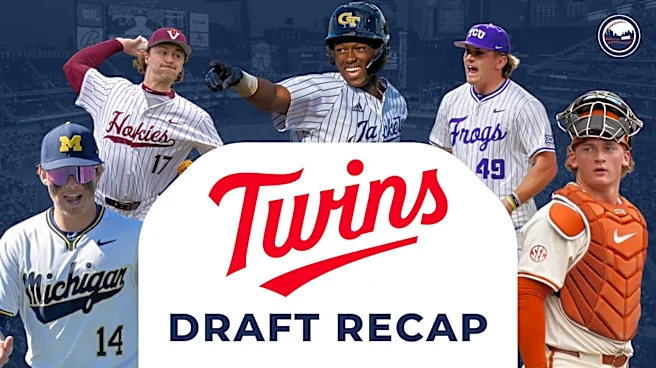







The Twins had a big opportunity this weekend, holding some of the biggest draft capital they have had in almost a decade. Time will tell how this group will fare in professional baseball, but there is huge potential with a handful of these draftees, and it is a class that I am quite excited to watch develop over the next few years. I took some time to write up a summary on each selection the Twins made, giving a baseline of each player’s profile and sharing my opinions on how they fit into the organization.
They did not select an infielder or outfielder until the 11th round, and I would be curious to hear if it was a deliberate strategy based on the system’s strengths and weaknesses or if it was just how the board fell. Either way, Minnesota is sitting on a class loaded with quality college arms that should hopefully cultivate a handful of major league pitchers over the next few years. Without further ado, we will begin with the Twins newest star prospect…
1.3 – C Vahn Lackey, Georgia Tech
It’s a home run pick by the Twins at pick 3, who believe they have found their catcher of the future in Georgia Tech’s Vahn Lackey. The 6’2” righty is a great athlete who possesses tantalizing potential behind the dish and has grown into an all-around impactful hitter.
His hit tool is borderline plus, most notably with his ability to crush fastballs. There are some questions about his ability to adjust to offspeed, but improved swing decisions in 2026 relieved some of those issues. With a max EV around 110 mph at 21 years old, Lackey has borderline plus raw power and really tapped into it this year, hitting 20 homers and slugging .772. He already looks like a well-rounded hitter, and given the consistent development we have seen from him over the last few years, it remains to be seen how much higher the ceiling can go.
Defensively, Lackey’s athleticism is evident behind the dish in his lateral movement and blocking ability. He has a rocket arm with a quick-trigger release. He has a great chance to stick at catcher and be impactful back there, but Lackey also played some good third base defense in 2025 and has the tools to be impactful there or in the corner outfield. He will be most valuable at catcher, but if Ryan Jeffers sticks around for awhile or one of the other catching prospects proves to be major league caliber, the versatility could be a huge asset for Minnesota.
Vahn Lackey also gets great regards for his personality and love for the game. He’s an easy guy to root for and a great baseball player who has the potential to push for MLB’s number 1 overall prospect and be one of the league’s premier catchers. It will be interesting to see where Vahn Lackey’s pro career begins, because he likely doesn’t need much time in Single-A(if any at all), and High-A Cedar Rapids’ catching position is already filled with Eduardo Tait and Enrique Jimenez. Double-A could be in play for Lackey this year, which would be a really fun challenge for the stud backstop.
2.43 C Carson Tinney, Texas
Fans may be confused by the Twins pouring more resources into yet another big catching prospect, but I don’t think the team is looking at the position here. They are looking at a slugger who is 6’4” with arguably the best raw power in the entire draft. Tinney hit 22 homers at Texas this year and registered exit velocities up to 116 mph.
There are some hit tool concerns, as he struck out at a 23.1% clip in 2026, but his 80% zone contact and fairly sound and efficient swing suggest that his contact skills should at least be playable. He also mitigates the hit tool issues with a patient approach, as he drew a 19.2% walk rate and led the SEC with 55 walks this year. The combination of patience and good enough contact should allow the 70 grade raw power to play in a big way. He immediately joins Emmanuel Rodriguez and Eduardo Tait as not only the most powerful prospects in the organization, but three of the most powerful in all of minor league baseball.
Defensively, Tinney lacks athleticism behind the dish and has a much more limited ceiling than Vahn Lackey. His arm is plus and will play, but his blocking and receiving are behind. There is hope that he can develop into an average catcher, but I can see the Twins exploring a move to first base sooner rather than later.
At 21 years old, this is an incredibly high upside bat who should mash through the lower levels with ease. Questions about his defense will lower his floor, but there is a Bryce Eldridge-esque profile here, and if Tinney can mash through the minors down the stretch, people may start to talk about him as a top 100 prospect very quickly.
2.73 RHP Brett Renfrow, Virginia Tech
As a 3 year college pitcher with a ton of innings under his belt, Brett Renfrow fits the typical starter mold with a bit of intriguing upside. He is a good strike-thrower with a solid 6’3” frame and some good extension down the mound. An over-the-top release with a pretty easy and sound delivery. His fastball sits in the 92-95 range and will creep up to 97 with good carry and spin. It is sure to be a good big league pitch if he can consistently work in the mid 90s while maintaining its shape and command. Good feel for spin on the breaking balls. His slider in the mid 80s gets impressive bite, but command needs some work. His curveball in the low 80s will steal some strikes and keep hitters off balance. His changeup feel is developing, but he has flashed good fade in the mid 80s.
If the pick comes under slot, I love it as a high probability big league arm with some legitimate mid-rotation upside. The carry fastball and feel for spin give Renfrow a good baseline as a middle reliever, while further development with the changeup or a spike in fastball velocity would put him squarely on track for a major league rotation spot. Not the most exciting pick on the back-end of the second round, but he is a valuable profile and one the the Twins have been severely lacking across the system this year.
3.79 RHP Ethan Wachsmann, Grandview HS
Wachsmann is the Twins’ biggest swing on day one. He is a raw prep pitcher with a big 6’5” frame and a ton of velocity. Fastball sits upper 90s and has worked up to triple digits with spin and carry potential. It’s complemented with a slider, curveball, and changeup. There is a lot of work to be done with the breaking balls, but the curveball has flashed spin rates close to 3,000 with sharp two-plane break. Upper 80s changeup kills spin and can get good depth, it’s a pitch that Twins leadership has already point out as one they like. The ball pops out of his hands with a surprisingly easy delivery from a 3/4 arm slot.
There will be a lot of work to do with Ethan Wachsmann, much like Charlee Soto and Dasan Hill in recent years. It’s a high-upside profile with frontline starter potential, but is a long ways out. He will be a really fun prospect to watch develop over the next few years.
4.107 RHP Tommy LaPour, TCU
Tommy LaPour’s profile screams bullpen bulldog. He had a really impressive sophomore campaign at TCU, posting a 3.09 ERA in 90 innings, but elbow soreness cost him most of the spring this year, and he struggled with command when he returned in April. If LaPour can build on his sophomore success in the Twins system, they may have gotten a discount on a live arm.
He has an upper 3/4 arm slot with some big arm speed in the delivery. His fastball sits mid 90s with a couple different shapes, but he will flash 99 at times with some big whiff potential. His slider in the mid 80s gets solid two plane movement, and there is harder cutter in the upper 80s, but both pitches aren’t particularly sharp. His changeup in the upper 80s has flashed some whiff potential with excellent fade, currently his most intriguing secondary.
There is a lot of uncertainty with LaPour after a wash of a season this year, but we will get a much better idea of who he is when we see him in Single-A and get some pitch data. For now, I’m intrigued by the idea of him as a bullpen arm, where that fastball really has a chance to play in the upper 90s.
5.139 RHP Steele Murdock, UC San Diego
The Twins spent all of Saturday night searching for the best baseball name, and when the sun rose on day 2 and it was time to make the pick, they nailed it. While Steele Murdock was a starter at UCSD, he is firmly a reliever profile who largely sticks to a fastball-slider combo. At 6’2” with an over-the-top release point, he gets good extension on the low 90s fastball with solid spin and carry, and has flashed as high as 99 mph. His slider has plus potential, showcasing good spin rates and some excellent depth in the low 80s. He has also flashed an upper 70s curveball and mid 80s changeup, but doesn’t seem to have much of a feel for either.
It’s an easy bullpen projection, and if we see that fastball find the upper 90s more consistently, then Murdock has two good big league pitches to work with. Still, there is value in trying to develop him as a starter and seeing if he can broaden the repertoire, which is what I expect the Twins to do when he starts his pro career.
6.168 RHP Ethan Lay, Sacramento State
This is a clear savings pick to clear some extra money for Wachsmann, but Ethan Lay still has some intriguing traits as a command arm. He pounded the strike zone against mid major competition, totaling 93 strikeouts and 16 walks in 88 innings at Sac State this spring. Doesn’t get much extension, but its an easy delivery from a high arm slot that generates a low 90s fastball with a typical four pitch arsenal. The strike-throwing gives him potential as a reliable back-end starter if we can see some stuff improvements as he pushes through the minors.
7.197 RHP Max Bayles, Santa Clara
Max Bayles had a successful junior year at Santa Clara, posting a 2.54 ERA with 104 strikeouts in 71 innings of work. His arsenal is headlined by a low 80s slider that he throws more than his fastball. The spinner is a plus offering that gets great depth and generated a 50% whiff rate this spring. His fastball sits around 91 with poor traits and needs plenty of work to become a reliable pitch. His lacks a changeup feel, but doesn’t throw the pitch much anyway. Command is a struggle at times as Bayles walked more than 5.5 batters per 9 innings in 2026.
The slider will absolutely play out of the bullpen, and with his 6’3” frame, the Twins hope to find another gear with the fastball. If Bayles can get some carry on the heater and work it closer to the mid 90s, there is a nice reliever profile here in the middle rounds.
8.227 RHP Thomas Burns, Texas
A fun pick from the Twins as they bring in an SEC closer in Thomas Burns. Unlike the last few picks, Burns is a no-doubt pure reliever. At 6’3” with a high-effort, over-the-top delivery, Burns has command issues, but pumps a 70 grade fastball at 95-98 with elite riding action and flirts with triple digits. His cutter has above average shape and some whiff potential, but severely lacking a command feel with the pitch. His changeup has no feel for command at the moment and has hardly been an option for him at Texas. The fastball alone gives Burns a good chance to find his way to the major leagues, but there is a lot of work to do with locating his secondaries.
9.257 RHP JT Raab, Georgetown
Raab struggled with homers this spring, which led to a 6.90 ERA in his senior season at Georgetown, but with 66 strikeouts and 14 walks in 45.2 innings, there is plenty of intrigue in both the stuff and command from the 6’5” righty. He has a low-effort delivery from an over-the-top release point. His fastball sits low 90s with good extension down the mound. It got hit around at times this year, but has good ride at the top of the zone. There is potential for a reliable heater if he can continue to work it closer to the mid 90s. His main offspeed pitch is a splitter that he has been developing over the last couple years. Good depth and some fade on the pitch in the low 80s, but tends to slow his arm down a bit. He mixes in a developing slider that looks below average at the moment. It doesn’t looks like a big league repertoire yet, but his strong command, big frame, and continuous development over the last couple years at Georgetown give me hope that his stuff will continue to improve as he enters pro ball.
10.287 RHP Kole Klecker, Arizona State
As a Big 12 starter since his freshman year, Kole Klecker posted a 4.51 career ERA at TCU and Arizona State. He’s 6’2” with an over-the-top release that generates a carry fastball. He struggled with homers throughout college, but is a good strike-thrower with good strikeout numbers. Another typical mid-round college arm where we’re hoping for stuff improvements as he enters pro ball.
11.317 OF Aidan Teel, Mississippi State
The string of righty pitchers finally ends with Mississippi State outfielder Aidan Teel. After a great junior year at Virginia, Teel was a top 200 draft prospect in 2025 but decided to transfer to Mississippi State. It was an underwhelming season as his contact rates took a big hit in his transition to the SEC. Below average raw power, but his lofty swing can generate some gap power. Strikeout rate jumped by nearly 10% in 2026, but he has still shown flashes of an above average hit tool. Defensively, Teel has played mainly center field in college, and while he is a fringy runner, his great instincts and plus arm make him a good defender across the outfield. If the Twins can recover his hit tool or find more power, there is hope for a bench outfield bat.
12.347 2B Colby Turner, Michigan
This is probably my favorite pick from day two! Colby Turner broke out this spring as a junior at Michigan, batting .366 with a 1.057 OPS and smacked 14 homers. He is 6’0” with a compact build and is a twitchy athlete that could be an asset at second base or in the outfield. Turner has a short, contact-driven swing, yet also generates quality bat speed and has posted exit velocities north of 110 mph. An aggressive hitter who will expand the zone, but his swing allows him to get the barrel to balls that most hitters can’t touch, especially at the top of the zone. Average runner who lacks arm strength, but projects as a solid second baseman or outfielder.
Based on my first look at him, this feels like a profile that belongs much higher than the 12th round. I will be closely watching the contact and power metrics when Turner heads to Fort Myers. He is an up arrow guy with legitimate potential if he can build on what he did at Michigan this spring.
13.377 SS Isaiah Lane, Hope International (CA)
The path of Isaiah Lane’s collegiate baseball career may suggest some character concerns, but there is clear talent here in a late-round middle infielder. After having success in spotty playing time at Oklahoma as a freshman, he transferred to San Diego in 2025, where he was their starting shortstop and 2nd-most productive hitter, but was kicked off the team after the season due to a “violation of team rules,” as stated by multiple sources. He mashed at NAIA Hope International this year, posting a 1.112 OPS, the 2nd-highest in the GSAC.
Lane has solid bat speed and potential to grow into playable power as he continues to fill in his 6’2” frame. Contact has come and gone throughout college, but has flashed plus at times. I think his swing is a little whippy and inconsistent, some swing adjustments could potentially be in store. Solid athlete with smooth actions in the infield. He stands out defensively at the NAIA level, as you would expect, and I think he projects as a reliable middle infielder. Lots of uncertainty with Lane, but that’s not necessarily a bad thing at this point in the draft.
14.407 RHP Alec Bouchard, Wofford
Consistent and noticeable improvement from Alec Bouchard in his three years at Wofford is enough to intrigue me with this pick at the back end of the draft. He was the best pitcher in the SoCon this spring with a 2.83 ERA and 104 strikeouts to 27 walks in 86 innings. He gets good extension down the mound at 6’2” and throws a low 90s fastball with good spin. Breaking balls aren’t particularly sharp, but generate some depth. Good fade on the changeup. He’s a good strike-thrower who has stayed healthy throughout college and built up nice volume. A solid starter kit for the Twins to work with. You can’t ask for much more at this spot.
15.437 SS Charlie Scholvin, Toledo
Scholvin is kind of a lanky 6’1” infielder with excellent contact skills. He has a bit of a funky stance, but drives his hands through the zone efficiently with some good bat speed. He had a strikeout rate just over 7% in each of his last two season at Toledo and batted .360 this spring. He stands on the inside edge of the batters box, which has led to a ridiculous 65 hit by pitches over the last two years, the 2nd most in Division I baseball. He’s a line drive hitter with limited power, but his frame holds some potential for added muscle, which could give him some playable juice. He’s a solid runner who stole 25 bags this year. Not the twitchiest athlete and lacks fluidity at short, but a sure-handed glove that may be able to find a home in the infield. Limited ceiling, but there’s a path to the majors if that hit tool translates and he can add a little more punch with his bat.
16.467 RHP Connor Mattison, Kentucky
Mattison worked mainly out of the bullpen for Kentucky this spring after transferring in from GCU, posting an 8.10 ERA with 37 strikeouts to 13 walks in 36.1 innings. High effort delivery from a low 3/4 arm slot. Fastball sits low 90s with some armside run. His changeup is the prize here. It’s a plus pitch in the 80 mph range, falling off a table while getting elite velo separation. He has a decent slider and mixes in a curveball. He can hit the strikes zone with all of his pitches, but we likely need to see some fastball improvements to allow that changeup to play in the upper levels.
17.497 C Hideki Prather, California
Hideki Prather is another bat with a lot of uncertainty. He missed his freshman season at Clemson due to injury, and after only playing in 4 games his sophomore year, transferred to Cal where he broke out as their most productive hitter this spring. Prather batted .333 with a 1.053 OPS, slugging 14 homers while tallying 26 walks and 40 strikeouts as their starting catcher. He was also one of the top hitters in the California Collegiate League this summer.
He has a solid build just under 6’0” and moves well for a catcher. He has shown encouraging defensive skills and possesses a strong and accurate arm with a quick trigger. Offensively, he is a bit aggressive and can be prone to chase and whiff, especially against breaking balls. Good barrel feel with high fly ball rates helped him generate a ton of extra base hits in 2026. I’m very curious to see what the exit velocities look like in Fort Myers. It’s unclear exactly how high the ceiling is offensively, but at the very least, he’s a legit catcher that provides some organizational depth.
18.527 RHP Colter McAnelly, Utah
By Wyoming’s standards, Colter McAnelly was a phenom in high school. He was Perfert Game’s No. 1 ranked prospect in the state and delivered a 19 strikeout performance in the state championship game in his junior year. He struggled this spring, but was one of the best pitchers in the Big 12 in 2025, posting a 3.79 ERA with 92 strikeouts in 92.2 innings.
McAnelly is a good athlete at 6’4” with a somewhat funky short-arm delivery that lacks extension. His fastball sits around 90 and gets some whiff at the top of the zone, but he struggled to command the pitch this spring. Appears to have a harder cutter in the mid 80s and a slower curve in the upper 70s, the latter being more effective. Also mixes in a changeup in the low 80s. The Twins are hoping to reclaim the success that he had in 2025.
19.557 SS PJ Moutzouridis, Arizona State
PJ Moutzouridis is a glove first profile at shortstop. He is a good athlete at 6’0” with plus defense and a plus arm, a guy who can stick at short and play across the infield at a high level. He was an average college bat, making a lot of contact with an improving approach, but holds limited power. His swing is a little flat and geared for high contact rates. With a lower power ceiling but an impact glove, Moutzouridis projects as solid minor league depth.
20.587 RHP Michael Barnett, UCLA
The Twins cap off their draft with another big, projectable strike-thrower in 6’4” Michael Barnett. He was the epitome of efficiency for UCLA, limiting walks and getting quick outs which allowed him to throw a whopping 236 innings in his last 3 years with the Bruins. His walk rate jumped a little bit in 2026, but he still posted a 4.18 ERA with 58 strikeouts and 29 walks in his 71 innings.
With big extension from a low 3/4 release point, Barnett’s heater sits around 90, usually thrown as a sinker with some heavy running action. His changeup gets excellent fade in the upper 70s and he can land it for strikes at will. A low 80s slider rounds out the arsenal. He generates a lot of ground contact, and if that changeup plays as a whiff pitch, Barnett could move quickly through the lower minors and has the physical tools to push his stuff to the major league level.