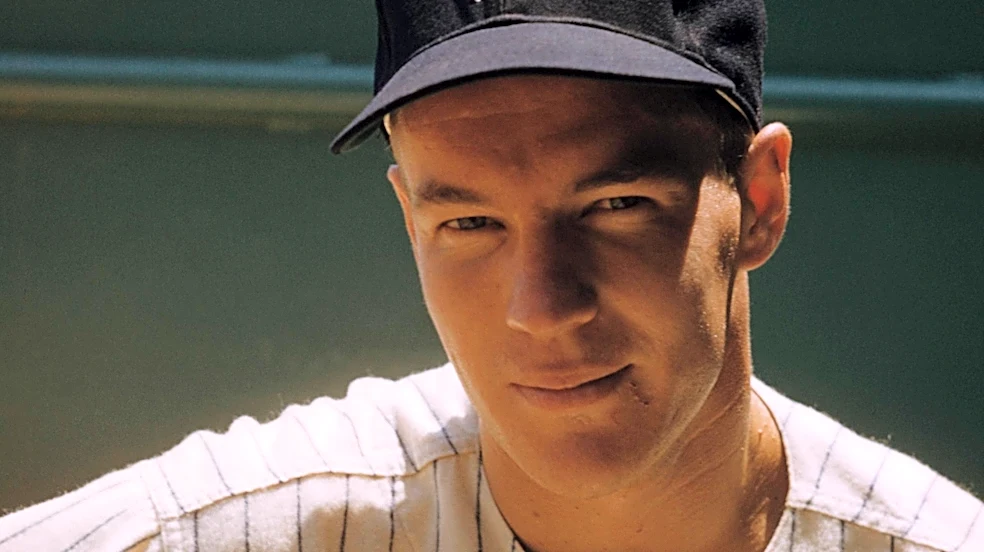



The 1950s were an incredible era for the Yankees. They won six championships in the decade, and a few more in the years immediately before and after it. You can probably name the legends from that time: Mickey Mantle, Yogi Berra, Whitey Ford. However, every team needs supporting pieces, and one of that era’s would be celebrating a birthday today.
Andrew Arthur “Andy” Carey
Born: October 18, 1931 (Oakland, CA)
Died: December 15, 2011 (Newport Beach, CA)
Yankees Tenure: 1952-60
At birth, Carey was known
as Andrew Arthur Hexem. However, his parents split when he was young and Carey didn’t have much contact with his biological father after that. His mother eventually remarried to Kenneth Carey — who had been her divorce attorney — and the future Yankee took on his stepfather’s last name.
Carey and his stepfather bonded over sports, and it became clear in his youth that the son was quite good at one. A star pitcher and third baseman in high school, Carey rebuffed several MLB teams and instead attended St. Mary’s College in the Bay Area. However, the school dropped their baseball program due to monetary issues after his freshman season, leading to Carey listening to major league offers. He eventually agreed to terms with the Yankees for $60,000 — a record for the franchise in the aftermath of the “Bonus Baby” rule being repealed.
With the Yankees, Carey had the reputation as a bit of a cocky young player. He made the team out of spring training 1952 after impressing in the Grapefruit League, but ended up spending the year going up and down from the minors. He stuck around starting in 1953 and would be a fixture for the team for years to come.
While he would spend most of his career at third base, the Yankees initially hoped to make him as flexible as possible in the field, as they looked to find a potential successor to Phil Rizzuto at shortstop. However, Carey viewed himself as a third baseman and pushed back against manager Casey Stengel. That would be a recurring them throughout Carey’s career, as he often was the subject of Stengel’s anger. Stengel heard from Carey’s minor league career that he could be motivated through anger. Carey was also winning to talk back himself, and the two would butt heads throughout the third baseman’s career.
On the field, Carey had his good years and bad. He broke out in 1954, hitting .302/.373/.423 in 122 games. He was credited with 3.6 fWAR that season, but only had two others where he was over even 1.5. However, he was still a fixture for the team in a highly successful era.
Despite being part of the team in 1953, Carey did not appear in that year’s victorious World Series. However, Carey did appear in four Fall Classics over his career, helping the Yankees win two of them: 1956 and ‘58. While he didn’t hit particularly well in either of those victorious series, he appeared in all and started six of seven games in 1956. He was also credited with making some key defensive plays to help preserve Don Larsen’s perfect game, and he later drove in a run during New York’s narrow 3-1 victory over Milwaukee in the 1957 opener.
He only recorded one hit in 1958, but it was an eighth inning single in Game 7, and he was on base for Bill Skowron’s three-run homer that basically put the series to bed.
For his career as a Yankee, Carey hit .266/.332/.397, which graded out to an exactly average 100 OPS+. However, with a new crop of youngsters coming through, Carey ended up being surpassed at third base by Clete Boyer. He only appeared in 41 games in 1959. After a handful of games the following season, the Yankees traded him to the Kansas City Athletics for Bob Cerv in May 1960.
Carey was traded a couple more times over his final years. He played for all of the A’s, White Sox, and Dodgers over the 1960-62 seasons. He also had been traded to the Phillies by the White Sox, but refused to report to Philadelphia. Eventually, Chicago worked out a deal with the Dodgers, where Carey would spend the final season of his career. He retired from baseball following the 1962 season.
Following his playing career, Carey settled back in the LA area and sold insurance (when he wasn’t scuba diving). He was married a couple times throughout his life, including one to actress Lucy Marlow. One of his children with Marlow — James — tragically died at the age of 23. Some sources cite his death as coming in a car crash, but SABR postulatesthat his name, location, and death date matches up with that of a man who was killed in a shootout with police following a robbery. Carey himself passed away in 2011 at the age of 80 due to Lewy body dementia.
Andy Carey doesn’t quite get the level of acclaim that a lot of other Yankees of that era do, but all of them played some role in one of the most impressive dynasties to ever grace the field.
See more of the “Yankees Birthday of the Day” series here.