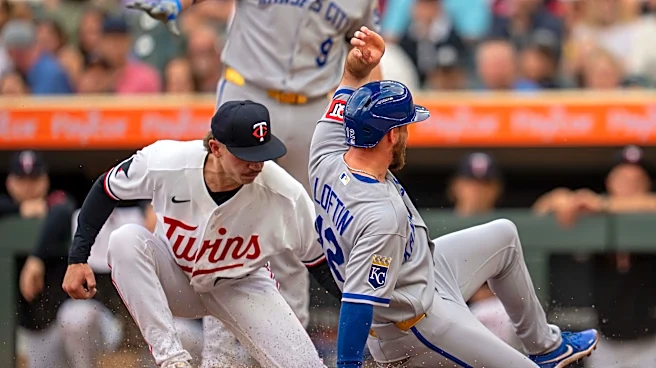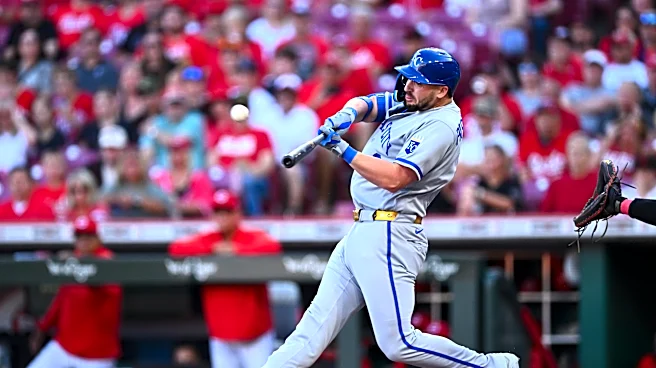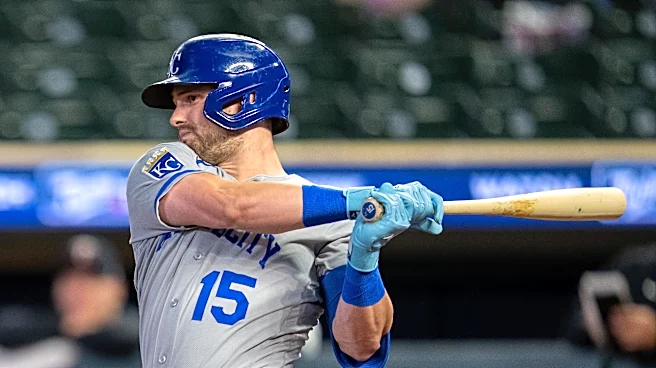






If there’s one mantra about hitting that’s become very popular lately, it’s got to be some variation of “hit the ball hard.” Statcast has made exit velocities very visible and a very big deal, and the sabermetric revolution has broadly valued power hitting in favor of contact hitting.
So you might think that the Kansas City Royals aren’t good at hitting the ball hard. After all, they’ve been among the worst offenses in the entirety of Major League Baseball for the past two years. This year, only the San
Diego Padres score fewer runs than the Royals, who score a measly 3.90 runs per game.
You would, however, be wrong. The Royals are actually really great at hitting the ball hard. One of the best ways to measure contact quality is hard-hit rate; a hard-hit ball is simply a batted ball hit harder than 95 miles per hour, and hard-hit rate is just how often a player or team hits the ball hard. And the Royals? They rank third.
Hard-hit rate matters because there is a sharp uptick in results from batted balls at or above 95 MPH. Per MLB, balls hit under 95 MPH have a batting average of .219 and a slugging percentage of .259, while balls hit over 95 MPH have an average of .524 and a slugging percentage of 1.047.
That the Royals would optimize for hard-hit balls makes sense. But the Royals aren’t seeing the results that you would expect for a team that hits the ball hard so often. Does that mean the Royals are, as Rex Hudler says, due for some hits to fall?
The answer is…no, not really. One of the best single stats for offensive performance is weighted on base average (wOBA), which assigns proper value to everything a hitter can do at the plate to one number. There’s also a stat called expected weighted on base average (xwOBA), which does the same thing except that it looks at exit velocity and launch angle as opposed to the actual on-field results for batted balls.
While there are some pretty extreme outliers one way or another–for instance, the New York Mets have a team wOBA of .288 and an xwOBA of .316, and the Tampa Bay Rays have a wOBA of .324 and an xwOBA of .309–the median difference one way or another between the two stats is .006. The Royals? Also at a .006 difference. In other words, the difference between expected performance and actual performance is not that big. In other other words, the Royals may have been a little bit unlucky, but not in such a way that you can expect Kansas City to score a bazillion runs per game moving forward.
This is important because, and I beg you to remember this, not all hard-hit outs are created equally. You can hit a ground ball in front of the plate at 200 MPH and it still isn’t going to result in a double; you can hit a fly ball straight up at 300 MPH and it isn’t going to fly out of the park. Friend of the site Shaun Newkirk pointed this out on Twitter the other week.
The picture becomes clearer when you break down the Royals’ hard-hit rate by batted-ball type:
- Ground balls: 41%, 2nd in MLB
- Line drives: 59.2%, 2nd in MLB
- Fly balls: 39.8%, 28th in MLB
First of all, its good for the Royals to be hitting hard line drives at the second-highest rate in the league! That’s nice! Unfortunately, line drives are the least common of those three batted ball events, with the league hitting liners at about a 19% clip.
And when it comes to the other two much more common batted ball events, the Royals have it backwards. You just can’t hit home runs over the fence if you’re hitting a ball on the ground; hitting them harder is generally better than hitting them weaker, but hard-hit ground balls also turn into double plays at a higher clip than weakly hit ground balls, so it’s not exactly a perfect trade-off.
Meanwhile, fly balls are how you hit home runs. I don’t need to tell you that hitting fly balls weakly results in fewer home runs hit per fly ball. But some data is nice anyways, and wouldn’t you know it, the Royals have the third-worst home run per fly ball ratio in the league.
There are other issues with this team; namely, that they continue to hit infield fly balls–automatic outs–in the top third of the league. However, it’s the distribution of hard-hit balls that’s really the issue here. It certainly seems that the Royals have some potential here. If only we could trust this organization to identify the problem and make moves to change it.