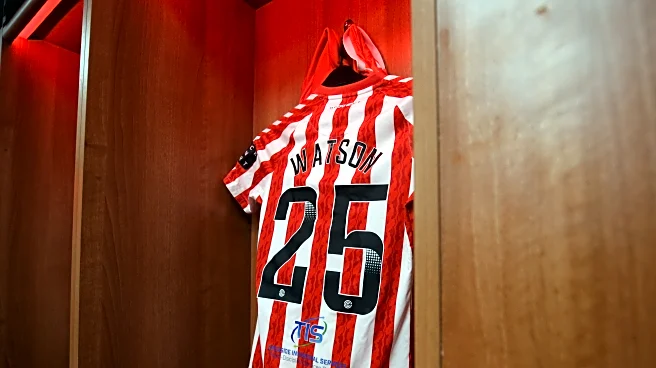




There are seasons in football that drift, seasons that never quite settle into a rhythm and seasons where the story becomes one of “what might’ve been” rather than what was.
Sunderland Women know that feeling all too well, amid a 2025/2026 campaign that promised stability yet has instead lurched between inconsistency and frustration, with performances that flicker brightly one week and fade the next.
Yet amid the turbulence, one player has refused to dim.
Katy Watson, still young enough to be spoken
about in terms of potential, has instead played with the authority of someone who already understands her importance. She’s become Sunderland’s constant; their spark, and one of their most reliable sources of attacking threat in a season where reliability has been in short supply.
To watch Watson now is to see a footballer who’s grown into her role with remarkable speed.
Her development over the past few seasons has been steady but unmistakable — the kind of upward curve that coaches dream of and opponents dread. She’s added layers to her game, sharpened her instincts, and embraced responsibility with a maturity that belies her age. Within a team still searching for its identity, Watson has forged her own.
What makes Watson’s rise particularly compelling is the way she’s adapted her game to meet the demands placed upon her. Early in her senior career, she was viewed primarily as a central striker — a “classic number nine” with a natural instinct for goal and a willingness to occupy defenders.
But as Sunderland’s tactical needs have shifted and as her own skillset has expanded, she’s shown an impressive versatility. She can lead the line but she can also operate effectively from the wing, drifting inside to combine, stretching the pitch with her runs, or driving directly at defenders.
That adaptability has become one of her definitive traits and has given Sunderland a tactical flexibility they would otherwise lack. Her ability to play multiple roles has become a key part of the team’s attacking identity and is one of the reasons she remains indispensable even as the team’s form has fluctuated.

Her hold‑up play has improved significantly — a testament to both physical development and technical refinement.
Watson no longer simply receives the ball; instead, she protects it, manipulates it, and uses her body with a maturity that seems beyond her years. There are still moments where Watson may be too eager to progress the ball herself, which has resulted in possession being conceded, but given the difficulties Sunderland have had so far this season, you can’t fault the effort and desire for her to get forward.
She can pin a centre half, roll them or lay the ball off with a deftness that keeps Sunderland’s attacks alive.
It’s a skill that often goes unnoticed outside coaching circles, but it’s become one of the pillars of the Lasses’ attacking structure. When Sunderland need a moment of calm, a way to relieve pressure, or a platform to build from, Watson provides it. Her ability to bring others into play has become a crucial part of how Sunderland progress the ball — especially in matches in which they’ve struggled to establish control.
However, what elevates her beyond a traditional target forward is the explosiveness she brings once the ball is at her feet.
Her pace isn’t merely in the form of straight‑line speed; it’s functional, purposeful, and tied to her ability to read the game. She accelerates at the right moments, bursts into channels with conviction and forces defenders into uncomfortable decisions. When Sunderland transition quickly, Watson becomes the spearhead of the counter‑attack, capable of carrying the ball over distance or releasing a teammate with a well‑weighted pass.
Her ability to spring a counter has become one of the team’s most reliable features — especially during matches where they’ve been forced to absorb pressure. It’s in these moments, when the pitch opens up, when defenders are backpedalling and when the game becomes stretched, that Watson looks most dangerous.
Her dribbling has also taken on a new dimension this season.
Watson has always been capable of beating a defender, but now she does so with a sharper sense of timing and a more varied repertoire. She can glide past opponents with a drop of the shoulder, weave out of tight spaces with quick touches or use her strength to ride challenges — as evidenced by her goal against Crystal Palace.
There’s a directness to her play that defenders find difficult to contain, but also a subtlety; an understanding of when to slow the game down, when to draw a foul and when to shift the ball onto her stronger foot.
Watching her navigate pressure has become one of the few consistent joys in a Sunderland season that’s offered too few. Her ability to weave out of tackles, to stay on her feet when others might go down and to keep the ball moving even under duress have become defining features of her game.

This is perhaps the most telling part of Watson’s 2025/2026 season.
Sunderland’s form has been mixed at best and poor at worst, with a campaign defined by inconsistency, injuries, and a struggle to impose themselves in key moments. Yet through it all, Watson has remained a standout.
She refuses to fade, continues to demand the ball and continues to make things happen even when the team’s structure falters. In a side searching for identity, she’s provided one through sheer force of performance. Her consistency has become a lifeline for Sunderland — a reminder that even in difficult seasons, individual excellence can still shine through.
There’s a resilience to her that feels innate. Young players often fluctuate, their form rising and falling with confidence, but Watson has shown a steadiness that suggests a deeper competitive drive. She plays with a seriousness, a focus, and a willingness to shoulder responsibility that’s rare for someone of her age.
It is not that she is immune to frustration — no forward is — but that she channels it productively.
Missed chances don’t linger. Physical battles don’t deter her and difficult matches don’t diminish her influence. Instead, she keeps going, keeps pressing and keeps offering herself as the outlet Sunderland need. That relentlessness has become one of her defining traits — and it’s one of the reasons she’s been able to maintain such a high level of performance even as the team around her has struggled.
Her rise over the past few seasons has been shaped by this mentality as much as by her technical growth.
Coaches within the club speak of her appetite to improve, her openness to feedback and her ability to translate training ground work into matchday execution. She’s added layers to her game each year, becoming more complete, more versatile, and more tactically aware.
That adaptability — the ability to play centrally or wide, to lead the line or drift into pockets — has made her indispensable, and it’s also made her a more unpredictable and therefore more dangerous player. Opponents can’t simply mark her out of the game — she moves too intelligently, too fluidly, too purposefully.
When deployed as a striker, she becomes a focal point who can occupy defenders, link play, and threaten in behind. Conversely, when used on the wing, she becomes a different kind of problem: a direct runner who can isolate full backs, cut inside to shoot, or combine in tight spaces.
Her movement off the ball has become increasingly intelligent, with diagonal runs that stretch defences and create openings for teammates.
She also reads the game with a clarity that allows her to exploit weaknesses, whether that means pulling wide to drag a centre‑back out of position or dropping deep to overload midfield. Her understanding of space has become one of her greatest strengths and is one of the reasons she’s been able to influence matches even when Sunderland have struggled to control possession.

What makes Watson so intriguing is that she’s still far from the finished product.
There are refinements to come — sharper decision‑making in the final third, more consistency in her finishing, greater composure under pressure — but this is natural for a young forward. The foundation she’s built is strong, and the rate of her development suggests she will continue to climb.
When watching her, there’s a sense that she’s only just beginning to understand how good she can be. Her potential feels expansive, her trajectory steep and her future bright. She’s already a standout and what she becomes next is worth watching closely.
For Sunderland, that potential is both a gift and a challenge.
In the short term, Watson is central to our ambitions. She’s the player who can turn a match, lift the team and provide the spark that’s often been missing. But in the long term, her trajectory may well outpace the club’s current standing.
That isn’t a criticism of Sunderland but a reflection of Watson’s talent. Players with her blend of physicality, intelligence, and technical ability tend to attract attention, and if she continues on this path, opportunities will come.
The question for Sunderland is whether they can build quickly enough to match her ambitions, but for now, she remains Sunderland’s beating heart in attack and her performances have provided a sense of continuity in a season defined by uncertainty.
She’s become the player supporters look to when the team needs inspiration, the one who can conjure something from nothing and the one who plays with a fearlessness that cuts through the noise. Even during matches where Sunderland have struggled, Watson has found ways to impose herself, to create danger and to remind everyone watching that she’s operating on a different level.
There’s a single moment that encapsulates her season — not a goal, but a sequence of play as Sunderland were under pressure, pinned back and struggling to escape their own half.
The ball was played into Watson with her back to goal and a defender tight to her. She cushioned the pass, rolled her marker with a sharp turn, and surged forward into space.
Two more defenders converged but she weaved between them with quick touches, driving the team up the pitch. By the time she released the ball to a teammate, Sunderland had gone from defending their box to attacking the opposition’s. It was a passage of play that changed the momentum of the match and it was entirely her doing.
Moments like that are why Watson stands out.
They reveal not just technical ability but personality, the willingness to take responsibility, to change the flow of a game and to impose herself when others hesitate. They’re the moments that separate good players from special ones; the moments that define seasons — even difficult ones.
Sunderland’s campaign may not be one that lives long in the memory for its collective achievements, but it’ll be remembered for Watson’s emergence as a genuine attacking force.
She’s been the constant in a campaign of variables, the bright spark in a year of shadows and the player who’s given supporters something to believe in. And as she continues to grow, continues to refine her game and push her own boundaries, the sense of possibility around her only expands.
There’s a high ceiling here — a very high one — and Watson is climbing towards it with purpose. Sunderland may be navigating a difficult period but in Watson, they have a player who represents not just the present but the future; not just hope but substance.
She is already a standout, and what she becomes next is a story that’s still being written.