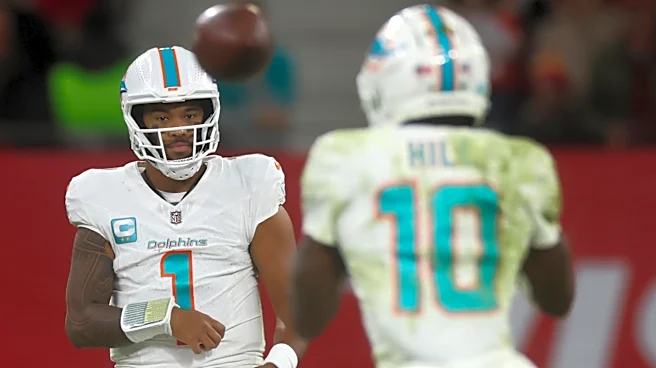






It’s well documented that a large portion of the Miami Dolphins’ 2026 salary cap is going toward multiple players who are no longer on the team. Tua Tagovailoa is costing more than $50 million in actual cash and will count $55.4 million on the cap. Tyreek Hill ($28 million), Jaylen Waddle ($23 million), Jalen Ramsey ($21 million), Minkah Fitzpatrick ($13 million), Bradley Chubb ($11 million), and Terron Armstrong (11 million) all have cap hits north of $10 million and aren’t on the roster.
Because
of these massive cap hits for players off the roster, the Dolphins have needed to do some gymnastics to get under the salary cap and create space in order to sign injury replacements during the season. According to Jason Fitzgerald at Over the Cap, the Miami Dolphins may be the first team in NFL history to restructure every single contract they were able to restructure.
“The Dolphins did four minor restructures to save about $2.516 million in cap room this year,” said Fitzgerald. “They now have $9 million in cap room. I believe they have no players remaining on the roster to save any cap room as those were the only players left with any savings. The restructures were as low as $340,000.”
Typically, restructures involve multi-million-dollar contracts.
The reason some contracts can’t be restructured is that they are already making the NFL league minimum for their years of service.
How does an NFL contract restructure work?
An NFL contract restructure works because the Collective Bargaining Agreement allows you to spread out signing bonuses up to five years. The team converts as much of the player’s base salary as possible to signing bonus. Now only 20% of that cap hit will count in the current year. Here’s an example using round numbers.
Player X is scheduled to make $6 million in 2026. The team would pay him $5 million up front leaving him with a minimum salary of $1 million. Then that $5 million is spread out evenly over five years on the cap at $1 million per season. Instead of the player counting $6 million on the cap, they would only count $2 million with $4 million still to be accounted for in future years.
The bill always comes due — every cent that is paid is eventually accounted for — but as the salary cap goes up every year (except during COVID), you’re planning on spending that increase before it happens. When a player leave the team via trade, retirement, or release, the remaining dead cap accelerates. That’s what happened with most of the players we mentioned in the first paragraph of the article.
Think of it as maxing out the credit card but without the compounding interest. You’ve pushed as much current and past spending into the future as you possibly could.
Why would the Dolphins restructure so many contracts now?
Like every NFL team, the Dolphins need some wiggle room during the season. You can’t restructure the contracts for as much space during the season once salary has started to be paid. If an injury pops up and you need a million bucks to sign a replacement, you wouldn’t be able to create that space.
Most teams like to have $15 million in reserve heading into the season. Miami maxed out everything to get to $9 million. That way they can add a few players down the line.
Eleven NFL teams have less cap space than Miami, but this gives the Dolphins the chance to potentially claim some players during the season that are cast off from their existing teams with their existing contracts as they build for the future.