





DISCLOSURE NOTICE: Reed Sheppard is the author’s adopted nephew.*
Rockets fans got to see a lot more of Reed Sheppard this season. Which is nice for a player picked third in the NBA draft. Some people, perhaps even the coach of the Houston Rockets, might view Reed Sheppard’s sophomore NBA season as a disappointment. I do not.
Reed Sheppard was selected largely as a shooting prospect at point guard, and since he mostly acted as a shooter for the Rockets, that’s what I’m going to talk about most. I believed
Reed amply lived up to that billing in his age 21 season. When he was allowed to be a point guard, he showed that he could be one. His defense improved considerably from his rookie season, though as the weakest defender in a typical group of Rockets players, or at least the shortest, he’ll be the target of competent offense most of the time. Many, many, other teams have managed to deal with this problem with aplomb. You might have noticed the fairly recent success of the Golden State Warriors, for example.
Moreover, when Sheppard started in the regular season, the Rockets won at a great rate. While some metrics indicated lineups with Reed in them didn’t do well, reality, when he started, showed a different picture. I’m not against metrics in any fashion, in fact there are several below. They are one tool of analysis and deeper understanding. I’ve been part of The Revolution, from almost the beginning. My “Baseball Prospectus” user number is three digits, if you want proof of my commitment to The Great Cause.
That said, when the actual territory (games won, points actually scored) doesn’t match the map (descriptive metrics, rate measures), it’s useful to ask if the map is correct, and try to determine what accounts for the discrepancy. Dismissing anything that exists, but doesn’t fit the map, as merely noise or irrelevant, when it is, in reality, the entire measure of success or failure in both individual games and a season, in the NBA, is a flawed approach in my view. Why did we see a very convincing number of wins with Reed starting, while lineup data might suggest something else? It’s an important question for the Rockets, but that’s a discussion for another day.
Let’s look at what Reed did individually, as a player, instead, as that’s what these recaps are for anyway.
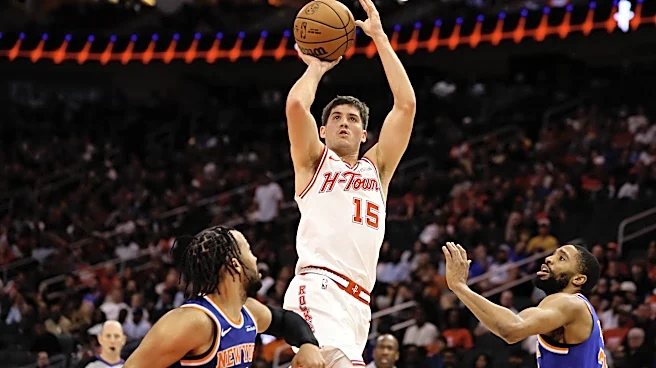
When we talk about a shooter these days in the NBA, we mean a three point shooter, with rare exception. Reed Sheppard was a very good, almost great, three point shooter in his first season getting significant minutes. To my eyes, the shot is so pretty, so fundamentally perfect, that it surprises me when it doesn’t go in. This can lead to a kind of unwarranted disappointment, or bias, when in fact results were good. (I won’t cover the playoffs, but Reed’s first outing was a great performance. One series is, in fact, very small sample. LeBron James has played more playoff minutes than Reed, Amen, Tari and Jabari have played minutes in the NBA. LeBron’s playoff performance is pretty solidly established, I’d say.)
What makes for a great shooter? First of all a great shooter has to make the shot a great percentage, second of all, that shooter must take enough shots to matter. An 80% three point shooter would be incredible, unless you learned that 80% amounted to 4-5 over 82 games played, and it all happened in one game.
For the season Reed shot 39% from three point range. I think it could have been better, and I’ll show you why I think so below.
Let’s put Reed’s 39% in context. That’s 87th percentile in the NBA. That’s good for any player, only thirteen percent of the NBA shot it better, but remember, there could be some smaller samples contained there. That’s why we’ll also look at attempts. Reed took 7 three pointers per game in his 26 average minutes (so it’s going up, on average, every 3.7 minutes of play.) That number ranks in the 94 percentile of the NBA. So only 6 percent of NBA players attempted more threes per game, and I’d venture a guess that most of them averaged more than 26 minutes per game.
So not only was Reed a prolific shooter, he was almost a top 10% shooter. That has the makings of an elite NBA shooter at peak age, in my estimation, as players usually improve shooting over their careers.
I also think Reed’s overall percentage could have been better this season. Why? The Janury/Feb Slump for the Rockets.
Here’s Reed’s 3pt shooting by month:
OCT: 36%, NOV: 48% DEC: 39% JAN: 33% FEB: 36% MAR: 42% APR: 40%
By far his worst shooting months corresponded with significantly higher volume, which might suggest he was taking more ill advised shots in those months. All the Rockets main three point shooters also shot it more in January, and made it less. (Except Tari, who was just weird.)
Here’s Jabari
OCT: 37%, NOV: 40% DEC: 38% JAN: 30% FEB:45% MAR: 33% APR: 39%
Durant:
OCT: 37%, NOV: 39% DEC: 49% JAN: 37% FEB: 38% MAR: 45% APR: 44%
Eason:
OCT: 53%, NOV: 50% DEC: 42% JAN:47% FEB: 32% MAR: 20% APR: 29%
What we see overall is a real swoon in January for the only volume three point shooters of the Rockets (not Tari, his shooting season was far stranger). Since it’s general, I think it was related to a very difficult stretch of schedule where the Rockets hardly played at home. At any rate, it did seem to affect every Rockets 3pt shooter who played significant minutes.
Reed Actual: 39% No January: 43%
Jabari Actual: 36% No January: 38% (January was by far the highest 3pt volume month for Jabari.)
Durant Actual: 41% No January: 57% (January was also by far the highest 3pa month for Durant, with 27% of his total 3pa occurring in that month.)
Tari: Shrug Emoji
Looking at overall offensive effectiveness, some might think Reed’s true shooting wasn’t very good. It was 60th percentile, and overall lower relative to the league by 1.4%. That’s far from bad from a developing and hitherto low minutes player as I see it.
What about??? What about defense, right?
Well, based on impact metrics Reed was very slightly positive on defense +.2 pts (and very slightly negative on offense, by -.2pts).
As much as I’d like to write a dissertation on Reed, I’ve well exceeded the normal length for this sort of thing, so I’ll leave it there. In my opinion Reed had a very good season, especially considering he nearly doubled his minutes played, and had no fixed role in the Rockets rotation. Some will say that doesn’t, or shouldn’t matter, but if you find a single NBA player (ever) who said that an inconsistent role doesn’t affect them, let me know.
I think Reed has a great future. Perhaps on another team Sheppard would already be talked about as future shooting star of the NBA.
*Reed Sheppard is not in fact the author’s nephew, adopted or otherwise.