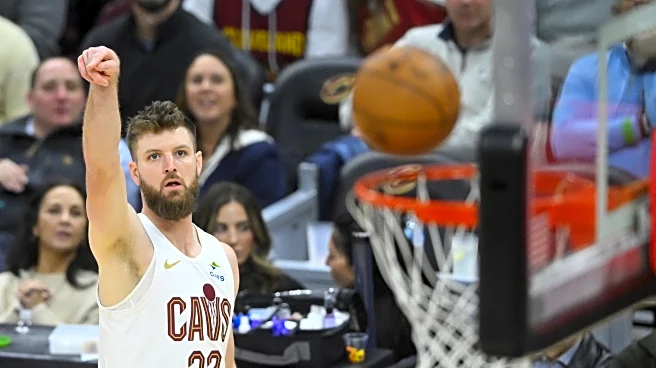

CLEVELAND — Last December, Giannis Antetokounmpo faced the Cleveland Cavaliers three days after securing an NBA Cup title by steamrolling the eventual champion Oklahoma City Thunder. He put up 26 points
by continually slicing through one of the best defenses in recent memory like a knife through hot butter.
That success didn’t carry over to later in the week when he faced the Cavs.
“It’s definitely harder,” Antetokounmpo said when asked afterward about the difference between Oklahoma City’s defense and Cleveland’s. “I think they show, they close gaps better, a better rebounding team. That’s pretty much it. It’s harder. I know OKC was a great defensive team, but we were bigger than them. … Here’s a team that can match up against us.”
The Cavs team that Antetokounmpo was referring to featured a starting front court of Dean Wade, Evan Mobley, and Jarrett Allen. The same starting front court that has just fueled the Cavs to consecutive impressive wins over current Western Conference playoff teams.
Defense has been an issue for the Cavs this season. They’re 12th in defensive rating after not being outside the top eight since drafting Mobley five seasons ago. However, that hasn’t been an issue when the jumbo front court is playing.
The Cavs have registered a 103 defensive rating (98th percentile) when Wade, Mobley, and Allen share the floor. It isn’t a large sample size. The trio has only played 46 minutes together so far, but this has been a recurring trend over the past five years, as shown in the table below. Last year was the only time the Cavs have been outside the 98th percentile in defensive rating when their jumbo front court plays together.
Mobley and Allen deserve the majority of the credit for why that trio has been so good together over the last five seasons.
“It’s really easy when you play with those two bigs,” Wade told Fear the Sword after Wednesday’s win over the Phoenix Suns. “They always have your back, and they’re always communicating. … Evan and J.A. can both guard one through five. They move their feet so well. So as long as we keep a body in front of a body, especially with those two, I feel like it’s almost impossible to get by those two. All the credit has to go to those two.”
While the grouping doesn’t work without Cleveland’s two centers, Wade’s contributions shouldn’t be diminished. He has continually proven that he can defend the other team’s best perimeter player, even if they’re guards. His size and lateral quickness make that possible. And when he has the bigs behind him, Wade has the freedom to be aggressive at the point of attack.
“Dean’s a great on-ball defender,” Mobley said. “He has a lot of size, can guard guards, and then with me and J.A. in there, it’s hard to score in the paint.”
Wade drew the primary assignment on Devin Booker on Wednesday and did a great job. According to the NBA’s matchup data, Booker was held to just two points on 1-4 shooting when Wade was guarding him.
This stop on Booker is a good example of why putting Wade on a dynamic guard works so well, even though Allen was the only other big on the floor in this clip. Phoenix tried to continually test Wade’s foot speed by putting him in the pick-and-roll. Allen’s defense in drop coverage, and Wade’s ability to hedge and take away the outside shot, while also recovering back to the ball handler, made this an ineffective strategy.
Support us and Let ‘Em Know with Homage!

Anything bought from the links helps support Fear the Sword. You can also shop all of Homage’s Cavs gear HERE. The link to the 2016 championship shirt HERE.
Defending guards wasn’t natural for Wade. He admits that he’s gotten more comfortable doing so in recent years and points to the middle of last season as a turning point for him. Wade knows that he can be more aggressive, pressuring the ball, considering the help he has on the backside.
Wade playing the three also gives the Cavs a rebounding advantage that they have lacked. That’s what head coach Kenny Atkinson pointed to when asked what he’s liked about the grouping.
The Cavs have consistently been a better rebounding team with Wade on the floor. He has the discipline and strength to be good at boxing his opponents out. When he’s playing small forward, that role changes.
“A lot of threes don’t crash that hard,” Wade said. “So on the defensive end, I would just peek back, and if they weren’t crashing, I would go and just try to sandwich Mark Williams. And if I can’t get to him fast enough, then I’m kind of free roaming and just trying to get loose balls that bounce high.
“But when you’re the four or five, your only goal is to box out. A lot of times, when you do box out, neither one of you is going to get [the rebound]. And that’s the biggest thing. As long as he doesn’t get it, it’s fine. But when I’m the three, like tonight, I’m just crashing, trying to get loose ones, trying to squeeze rebounds, trying to box out bigs, keep them out of the play. The mentality is going to be a little different knowing who you’re guarding.”
Better rebounding, combined with being able to disrupt passing lanes with the team’s overall length, has led to better transition offense. The Cavs have added six points per 100 possessions in transition (97th percentile) when Wade, Mobley, and Allen share the floor.
Even though Wade isn’t necessarily the most versatile offensive player, his ability to be an off-ball shooter and cutter is exactly what’s needed when he’s playing alongside the core four of Darius Garland, Donovan Mitchell, Mobley, and Allen.
“My main job is defense, and having everyone’s back,” Wade said when asked about playing with the starters, “and then on offense, just space [the floor]. It’s really up to those guys how I play on offense, which is perfect. I think that what they like about me is that I just space the floor and give those guys room to work. I don’t need [shots]. One game I might get two shots, next game I might get 15. That’s fine with me. It doesn’t affect the way I play. As hard as I play, I’ll play that no matter what. … When you got such dynamic basketball players from Evan, J.A., to D.G., and Don — people that can really just make it happen in any aspect of the game.”
This formula has worked for the Cavs in the halfcourt. The core four with Wade have registered a 106.7 half-court offensive rating (95th percentile) and had a 110.4 half-court offensive rating (99th percentile) last season.
It turns out that just providing additional space and room to operate is exactly what the two most dynamic guards and bigs need on offense.
“My job is to just stay spaced,” Wade said. “If you’ve got to cut, cut. And if they throw it to you, shoot it. I mean, it’s really easy. … Tonight I only had five points, but the ball only came a couple times, and that’s perfectly fine. We won the game, and everyone was playing really well. My main focus is defense, and then offense is definitely second.”
Figuring out a suitable starting small forward to fit with the team’s core four has been a continual challenge. Max Strus, De’Andre Hunter, Jaylon Tyson, Isaac Okoro, and even Sam Merrill have all had chances to claim the role over the last several seasons.
Yet, the one player who makes the most sense was there the whole time in Wade.
He isn’t the most exciting player and doesn’t have the flashiest skillset. Although those aren’t things the team needs. They need someone who can space the floor and find the open man offensively while amplifying what the starting front court does best defensively. Wade does all of those things better than anyone else on the roster.
“He’s invaluable,” Mitchell said of Wade a few weeks ago. “He’s consistent every day with what he does, even when the shots necessarily aren’t falling for him. … Being able to be versatile is his specialty, and he brings that for us every night.”