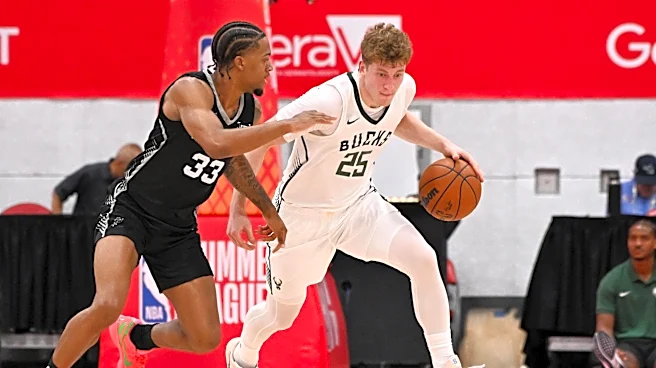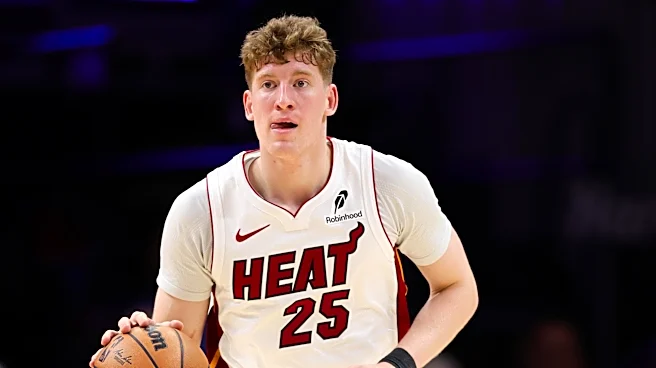




Make a short list of what matters for success in the NBA. Go on, do it. What did you muster? Chances are, you came up with some combination of shot creation, shooting, size, versatility, and defence. What if I told you that point guard Kasparas Jakučionis, acquired as part of the trade that sent Giannis to the Miami Heat, has them all?
Rise and fall
Born in Vilnius, Lithuania’s capital and largest city, Jakučionis made his professional debut for FC Barcelona as a 17-year-old, where he played until he moved to Illinois
to play under coach Brad Underwood. It wouldn’t last long. Jakučionis excelled as a freshman, putting up 15.0 PPG, 5.7 RPG, and 4.7 APG in 31.8 MPG across 33 contests, earning a place on the Big Ten All-Freshman Team and receiving second-team All-Big Ten honours.
In March Madness, Jakučionis posted a near triple-double in the Fighting Illini’s first-round defeat of the 11th-seeded Xavier Musketeers, going for 16 points, nine rebounds, and 10 assists (albeit on 3/11 shooting and with six turnovers). However, in their second round 84-75 loss to the third-seeded Kentucky Wildcats, Jakučionis struggled, posting six more turnovers to go along with 13 points (5/13 FGA), five rebounds, and two assists.
Still, Jakučionis’ prospects were high—The Athletic’s Sam Vecenie had him seventh in his pre-draft rankings, ESPN’s Jonathon Givony ranked him 10th, and No Ceilings placed him 10th—and so he entered the 2025 NBA draft full of hope, only to slide all the way down to the Miami Heat with the 20th overall selection.
Not so raw rookie
Jakučionis’ rookie season was delayed before it even started. A lingering groin injury kept him out of early-season action and then he had to bide his time and earn the trust of Heat coach Erik Spoelstra before seeing meaningful minutes. It took until Game 27 for that to happen, and even then Jakučionis logged less than eight minutes of playing time, hitting his only shot attempt—a three-pointer—and adding an assist (and a turnover) in a 106-95 win over the Brooklyn Nets. The very next night, however, he would start, logging 38 minutes in a 129-116 loss to the Boston Celtics. Despite the loss, Jakučionis broke out: 17 points, six rebounds, and four assists, knocking down 5/8 shots from deep. It would prove a harbinger of things to come.
Jakučionis played in 50 of the Heat’s final 54 games, finishing the season with averages of 6.2 PPG, 2.6 RPG, and 2.6 APG in 17.8 MPG, shooting .429/.423/.879. Shooting splits aside, the numbers don’t jump off the page—that will happen when you’re largely relegated to an off-ball spacer and have the third-lowest usage on the entire roster—but Jakučionis certainly had his moments. In February, he dropped a career-high nine assists in a blowout win against the Chicago Bulls. A week later, he had back-to-back 20-point outings, shooting a blistering 12/16 from three. He also finished the campaign with the fourth-best net plus/minus for Heat players who played regular minutes. So, while Jakučionis might’ve slipped in the draft and gone under the radar in his rookie season, there was certainly something there. Thankfully for Bucks fans, Jon Horst noticed.
Point of the future
While a Giannis trade might have lingered for years, the Miami Heat iteration of the saga went back and forth for months. And with good reason. One, you don’t trade your franchise’s best-ever player without exhausting every possible avenue. Two, you don’t pull the trigger until you get your guy. For Horst and the Bucks, this was Jakučionis, whom the Heat reportedly withheld until the final moments.
Positionally, make no mistake, Jakučionis is a point guard. Despite his low usage and role as an off-ball spacer with the Heat, Jakučionis is at his best with the ball in his hands. According to Cleaning the Glass (CTG), his 1.21 assist to usage ratio (measuring how often players get an assist given how much they had the ball) places him on the 85th percentile—tying Kevin Porter Jr. (1.21) and ranking better than the Bucks’ other primary creators last year, Ryan Rollins (1.00) and Giannis (0.93). More specifically, he’s dynamic in the pick and roll, able to hit rollers with either hand, and uses his height—he’s a legitimate 6’5”—to see over smaller defenders and create passing angles that others can’t.
However, like any great passer, Jakučionis can be overly ambitious at times, leading to inconsistent results and the accumulation of turnovers. This has quickly become apparent in Summer League play, where he’s struggled under ball pressure. It also reared its head in the two most recent games of Lithuania’s FIBA World Cup European Qualifiers, where he got off to a blazing start, dishing out eight assists to just two turnovers against Great Britain, but then struggled against Italy, coughing up six turnovers while being limited to just one assist.
Of course, as his rookie season proved, Jakučionis’ impact isn’t limited to his passing. In a league that puts a premium on spacing, Jakučionis’ value as a shooter cannot be overstated. Last year, his 60.5% effective field goal percentage placed him in the 96th percentile for combo guards (per CTG), higher than all-timers Shai Gilgeous-Alexander (59.7%) and Stephen Curry (58.6%). Truthfully, this percentage is likely inflated due to his off-ball role with the Heat, where he was assisted on 78% of all of his made shots and threes made up 60% of his shot diet. He also has some work to do at the rim (57%, 31st percentile) and in the mid-range (29%, 6th percentile), but with only 47 and 24 shots from these locations it would be unwise to put too much stock in the numbers. In all, Jakučionis’ ability to play off the ball is a testament to his offensive versatility, making him even more valuable as a potential long-term piece next to Ryan Rollins and Brayden Burries, who can both similarly create and space. He’s also a knockdown free throw shooter, hitting 85% of his free throws at Illinois and 88% of them for the Heat, so he’s a guy you trust with the ball in his hands late in games.
On the other side of the ball, Jakučionis has ideal size for a modern backcourt player. At 6’5” and 200 lbs, he has the length and bulk to switch defensively and can also help out on the boards, where his 7.6% total rebounding percentage is similar to Milwaukee’s strong rebounding guards in Porter (8.9%) and Rollins (8.0%). Last season, he was particularly handy as an offensive rebounder, with an offensive rebounding percentage of 4.7%, better than Bucks bigs Kyle Kuzma (3.6%), Pete Nance (4.2%), and Myles Turner (4.5%), per Basketball-Reference. This isn’t new, either, with NBADraft.net’s Isaiah Maldonado stating that Jakučionis “makes good use of his frame to snag boards and extend plays” in his pre-draft scouting report.
All things considered, it shouldn’t come as a surprise that Horst was adamant about receiving Jakučionis as part of the Giannis trade. With premier playmaking, elite shooting, positional versatility and size, and the ability to help out on defence, Jakučionis is an ideal prospect for a rebuilding Milwaukee Bucks team looking to find its identity. And if he puts it all together, he just might be the Bucks’ long-term answer at the point.
Now it’s time to get to work.