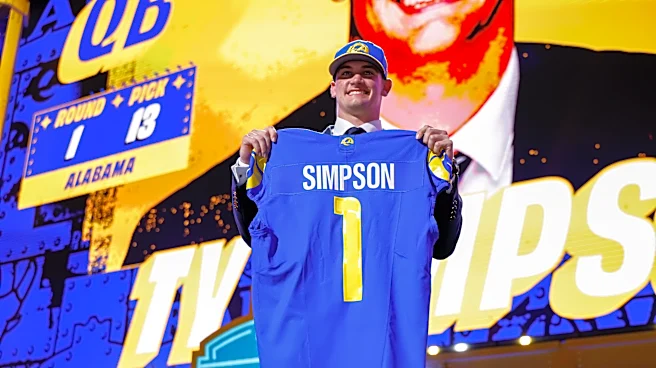







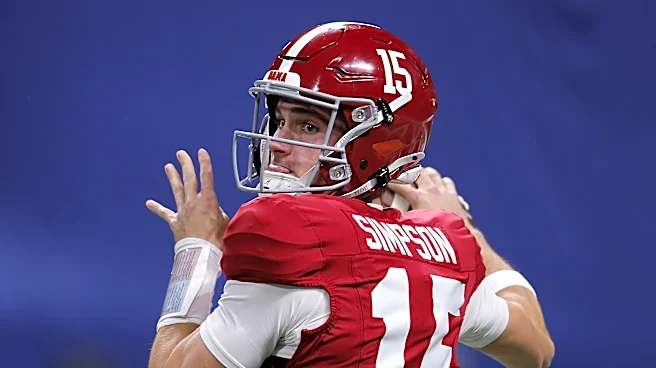
Believe it or not, Les Snead has been the General Manager or the Los Angeles Rams for 15 years. The future of Les Snead with the Los Angeles Rams may ultimately come down to one defining gamble: the decision to invest in Ty Simpson as the franchise’s quarterback of the future. For a general manager known for bold, win-now decisions, this pick represents a rare moment of long-term vision—and one that will either extend his legacy as the organization’s aggressive GM or accelerate his exit.
Two critical
factors will determine whether this move “makes” or “breaks” Snead’s future with the Rams: 1) what happens during the 2026 season with Matthew Stafford still under center, 2) and whether Simpson proves capable of sustaining success once Stafford steps away.
The 2026 Super Bowl Factor
Snead’s reputation was cemented when the Rams captured Super Bowl LVI, validating his aggressive roster-building philosophy. However, the pressure to win again hasn’t disappeared—it has intensified. The 2026 season could serve as a defining checkpoint.
If the Rams win the Super Bowl in 2026 while Simpson develops patiently behind Stafford, Snead will have executed a perfect balancing act. He would prove that the organization can contend in the present while preparing for the future—a rare feat in today’s NFL. It would reinforce the idea that Snead is not just a risk-taker, but a forward-thinking architect capable of managing multiple timelines at once.
In that scenario, Simpson’s lack of immediate contribution wouldn’t matter. In fact, it would be seen as a strength. Developing behind a veteran like Stafford, within Sean McVay’s system, would position Simpson to succeed without being rushed. Snead would gain credibility for resisting the urge to force a transition too early.
But if the Rams fall short of a Super Bowl in 2026, the narrative shifts quickly.
Failing to capitalize on the remaining window with Stafford raises serious questions. Why draft a developmental quarterback instead of adding immediate-impact talent? Why prioritize the future when the present still had championship potential? In a results-driven league, anything short of a title could be viewed as a missed opportunity—especially given the Rams’ history of pushing all their chips to the center of the table.
If that happens, Simpson’s presence becomes less of a strategic asset and more of a symbol of misplaced priorities.
Life After Stafford Factor
While 2026 will shape perception, the true verdict on Snead’s decision will come after Stafford’s eventual retirement. This is where Simpson must deliver.
If Simpson develops into a capable—or better yet, high-level—starter who keeps the Rams in playoff contention, Snead will once again look like a visionary. Successfully transitioning from a Super Bowl-winning veteran quarterback to a homegrown successor is one of the most difficult feats in the NFL. Pulling it off would validate the Simpson pick as a cornerstone decision.
It would also signal a philosophical evolution. For years, Snead leaned heavily on trades and veteran acquisitions. Hitting on Simpson would demonstrate that he can also build sustainably through the draft, giving the Rams long-term stability at the game’s most important position.
However, the downside scenario is just as impactful.
If Simpson struggles to adjust to the speed, complexity, and physical demands of the NFL, the consequences could be severe. Quarterback misses don’t just set a team back—they can derail entire organizational timelines. The Rams would find themselves searching once again for an answer at quarterback, potentially wasting prime years of their core roster and undoing any momentum built during the Stafford era.
In that case, criticism of Snead would intensify. Questions about his drafting track record, long-term planning, and overall vision would dominate the conversation. After years of trading away premium picks, the expectation is clear: when you finally invest in a quarterback, you must get it right.