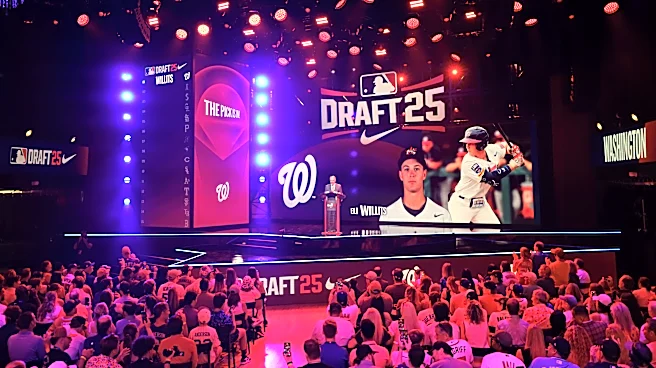



Earlier this week, the crew over at OverSlot, a website dedicated to covering the MLB Draft and prospects, released an MLB mock draft simulator, something that the draft community has been sorely lacking on the baseball scene. Not only does the simulator allow you to test out different hypothetical scenarios with any team of your choosing, but it also has the many nuances of the MLB Draft built into it, such as signing bonuses and working within your team’s constrained budget.
I’ve been messing around
with the simulator the last few days, and wanted to show off some different ways the draft in July could play out for the Nats, depending on the front office’s strategy. Jim Callis of MLB Pipeline mentioned in an 11-pick mock draft the other day that he thinks the Nationals will go with a college hitter with the 11th overall pick, something I will keep in mind while doing these mocks. I recommend any draft fans also give the free simulator a shot, to help them better understand this years draft class and the kinds of strategies the Nationals could deploy.
Scenario 1: College Pitcher/Slot Value

In my first mock, I get a gift from the simulator, snagging my favorite pitcher and a top 5 talent in the draft in Jackson Flora with the 11th pick, at slot value. If there is any pitcher in this draft class who could speedrun the minor leagues and make an impact in the big leagues in the next year or two, it’s Flora, who features multiple plus offerings and great strike-throwing ability (and as of me writing this, gave up his first run in over a MONTH).
I went into my second pick primarily looking for a college bat with a strong track record of success, but loved the value of getting right-handed pitcher Cade Townsend out of Ole Miss for slot value. Townsend missed a few starts during March with a shoulder injury, but has been electric in the 7 starts he has made for the Rebels in 2026, posting a 1.82 ERA, 2.22 FIP, and 32.5 K-BB%.
I splurged into my bonus pool a little with the Nats’ third-round pick, grabbing Virginia prep shortstop Will Yow, whose excellent speed and defense offer him a higher floor than most prep bats, coming in as my 32nd-ranked prospect in the entire draft currently.
The focus with my remaining top 10 picks was college players who I could save bonus pool money on, but also offered some intriguing upside, especially from the pitchers. Overall, I would be thrilled with this draft path for the Nats in July, as they get to add 2 extremely polished right-handed pitchers to their farm system, a toolsy prep shortstop, and a cluster of college arms and bats.
Scenario 2: College Hitter/Slightly Underslot
I went into this mock draft looking for my favorite combination of upside and savings from a college bat with my first round pick. There were multiple solid choices, but my favorite of the bunch ended up being Sawyer Strosnider, a left-handed hitting outfielder out of TCU. With the 700k underslot savings from the Strosnider pick, I had some wiggle room to buy down some talent with my later selections.
I was willing to use up some of my savings on the second round pick, but ended up not needing to, selecting Tennessee prep catcher Will Brick, my 17th-ranked prospect in the entire draft, as I am a huge believer in his ability to hit and stick behind the dish defensively.
I dug into those savings with the Nats’ third round selection, splurging 1.1 million dollars overslot for right-handed prep arm Joseph Contreras, one of the more famous names in this year’s class after a gutsy performance against Team USA in the World Baseball Classic, during which he got Aaron Judge to ground into a double play. Contreras reminds me of current Nats pitching prospect Miguel Sime Jr. as a prospect, a high school flamethrower who has trouble throwing strikes, but could be a huge hit if developed correctly in pro ball.
The focus of my remaining top 10 round selections was primarily on savings, as I spent a little more than I had saved on Conteras in the 3rd round, but had some fun highlights, such as Eli Willits’ older brother Jaxon Willits, a shortstop at Oklahoma, in the 4th round, and a lefty with big strikeout stuff in the 5th round in Cam Johnson, also out of Oklahoma.
Scenario 3: College Hitter/Heavily Underslot

I went into this final mock with one goal in mind: to mimic Paul Toboni and the Nationals front office to the best of my abilities. That meant my focus, at least with my first round pick, would be on athletic position players who are located up the middle defensive positions, such as catcher, shortstop, and center field, with room to adjust for best player available, depending on how the draft board shook out. In this mock, I got a prospect who checked just about every box in shortstop Tyler Bell, a draft-eligible sophomore at Kentucky with excellent defense and plus power potential. Snagging Bell 11th overall saved me 1.5 million dollars underslot, meaning I could get very creative with my money the rest of the draft.
I thought about different strategies for how to deploy my savings in the next few rounds, but decided I wanted to use them all in one place to snag California prep left-handed pitcher Logan Schmidt with the 42nd overall pick, great value as he is my 16th-ranked prospect in the class currently. Schmidt is just a grade below the top prep arms, Gio Rojas and Carson Bolemon, in this year’s draft for me, but could end up being the best pitcher in this draft class with proper development, as he’s up to 97 from the left side with elite extension and 2 blossoming breaking balls.
I needed to make back about 600k in savings with my remaining draft picks, but I was able to snag a college pitcher with great stuff in the 3rd round in Owen Kramkowski, who has great control and solid stuff, but has struggled to turn it into consistent results so far at Arizona. I also was able to snag a college shortstop having a breakout junior season in Dee Kennedy out of Kansas State in the 4th round (who I played against in high school, where he was also very good).
Overall, I think all 3 of these mock drafts would be successful drafts for the Nationals in real life, especially one like the first one, where they can get a top player in the draft at slot value. Toboni and the Red Sox staff tended to favor certain kinds of prospects during their drafts in the past, but showed a willingness to go off that script when they felt it would benefit them, meaning all bets are off as to what will happen come this July.