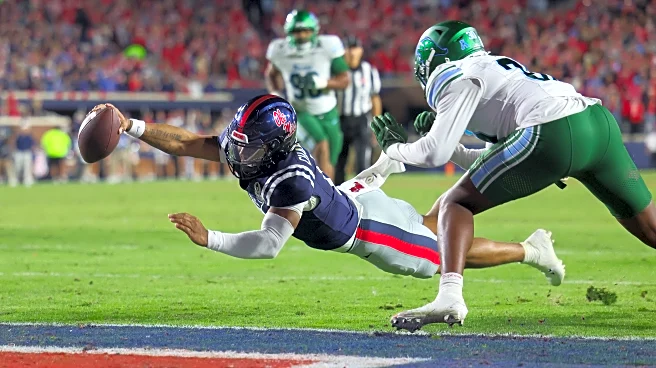




A historic Tulane season resulted in a conference championship and a seat in the College Football Playoff — just the second team in American Conference history to achieve that combo. However, upon reaching the CFP stage, the moment was quite anticlimactic as Tulane quickly experienced a double-digit deficit and didn’t notch its lone touchdown until the final four minutes of action.
Ole Miss handled the Green Wave in a 41-10 thrashing in Oxford, MS, and it wasn’t the first time such a result transpired.
Exactly three months prior on Sept. 20, Ole Miss produced a 45-10 victory over Tulane, proving 30+ points of separation between the teams on two occasions. Here are several takeaways from Saturday at Vaught-Hemingway Stadium, as Tulane’s dream season screeched to a conclusion while Ole Miss clinched a berth to the Sugar Bowl to face Georgia:
1-on-1 perimeter matchups were a nightmare

This observation was very clear within seven snaps for Ole Miss’ offense. It was also clear during the September matchup where the Rebels won 45-10. The greatest mismatch between Tulane and Ole Miss was not in the trenches but rather on the perimeter. Any time a Rebel receiver ran a quick hitch or out route toward the boundary, it was a catastrophic situation for the Tulane defense.
The first play of the game was a hitch to De’Zhaun Stribling, who shed off the Tulane corner for a 30-yard pickup. The second play was a crossing route to Dae’Quan Wright, and the tight end sprinted his way toward the perimeter to accrue 25 yards. Then on Ole Miss’ second possession, Trinidad Chambliss delivered a 26-yard bullet to Deuce Alexander down the sideline. The Rebels only needed seven plays to generate 135 yards and a 14-0 lead, and they relied heavily on 1-on-1 perimeter matchups to do so.
Tulane struggled in pass coverage all year, ranked 124th heading into this matchup, and those struggles persisted against Ole Miss. The Rebel quarterbacks connected on 27-of-34 attempts, and the receivers tallied 214 of their 346 yards after the catch, using speed, cuts, and stiff arms to routinely blow by Tulane defensive backs. This was the main mismatch leading to the Rebels’ 41-point barrage.
Tulane offense wasn’t as bad as score implied

While Tulane’s defense had its struggles, the Green Wave offense wasn’t that bad in Oxford, at least compared to what the final scoreboard said. This was also the case in round one when Tulane invaded Ole Miss territory five times and only managed 10 points. Except the offense was much, much better in the CFP rematch than it was in the September meeting.
Tulane generated 421 yards of offense and it wasn’t like they all occurred in garbage time, as the Green Wave entered the break with 206. Jon Sumrall’s team landed inside the Ole Miss 45-yard line on each of its first four possessions, yet those drives only materialized in three points. Tulane was subject to a first drive interception deep in Ole Miss territory, a first quarter turnover on downs, a field goal, and a punt to prevent a real impact on the scoreboard.
The Green Wave ran the ball exceptionally well through redshirt freshman tailback Jamauri McClure, who became the team’s No. 1 option in November. McClure averaged 5.6 yards per carry in an 84-yard performance, racking up 9+ yards on a third of his handoffs — although he was noticeably less-utilized in Ole Miss territory. Jake Retzlaff also threw for 306 yards, converting several key third downs with impressive throws.
But every time Ole Miss’ defense needed to come up clutch, it did so. Tulane turned it over three times and finished 0-of-4 on fourth down, ultimately hiding the evidence of a respectable Green Wave offensive performance.
We saw the same exact game twice

Some of the similarities were discussed earlier, but let’s compare the Sept. 20 matchup in Oxford to the Dec. 20 rematch:
- Sept. 20 final score was 45-10. Dec. 20 final score was 41-10.
- Sept. 20 Tulane scored a second quarter field goal and its lone touchdown with 3:29 remaining in the fourth. Dec. 20 Tulane scored a second quarter field goal and its lone touchdown with 4:00 remaining in the fourth.
- Tulane did not surrender more sacks than Ole Miss in either matchup (0 vs. 1 on Sept. 20, 2 vs. 2 on Dec. 20), yet the Rebels dominated in the quarterback pressures stat each time.
- Tulane ran the ball well on both occasions but struggled to move offensively upon reaching Ole Miss territory.
- Ole Miss dominated the Green Wave on the perimeter both times through sideline catches and blocking on outside plays.
- Ole Miss flew out of the gate with a rapid touchdown drive in both meetings. The Rebels led 13-0 before Tulane scored on Sept. 20 and 14-0 before Tulane scored on Dec. 20.
- Both games featured Deuce Alexander as the Ole Miss leading receiver. Those were two of his only three games above 80 yards all year.
There were eight other rematches this year, and six of them were split 1-1. The only other instances of doubling down in rematches were Boise State vs. UNLV and Texas Tech vs. BYU. It’s hard to beat a team twice, but Ole Miss did so in nearly identical fashion, where it felt like déjà vu to all Ole Miss and Tulane fans, players, and coaches alike.
CFP campus site games rule

The 12-team College Football Playoff draws plenty of criticism, and some of it is deserved. Twelve teams fighting for a national championship can be excessive, although one of the benefits is increased access to half the FBS. But one aspect the CFP absolutely nailed was campus site home games for the first round.
A record 68,251 fans flocked into Vaught-Hemingway Stadium for Saturday’s matchup between Ole Miss and Tulane, and everything about it was electric. The tailgating scene on The Grove was spectacular from the crack of dawn until kickoff. The energy in the stadium was unmatched. Fans donned Santa hats (which was a cool giveaway) while also wearing light-up wristbands that created coordinated light shows during all the timeouts. School spirit was as united as ever on campus.
The fans fully bought into the atmosphere, and the lopsided nature of the contest didn’t matter to any attendee. Almost every seat was occupied during the waning minutes of the fourth quarter, as the entire Ole Miss crowd sang an acoustic “Don’t Stop Believin’” during actual gameplay, while also vociferously chanting “PETE! PETE! PETE!” in support of new head coach Pete Golding during his debut. The pyrotechnics budget may have also been exceeded, but it was worth it as Vaught-Hemingway Stadium was the ultimate place to be Saturday evening.
The lively scene was so remarkable and created lasting memories for all Ole Miss — and even Tulane — fans. A true homefield advantage was concocted, and honestly, I wouldn’t blame teams for striving for the 5-8 seed just to give their home crowds an opportunity to experience a playoff game.