




Few prospects in the 2026 class embody the idea of a true late-round upside swing quite like Seattle Seahawks sixth-round pick Emmanuel Henderson Jr. A former five-star running back recruit, elite multi-sport athlete, and one of the fastest players in the entire draft cycle, Henderson enters the NFL as a developmental offensive weapon whose clearest early path onto the field will likely come through special teams. For teams searching for explosive athletic traits, return-game value, and a player whose best
football may still be ahead of him, Henderson emerged as one of the most fascinating Day 3 bets in the class.
Who is Emmanuel Henderson Jr.?
Before becoming a wide receiver full-time, Henderson spent his high school career playing both defensive back and running back, and football was far from his only sport. He was also a standout basketball player who routinely posted double-doubles and became locally known for violent, highlight-level dunks that showcased his rare lower-body explosiveness. On the track, Henderson competed as both a sprinter and jumper, and that background shows up constantly on tape through his acceleration, body control, spatial awareness, and ability to track the football vertically.
As a recruit, Henderson finished as the No. 2 running back in the country behind only Nick Singleton and ultimately chose University of Alabama. The transition to wide receiver, however, never fully materialized in Tuscaloosa. Buried inside one of the deepest receiver rooms in college football, Henderson struggled to carve out consistent offensive snaps and finished his Alabama career with very limited production as a pass catcher. Only 5 receptions for 95 yards in 3 years.
The athletic profile, though, never stopped drawing NFL attention.
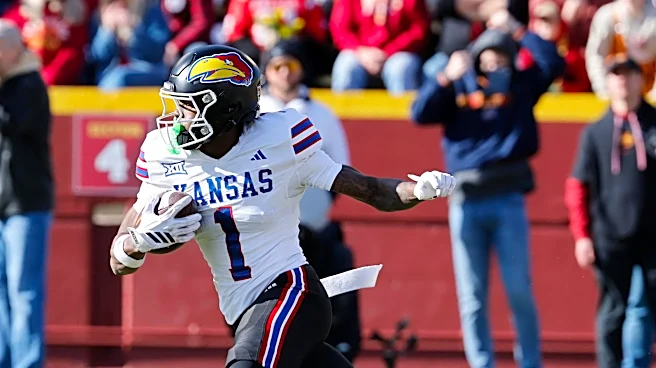
That eventually led to a transfer to University of Kansas, where Henderson finally found both opportunity and rhythm. He immediately became the Jayhawks’ primary vertical weapon, finishing the season with 45 receptions for 766 yards and five touchdowns while averaging an explosive 17 yards per catch. He also earned All-Big 12 recognition both as a receiver and return specialist, including a 94-yard kickoff return touchdown that perfectly encapsulated the kind of field-tilting acceleration he brings to the table.
Breaking down the selection
According to post-draft reports, the Seattle Seahawks lost out on a few targets they hoped would still be available later on Day 3. One of those names reportedly included Kendrick Law, a former Kentucky player known largely for his special teams value who came off the board to Detroit roughly 30 picks before Seattle selected Henderson.
Henderson reportedly became a favorite of Jay Harbaugh because of the overlap between his skill set and the role Seattle previously gave to Dareke Young. The combination of straight-line speed, return experience, and proven gunner reps in coverage units gives him an immediate pathway to a helmet on game day, even before the offensive side fully develops.
There were certainly other roster needs that may have appeared more logical on paper — edge rusher and linebacker immediately come to mind — but this portion of the draft is often about betting on traits rather than filling depth charts. Seattle likely viewed multiple remaining prospects similarly graded to priority UDFAs and chose to maximize athletic upside instead of drafting purely for positional need.
Seattle’s sixth-round selection of Emmanuel Henderson Jr. felt perfectly aligned with the philosophy that John Schneider and the new coaching staff have emphasized throughout this draft cycle: prioritize elite athletic traits, immediate special teams impact, and developmental upside regardless of positional value.
Emmanuel Henderson’s strengths
The defining trait of Henderson’s game is simple: speed — and not merely “college fast.” Internal GPS tracking reportedly clocked him north of 22 MPH, while he ran a 4.44-second forty at the Combine with additional reports suggesting times closer to the low 4.3s during pre-draft testing environments.
Defensive backs are forced to honor Henderson’s vertical burst before the snap even happens, which naturally creates stress on coverage structure and opens space for posts, deep overs, slot fades, and vertical route concepts. Kansas consistently leaned into that gravity, using Henderson as a true field stretcher capable of flipping field position or changing the geometry of an entire drive with a single rep.
Beyond pure speed, Henderson consistently flashes advanced ball tracking ability. He locates deep passes naturally like a center fielder tracking a fly ball, showing comfort adjusting late to trajectories without panicking at the catch point. There are several reps where he maintains body control along the boundary while subtly manipulating spacing against defenders downfield.
The running back background also becomes obvious after the catch. Kansas frequently manufactured touches through quick crossers, glance routes, and underneath concepts designed to get Henderson moving horizontally before turning vertically. Once he plants and accelerates, pursuit angles disappear quickly.
His special teams value may ultimately be what earns him an early roster spot in Seattle.
Many evaluators viewed Henderson as one of the better special teams prospects in the class specifically because of his versatility. He averaged 22.8 yards per kickoff return during his college career while also recording 14 special teams tackles as gunner. The tape as a gunner is particularly intriguing. Henderson consistently wins with pure burst off the line, forcing return units to widen protections earlier than expected. On several reps, he’s already even with the returner before the blocking structure fully develops, creating immediate disruption in the return lane.
That combination of open-field explosiveness, return value, and coverage utility significantly increases his odds of sticking on an active roster early in his career. If the technical refinement eventually catches up to the athletic profile, Seattle may wind up developing more than just a special teamer.
Concerns
The biggest issue in Henderson’s game remains technical refinement.
Despite possessing legitimate vertical speed, he is still an inconsistent route runner overall. Too often, he rounds off breaks instead of snapping them with urgency, which allows defensive backs to anticipate route tempo early and close windows in intermediate areas of the field.
That issue becomes especially noticeable on curls and outbreaking concepts. On several reps, Henderson fails to fully sink his hips entering the break point, drifting upward through transitions instead of creating sharp directional change. NFL corners will read those indicators quickly, and without cleaner footwork, separation underneath could become a challenge early in his career.
Physical corners can also disrupt him at the line of scrimmage because Henderson still lacks both developed play strength and a polished release package against press coverage. His frame is relatively lean by NFL standards, and stronger corners are able to reroute him if they land clean contact early in the rep.
The hands also remain somewhat inconsistent. Henderson frequently allows the football into his chest instead of naturally extending and plucking away from his frame, which can create problems in tighter NFL throwing windows.
Even with the productive season at Kansas boosting his draft stock considerably, evaluators still had to wrestle with the reality that his overall collegiate receiving résumé remains relatively limited compared to many other receiver prospects in this class.
Final Thoughts
Emmanuel Henderson Jr.’s path to carving out a role on Seattle’s roster will not be simple. The receiver room already features major names like Jaxon Smith-Njigba, Rashid Shaheed, and Cooper Kupp, while the organization also remains intrigued by the upside of Tory Horton and made a point to retain Jake Bobo. Realistically, Henderson initially enters the building competing for one of the final receiver spots as a WR5 or WR6 candidate alongside players like Cody White and several UDFAs.
Because of that, his clearest route to surviving final cuts will come through special teams. Seattle clearly valued the combination of speed, return production, and gunner experience in a role that closely mirrors what Dareke Young previously provided. Creating immediate impact there will likely determine whether Henderson sticks on the active roster while continuing to develop offensively.
Long term, though, there is a genuinely intriguing offensive projection here.
Henderson brings legitimate vertical stress ability, explosive movement skills on jet sweeps and manufactured touches, and the kind of acceleration that can instantly punish defensive hesitation in space. He also provides insurance for a receiver room that still carries long-term questions surrounding both Horton’s health and Kupp’s future durability. In the end, Seattle appears to view Henderson exactly as the kind of developmental investment worth making late on Day 3: an explosive athlete with rare traits who may require patience before his game fully comes together.