


Aside from perhaps only the Jackie Robinsons and Babe Ruths of the baseball canon, few other names are tossed around as frequently as that of Tommy John. Although his ubiquitous acknowledgement comes more from a revolutionary medical procedure than a reputation as a player, Tommy John stuck in the big leagues for more than a quarter-century, and was an excellent pitcher for longer than most pitchers’ entire careers last.
As a teammate of both Early Wynn, who debuted in 1939, and ‘90s two-sport star
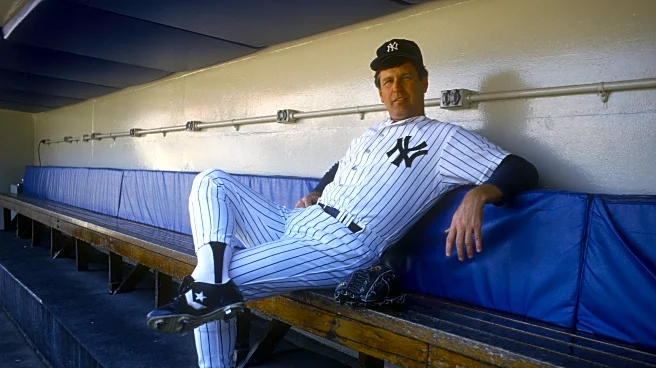
Deion Sanders, Tommy John was a four-time All-Star who reached his peak playing fame in the late ‘70s, finishing second in Cy Young Award voting twice. The lefty did this in his mid-30s, having already undergone a then-experimental elbow surgery which now bears his name, only to have more than a decade of Major League pitching ahead of him. Part of that stretch of excellence came with the New York Yankees, after signing what we deem as one of the franchise’s most important free agent contracts.
Tommy John
Signing Date: November 21, 1978
Contract: Three years, $1.8 million
Prior to the aforementioned signing with the Yankees, Tommy John made his debut back in 1963 with Cleveland, as a spry 20-year-old. The lefty spent two decent-but-brief seasons in Cleveland, before being shipped to the South Side of Chicago in a three-team trade. John spent seven terrific seasons with the White Sox, highlighted by a 1968 season when he posted a sparkling 1.98 ERA in 177.1 innings, making his first All-Star team.
Prior to the 1972 season, Tommy John was traded to the Dodgers in as high-profile a one-for-one trade as you will see, sent in exchange for Dick Allen. Allen immediately went and won the MVP award in ‘72, but John did his best to match it, entering the best and most significant stretch of his career. His first two seasons in L.A. saw him pitch over 400 combined innings with a neat and tidy 3.00 ERA.
The left-hander was even better in 1974, but was forced to leave mid-game in a July start against the Expos. John heard a pop and had significant pain in his throwing elbow; he would not return for the rest of the season. An external doctor told John that it was a career-ending injury, having torn his UCL, though Dodgers’ team doctor Frank Jobe had different plans. He performed the now universally known and eponymous reconstructive surgery, using a tendon from John’s wrist and placing it in his throwing elbow. It was a leap of faith, with the procedure never being done on an athlete, but it was a resounding success. John missed all of the ‘75 season, but ultimately returned, pitching 14 (!) more seasons following the procedure, and of course, paving the way for thousands of other hurlers.
John returned from the procedure for his age-33 season, and was as good as ever. The lefty pitched three more seasons with the Dodgers, working well over 200 innings in each, finishing second in Cy Young voting in ‘77, and making another All-Star team during that stretch. Following another excellent run in 1978, the 15-year veteran hit free agency for the first time.
On November 21, 1978, Tommy John inked a three-year $1.8 million deal with the Yankees. During his time as a free agent, John was only offered a two-year deal from the Dodgers, and despite receiving lucrative offers from other clubs, he opted to jump to the two-time defending champions. It was an overall mission by the Yankees to bolster their rotation that offseason with veterans, as they also added Red Sox division rival and John’s former Cleveland teammate Luis Tiant, who joined the ’79 rotation on a two-year contract.
John’s impact in the Bronx was immediate and significant. In 1979, He set a career high with 276.1 innings pitched, doing so at a very high level, managing a sub-3 ERA, notching his first 20-win campaign, and once again finishing second in Cy Young voting. The concerns and initial doom of his injury and procedure back in ‘74 were fading in the rearview mirror.
Now 37 years old for 1980, John just kept on rolling in the pinstripes under new manager Dick Howser. Pitching a whopping 265.1 innings, he won another 22 games, and made his fourth (and third consecutive) All-Star team. In 1981, despite his medical history and 4oth birthday beginning to knock on the door, John continued to deal. Although he pitched in just 140.1 innings, thanks to a strike and a frightening medical scare with one of his sons, it was one of his best seasons from a run prevention standpoint, as he continued to do his job at a high level with a 2.63 ERA in the shortened campaign.
The workhorse lefty did what he could in the postseason during his time in New York as well. In 1980, he pitched well in what was ultimately a loss in Game 3 of that year’s ALCS, when fellow free agent addition Goose Gossage got burned by George Brett. In 1981, however, he helped spearhead their postseason run. He was the winning pitcher in Game 1 of the ALCS, stymieing the A’s with six innings of one-run ball. Then in Game 2 of the World Series against the Dodgers that season, John tossed seven shutout frames and did not allow a baserunner to reach until the fifth inning as the Yankees took a 2-0 series lead.
The advantage didn’t last, New York losing four in a row to fall short. John pitched in relief for Game 4, allowing a pair of unearned runs to score after coming in with the bases loaded, and would eventually start Game 6. In that game, John pitched well on short rest, allowing a run over four innings, but was pinch-hit for at a crucial point in favor of Bobby Murcer, a move that proved to be unsuccessful for skipper Bob Lemon and company. It was a controversial move at the time, which is understandable given how the lefty was pitching, but also stands as a testament to how much the game has changed since then. The bullpen allowed eight runs in the final five innings, ultimately leading to a loss in the game and series.

The relationship between John and the Yankees began to sour headed into the 1982 season. It began with back-and-forth negotiations for the season, before a slightly diminished performance, a change in roles, and contract disputes continued to turn things south. It had gotten to a point of John threatening pursuit of a breach of contract, and unsurprisingly, his time in New York was just about done. In August of 1982, Tommy John was traded to the Angels for a player to be named later.
Despite his already-lengthy career, John actually still had plenty of baseball ahead of him, though the best of the lefty had already been seen over the last two decades of pitching. He pitched for two full (and two partial) seasons with the Angels, not quite meeting his standards of performance, but continuing to pitch plenty of innings, especially in his first season there (234.2).
John was released by the Angels after an unconvincing start to his age-42 season in 1985, and was picked up shortly after by the Athletics, though his stretch in Oakland proved to be even worse, tossing 48 innings with a 6.19 ERA. Well into his 40s, his career easily could have been done, but the left-hander defied the odds again and pitched for four more seasons in the bigs, all of which came in a return to the Yankees. He even posted a sub-3 ERA in over 70 innings in ‘86, and tossed 187.2 innings a year later at the age of 44. Tommy John would pitch his final game at 46 years old in the 1989 season with New York.
Tommy John’s career could be categorized as “historic” with a certainty that few other players could match. Not only was he a great pitcher, who manned Major League mounds in 26 different seasons, but he was of course a trailblazer in modern baseball medicine on top of it. His signing with the Yankees came relatively shortly after his revolutionary procedure, and his success in New York helped solidify the validity of the practice. His eponymous surgery is certainly vital to baseball history, but John should also be remembered as an excellent pitcher, particularly during his first stretch with the Yankees.
See more of the “50 Most Notable Yankees Free Agent Signings in 50 Years” series here.