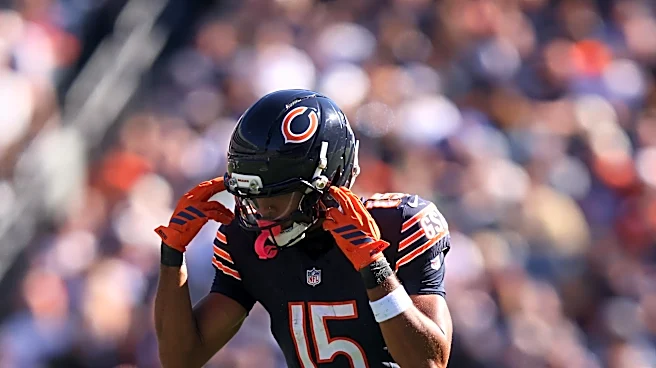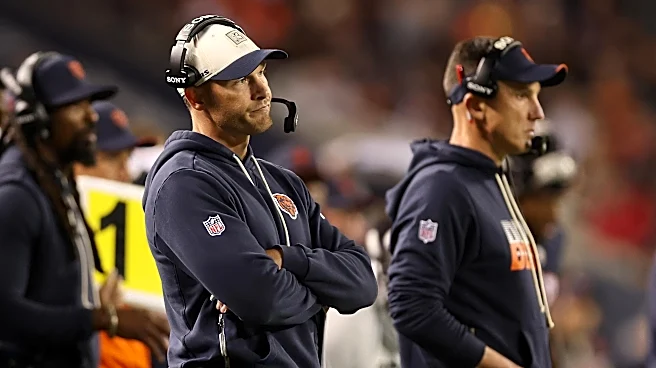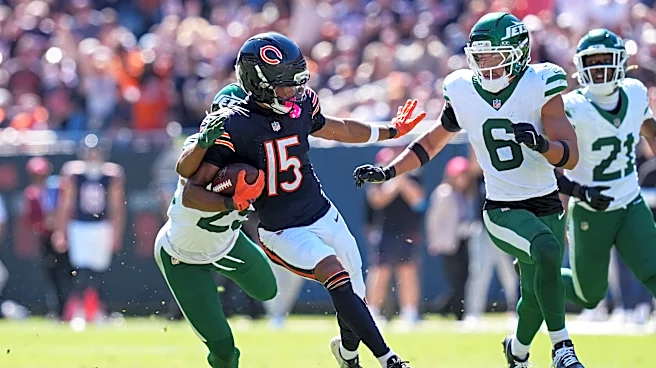





Well, Ben Johnson got us again.
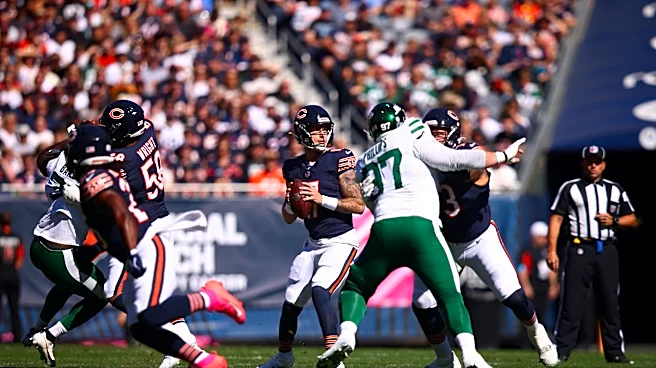
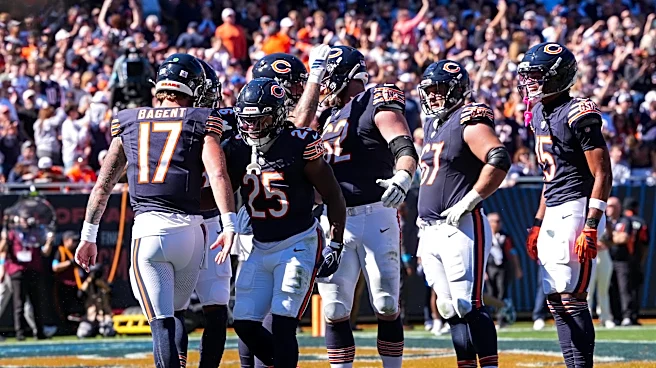
After spending the entire week refusing to publicly name his starting quarterback, Johnson decided to take things one step further Sunday afternoon. Case Keenum and Tyson Bagent both trotted onto the field for Chicago’s first offensive snap, with Bagent split out wide while Keenum took the snap, handed the ball off and promptly headed to the sideline.
So, technically, both quarterbacks started.
Very funny, Ben.
From that point forward, though, this was Tyson Bagent’s offense.
With Caleb Williams missing his second consecutive game due to the hamstring injury suffered against Minnesota, Bagent stepped back into the lineup after clearing concussion protocol and was tasked with following up Case Keenum’s fantastic performance against Philadelphia.
The result?
Another Bears win, and somehow an even more dominant offensive performance.
Chicago defeated New York 23-12, but the final score doesn’t come remotely close to explaining what happened at Soldier Field.
The Bears outgained the Jets 492-157, picked up 34 first downs compared to New York’s seven and possessed the football for an absurd 42:45. Chicago ran 89 offensive plays.
The Jets ran 32.
According to Football Perspective, that 89-to-32 split was the second-most lopsided play differential in NFL history, trailing only Pittsburgh’s 90-to-28 advantage over the expansion Browns in 1999.
It gets better.
Chicago actually finished with more first downs than New York had offensive plays, something SumerSports noted hadn’t happened in an NFL game since 2016.
The Bears’ 34 first downs were also their most in a game since at least 1941, while their +335 advantage in total yardage was Chicago’s largest since a +343 performance against the St. Louis Cardinals in 1979.
Oh, and Tory Taylor never had to punt.
It was one of those afternoons where it felt like the Bears had the football for about three hours while the Jets occasionally stopped by to run a few plays.
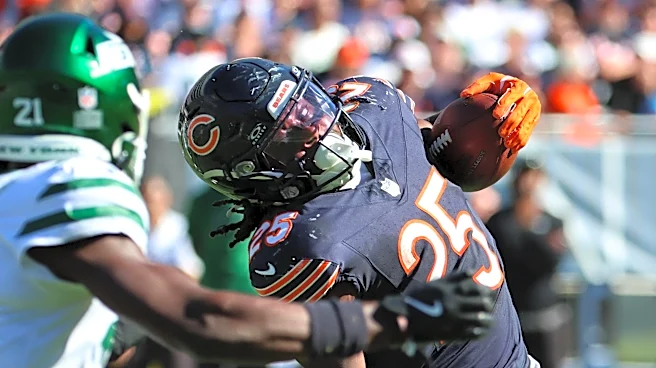
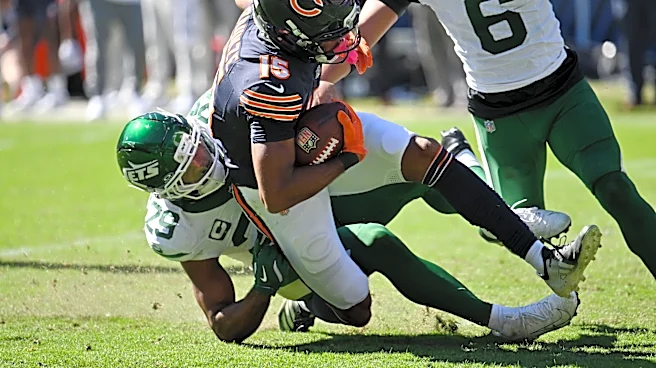
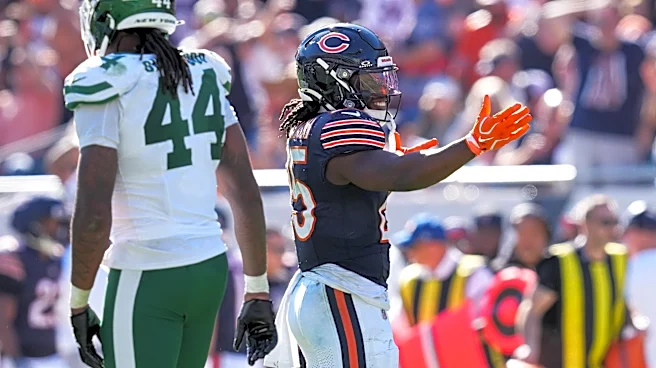
A lot of that credit belongs to the running game. Kyle Monangai absolutely wore New York down, carrying the ball 30 times for 146 yards and two touchdowns, while Chicago finished with 232 yards on the ground. That allowed Johnson to keep Bagent in favorable situations throughout the afternoon and control the game without asking his backup quarterback to carry the offense.
But Bagent held up his end of the bargain.
He completed 25 of 34 attempts for a career-high 268 yards, finishing with no touchdowns, one interception and an 84.0 passer rating. Those numbers aren’t going to jump off the page, especially after what Keenum did against Philadelphia, but I thought Bagent looked noticeably more comfortable operating this offense than the quarterback I charted back in 2023.
If you’ve followed my work for a while, you know I haven’t exactly been shy about my concerns with Bagent.
The arm talent is limited. That’s not suddenly going to change. There are throws Williams can make within this offense that Bagent simply cannot, and we’ve seen how that can restrict the field when defenses begin squeezing the underneath areas.
But what has changed is how comfortable he looks operating within those limitations.
Bagent has always gotten the ball out quickly and avoided sacks well, but against New York there was more confidence in what he was seeing. He played within structure, got through the concepts more consistently (but did have a few plays he perhaps moved through those concepts a bit too quickly, overlooking open receivers down field) and generally gave his playmakers opportunities to do the work after the catch.
When the pocket was clean, he was about as efficient as you could ask for.
Next Gen Stats had Bagent completing 21 of 23 passes from a clean pocket for 202 yards, performing 17.3 percentage points above expectation. Under pressure, however, things changed dramatically. He completed just four of 11 attempts for 66 yards with the interception.
That split does a pretty good job of illustrating both sides of Bagent’s afternoon.
When Chicago kept him comfortable and the offense stayed on schedule, he distributed the football efficiently and helped sustain drive after drive. When New York forced him off his spot or sped up the picture, some of the limitations and questionable decisions began to surface.
And the afternoon certainly wasn’t flawless.
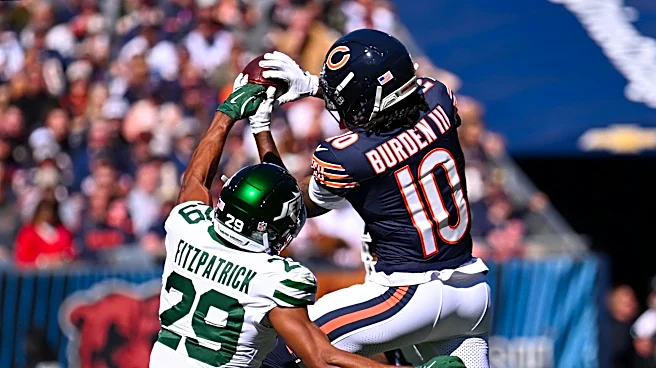
The official box score lists one interception, but there were a few other throws where Bagent flirted with danger, including turnovers that were erased by Jets penalties. The interception that did count came on a pass behind Colston Loveland over the middle, giving Minkah Fitzpatrick New York’s first interception since the final game of the 2024 season.
So we’re not walking away from this pretending Bagent suddenly turned into a different caliber of quarterback. What we can say is that he looked like a more developed version of the player we saw three years ago. That’s exactly what you want from a backup quarterback.
The Bears didn’t need Bagent to play hero ball. They needed him to run the offense, stay on schedule, avoid sacks and allow the talent around him to take over.
For most of Sunday afternoon, that’s exactly what he did. And for the second consecutive week, Ben Johnson showed just how adaptable this offense can be without Caleb Williams.
Keenum beat Philadelphia by operating like the veteran point guard we talked about last week, consistently anticipating windows and getting the football where the design told him to go. Bagent brought a little more mobility and a quicker trigger against New York, while Chicago leaned even harder on its rushing attack and controlled the football for nearly three quarters of the game.
Different quarterbacks. Different approaches. Same result. The Bears are 3-1, and three different quarterbacks have now led them to victories through the first four weeks of the season, something no NFL team had accomplished that early since the 1997 Jacksonville Jaguars.
Now let’s see what the numbers say about Bagent’s afternoon.
Benchmarks
Stat Formatting Key: This week we will be comparing Keenum’s week 3 start against Williams’ Season Totals and Averages.
(Season totals are underlined, Season Averages in Italics, and this week’s stats appear in regular text.)
C/A: 36/55 (65.5%) | 18/27.5 (65.5%) | 24/34 70.6%
Yards: 407 | 203.5 | 247
Touchdowns: 4 | 2 | 3
Turnovers: 1 | 0.5 | 0
QB at Fault Sacks: 0 | 0 | 0
aDOT: 7.7 | 6.1
Passer Rating: 92.0 | 110.8
True Passer Rating: 113.4 | 122.0
Time to Throw: 3.34s | 2.19s
Time to Pressure: 2.75s | 2.27s
Pressure Rate: 41.57% | 23.68%
On-Target Rate: 83.3% | 63.6%
Poor Play Rate / Big Play Rate: 7.5% PPR / 5.0% BRP | 0.0% PPR / 7.3% BRP
EPA per dropback: +0.31 | +0.18
ANY/A: 6.2 | 8.4
Game Scorecard

The full grading sheet for each play can be foundhere.
Game Notes
Note: Last year, I included PFF grades in these breakdowns. With PFF continuing to expand its use of AI across its platform, and with my confidence in how accurately its grades reflect quarterback performance declining, I’ve decided to move away from them this season. In their place, I’ll be using PFN’s Impact Score, which will be notated as PFN on grading sheets moving forward.
- NFL Passer Rating / True Passer Rating / PFN Impact Score: 83.9 / 102.5 / 80.8
- The NFL’s average passer rating through Week 4 sits at 92.2, making Tyson’s 83.9 against the Jets very a below average start.
- A 102.5 TPR hovers around the league average start mark of 100.0.
- As a reminder, TPR has a built in checks and balances system when it comes to ADoT, Tyson’s ADoT was only 6.0 last week, dinging him slightly for overly cautious play.
- On the PFN scale, where 75 represents an average qualifying starter and 90 is elite territory, Bagent finished Week 4 with a 80.8 Impact Score, ranking 7th of 32 qualifying quarterbacks.
- Tyson’s strong EPA/db (+0.22), success rate (61.1%) and CPOE (+8.0%) really helped him crack the top 10 in impact score this week.
- On-Target Throws: 2026 Average: 83.3% | Week 3: 73.3%
- Reminder: Completion percentage ≠ On-Target Percentage. I only chart aimed passes, meaning throwaways, spikes and passes deflected at the line are excluded. Drops can still be credited as on-target.
- Short-Level Passing (Behind LOS–9 yards): 17/22 | 77.3% On-Target
- Deep-Level Passing (10–20+ yards): 5/8 | 62.5% On-Target
- Overall Bagent was above league average when it came to on target throwing in week 4, he did have some rough misses that led to turnover worthy throws, however thanks to some timely flags those turnover don’t appear on the stat sheet. (the grading sheet, however..)
- Poor Play Rate / Big Play Rate: 11.6% PPR / 4.7% BPR
- While a 11.6% poor play rate is less than ideal, Ben Johnson and Tyson Bagent watch and review the same tape I do, and know how to correct these areas of weakness much better than I could ever suggest.
- Time to Throw: 2.48 seconds
- Tyson was overall quick with the ball, sometimes too quick, however. I counted at least 6 plays where Tyson either had a mad open downfield and did not throw to him, or moved off a deeper concept before it finished out, and dumped the ball off underneath. There is even an example on tape of this showing up in his and Burden’s body language, where Bagent moved off a concept for Luther Burden too quickly, and acknowledges it shortly after.
- EPA per Dropback:+0.22
- This mark ranked 11th among 32 qualifying quarterbacks in Week 4. So while Tyson accounted for exactly zero touchdowns directly, his EPA/db was better than Case Keenum’s week 3 mark by 0.04. A huge factor in that is the difference in success rate (Keenum: 51.4%, Bagent: 61.1%)
- Under Pressure: 12.50%
- The Bears offensive line dominated the Jets all afternoon, posting their lowest pressure rate allowed since week 17 of the 2025 season against the 49ers (17.39%).
- The Bakery Open For Business?
- I recorded three turnover worthy throws, and there were a total of five throws that were put into danger, two of which not getting a turnover worthy grade for the following reason:
- An interception that came off Tyson realizing he had a free play and throwing deep.
- An interception that came off a defensive player holding the intended receiver and sling-shotting ahead of him for the interception.
- All three graded turnover worth plays came in the first half, and they all came in the “anticipation routes thrown late/behind” variety. A concern I’ve had with Tyson since his stint starting in 2023.
- I recorded three turnover worthy throws, and there were a total of five throws that were put into danger, two of which not getting a turnover worthy grade for the following reason:
Play Reviews
The plays we’ll be reviewing are presented in the order they occurred in the game.
As a brief review, let’s recap the colors of the routes on these plays for those new to the process:
- Blue: Indicates pre-snap motion or post-snap blocking.
- Yellow: Routes other receivers run on the play.
- Red: Route the targeted receiver runs.
Situation: 1st Quarter, 1st and 10 CHI47 11:38
Play Grade: Good
Result: 20-yard completion to Luther Burden III
Notes: (+) Anticipation (+) Mid-Level Accuracy/Completion (+) Explosive Play
Analysis: This is a nice example of Bagent throwing with anticipation over the middle. At the top of the screen, Burden pushes vertically before breaking inside on a deep dig, while Loveland runs a shorter in-breaking route underneath. Backside, Odunze runs a corner-post double move, selling the break toward the sideline before bending back inside.
What I really like here is when Bagent commits to the throw. Burden is still working through his break when Bagent begins his throwing motion, so he’s throwing to where Burden is going to be rather than waiting for him to fully uncover. There’s an underneath defender in the throwing lane and a deeper defender closing from behind, making the timing and placement important.
Bagent clears the underneath defender’s reach and gets the ball to Burden before the deeper defender can close the window. I’d still like him to locate it a little better and let Burden keep his cleats on the grass, but I’m not docking him for having to leave his feet here. Burden secures the ball and finishes the catch through contact, giving the Bears a 20-yard gain created primarily through the air.
In all honesty, Good feels right here. The anticipation and intermediate accuracy work together to produce an explosive completion on first down, without needing Burden to manufacture the yardage after the catch. This was something that Bagent sorely missed in his 2023 tape, so it’s great to see it come to light almost immediately against the Jets.
Situation: 1st Quarter, 2nd and 8 CHI45 06:18
Play Grade: Great
Result: 22-yard completion to Luther Burden III
Notes: (+) Anticipation (+) Explosive Play (++) Mid-Level Accuracy/Completion
Analysis: This is a great example of Bagent throwing with anticipation and backing it up with excellent placement. The Bears pair Burden’s deep over route from the top of the screen with Odunze’s backside post creating a deep Scissors concept which threatens the deep middle of the field.
What I really like here is that Bagent trusts where Burden is going. He commits to the throw while the trailing defender is still close, putting the ball into the space Burden is working toward instead of waiting for a more obvious window.
The accuracy is what really elevates this play. Bagent puts the ball out in front along Burden’s crossing path, giving him a chance to secure it while keeping it beyond the trailing defender’s reach. That defender is close enough for the placement to matter, and Bagent delivers exactly where he needs to, which also allows Burden to make a play after the catch and pick up some YAC to boot.
Situation: 2nd Quarter, 1st and 10 CHI43 11:52
Play Grade: Poor, Turnover Worthy
Result: Pass Intercepted by Minkah Fitzpatrick
Notes: (–) Late Throw (–) Ball Placement/Accuracy (–) Throw Leading to Turnover
Analysis: This is a poor throw from Bagent that turns into a turnover. Loveland runs the deep dig from the bottom of the screen, with Kmet working a shorter inside route underneath and a vertical route from Odunze on the opposite side stretching the coverage. Loveland initially has some room as he turns inside, but that window doesn’t stay open.
The ball needs to arrive as Loveland comes out of his break. Instead, the late timing on the throw gives Fitzpatrick a chance to close from depth and work back into the play. By the time the pass reaches Loveland, Fitzpatrick has erased the separation and is moving across his path.
The placement compounds that problem. Bagent needs to lead Loveland across the field and keep the ball away from the closing defender. Instead, he puts it into Fitzpatrick’s path, allowing him to cross in front of Loveland and take the interception. Loveland ends up trying to reach through the defender to get to the ball.
What makes this turnover worthy is that the timing and location give the defense the advantage at the catch point. Fitzpatrick deserves credit for closing and finishing the play, but Bagent’s throw and hesitation to throw gives him that opportunity. The late delivery makes the window harder to hit, the placement favors the defender, and the result is a turnover.
Situation: 2nd Quarter, 3rd and 5 CHI47 00:27
Play Grade: Elite
Result: 37-yard Completion to Rome Odunze
Notes: (+) Explosive Play (+) Touch/Layering (+) Anticipation (++) Deep-Level Accuracy/Completion
Analysis: This is an elite throw from Bagent, with the anticipation, touch, and accuracy all showing up together. At the top of the screen, the Bears run a variation of Mills, pairing Odunze’s post with Burden’s dig underneath and Raymond working out to the flat. The dig threatens the space underneath the safety, while Rome’s post attacks behind him.
What I really like is that Bagent commits to the throw before Rome has created obvious separation. The defender is still close as Odunze breaks inside, but Bagent trusts the route and throws into the space he’s working toward. He lets the separation develop while the ball is traveling instead of waiting for Rome to look completely open, which again was something Bagent really struggled with in 2023, so this just further goes to show the development of the young QB.
The touch and placement are excellent. Bagent gives the ball enough height to clear the underneath coverage, then brings it down ahead of Odunze and away from the trailing defender. He finds the space between those defenders without hanging the pass up and giving them time to recover.
Rome reaches up to secure it, comes down running, and turns the completion into a 37-yard gain. He deserves credit for the yards after the catch, but Bagent’s placement gives him that opportunity. On third down with less than thirty seconds left in the half, that’s a huge play, setting up an opportunity for points heading into the half.
Situation: 3rd Quarter, 1st and 10 CHI20 0:57
Play Grade: Above Average
Result: 14-yard Completion to Luther Burden III
Notes: (+) Anticipation, (+) Mid-Level Accuracy/Completion
Analysis: Bagent picks up fourteen yards here by anticipating Burden’s adjustment and putting the ball into the space the coverage gives him. Burden pushes vertically from the bottom of the screen, with Kmet working toward the sideline underneath. A defender stays over the top while another runs closely with Burden, leaving room to bring the throw back underneath.
Bagent starts his delivery before Burden turns to meet the pass. It looks like a back-shoulder adjustment to the vertical route, and the timing matters. Waiting for Burden to turn around would give the nearby defender more time to recognize the throw and close on the catch point.
The ball gives Burden a chance to secure it before that defender can get through him. Burden has to adjust and goes down making the catch, so the placement doesn’t earn extra credit, but Bagent delivers a catchable pass in the available window and moves the chains. Just another example of the strides Bagent has taken as a passer since 2023.
Summary
Bagent finishes Week 4 with final grades of 1st Half (-2.35) / 2nd Half (0.50) / Game (-1.85), landing in the lower half of my “Average” range against the Jets.
This was definitely a tale of two halves for Bagent. All three of his turnover-worthy plays came before halftime, along with the majority of his negatively graded throws, dragging what was otherwise a fairly efficient afternoon down considerably. The second half was much cleaner. Bagent didn’t record a single turnover-worthy, Poor or Bad graded play after halftime, finishing that portion of the game with a positive 0.50 grade.
That’s probably the best way to summarize how I came away feeling about the performance as a whole.
There were still some of the limitations we’ve seen from Bagent in the past, particularly when pressure forced him off schedule, and three turnover-worthy throws in one half simply can’t be ignored. At the same time, I thought there were legitimate signs of growth from the quarterback I graded back in 2023. He operated the offense more comfortably, generally kept Chicago on schedule and, once he settled down, avoided compounding mistakes while the Bears completely took control of the game around him.
Of the quarterbacks I’m grading this season, you can see where Bagent’s Week 4 score landed him 5th of 5 players graded in Week 4. For a look at the entire season thus far, along with some quick notes on the other quarterbacks from this week, you can find that here.
And unlike the last couple of weeks, there isn’t much mystery about who I’ll be grading next.
Ben Johnson has already announced that Bagent will get another start Sunday at Lambeau Field against the Packers while Caleb Williams continues working his way back from the hamstring injury he suffered in Week 2. Johnson called Bagent “the guy” for Week 5, meaning he’ll now get something neither Keenum nor Bagent had over the previous two weeks: a second consecutive start and another full week of preparation knowing the offense is his.
That’s going to make next week’s evaluation particularly interesting.
Sunday showed us some real improvement from the player we last saw starting games in 2023, but it also showed there are still areas where his limitations can put the football in danger. Now he’ll take that into Lambeau Field for a divisional matchup where the Bears probably won’t be able to survive three turnover-worthy throws in a half.
We’ll see which version of Bagent shows up.
Until then, Bear Down!
Gary Baugher Jr. is a second year contributor to WCG, bringing football insight backed by over 16 years of experience in organized football and more than 30 years as a passionate fan of the game. You can follow him on Twitter at @iamcogs.