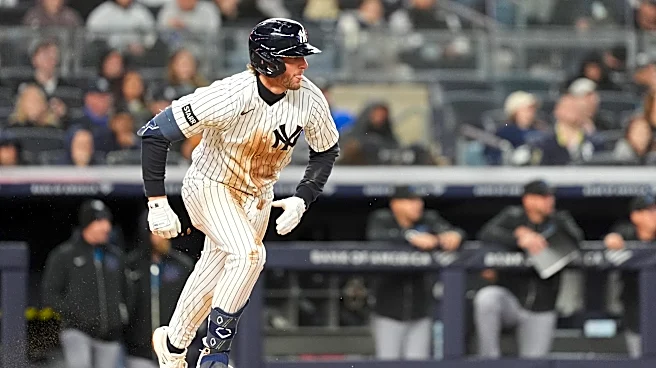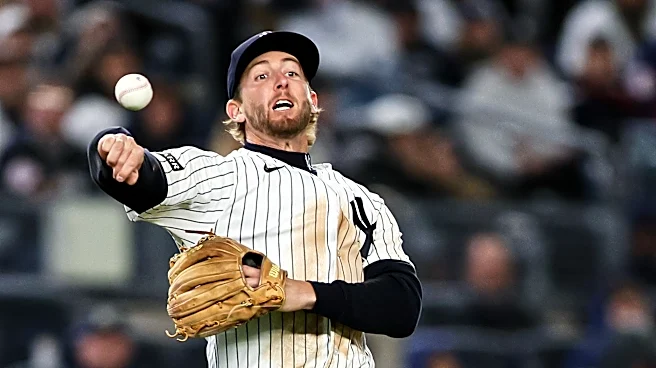


When the Yankees acquired third baseman Ryan McMahon last July, the general consensus was that they were bringing in a player who made up for his lack of pop at the plate with some of the best defense in the game. Although he has yet to earn a Gold Glove, this lack of hardware has been less the result of his defensive prowess and more the unfortunate reality of manning the hot corner at the same time as Nolan Arenado and Matt Chapman: his 66 Defensive Runs Saved and 46 Outs Above Average since 2017
trail only these two. McMahon’s first few months in pinstripes last season reinforced this expectation, for as he struggled with the bat down the stretch, the third baseman flashed the leather repeatedly, putting together a nice defensive highlight reel that culminated in a timely catch falling into the Red Sox dugout during Game 3 of the Wild Card Series.
Heading into 2026, the Yankees hoped that they would be able to unlock some of his potential at the plate, but were ultimately content with him serving as the defensively-strong left-handed half of a third base platoon with Amed Rosario. Unfortunately, while his offensive woes to start the season were not unexpected (even if this season-opening slump is particularly bad), it has been his early-season defense that has attracted the most attention — and not in a good way. After accruing 10 DRS and 7 OAA last season, making him a finalist for the NL Gold Glove at third despite only spending half the season there, McMahon has struggled out of the gate this season, having accrued -3 DRS and -2 OAA in just 67 innings heading into action last night.
While these numbers are drastic, we are still just a few games into the season, and defense is something that can take some time to stabilize. A quick film analysis, though, can give us a bit of insight into whether or not we should worry just yet, or if we can pump the brakes on the defensive alarms and instead focus all our criticism about McMahon’s bat rather than his glove. And so, I dove into the MLB Film Room, which had 14 plays listing McMahon as the primary fielder heading into last night’s game — six groundouts, three popups, three singles, one double, and one E5. Of these plays, I found a handful worth going through.
Let’s get started with the one E5, a throwing error by McMahon against the Seattle Mariners back on March 30th.
At first glance, this error might not look like a throwing error, as the ball reaches first baseman Ben Rice on one hop, and indeed, you can make the argument that a more experienced first baseman than Rice probably makes that play—even if he’s improved early on. But the truth is, this shouldn’t have been a tough play in the first place. The ball gets to McMahon on a fairly easy hop, and the batter, Seattle backup catcher Mitch Garver, is not a fast runner (he ranked in the 16th percentile last season). There’s no reason for McMahon to underthrow it to such an extent that the ball bounces on the grass as far out as it did, especially since he took a second to set himself before throwing.
Fortunately, while throws from the hot corner are more likely to need a scoop than one from the shortstop or second baseman, McMahon’s arm being this wild seemed to be very much a fluke thing. Here’s another play from the very next day:
An almost identical play, with a very different result: a throw right at Rice’s eye level.
What about the three singles? Well, two of those three occurred on slow “swinging bunts” down the third base line:
Of these two, the first was an almost impossible play, with the ball winding up in no-man’s land. The second is a play I would’ve liked to see McMahon make, and indeed one that he has made frequently; but there is ultimately a reason why it was listed as a single, not a throwing error.
The third single, on the other hand, is a bit more concerning to me:
I’m not quite sure what happened here; thanks to the lefty shift, McMahon was playing in the role of the shortstop, and wound up in a position where he could neither make the play or get to the third base bag with enough time to give Cody Bellinger a target to throw the ball, resulting in A) the pitcher essentially covering the bag as the same time as him, and B) because of that, nobody backing up the throw. The good thing about this play, though, is that this isn’t so much an issue to watch for than it is a weird confluence of events. If it happens again, would I be concerned? Absolutely — but not about McMahon’s defense, but about the infield’s assignments when in the shift.
Last, but certainly not least, the double:
Ouch! The ball, 104.1 mph off the bat, deflected off McMahon — first off his glove, then possibly off his head — before careening into left field for a double off the bat of Randy Arozarena. Yea, these plays happen; I’m not too concerned.
And ultimately, that’s where I think I current stand after watching McMahon’s defensive highlights so far: not too concerned. At the end of the day, good, dependable defense doesn’t exactly skyrocket up the OAA and DRS charts, while one or two misplays can drop you down quite a bit, allowing statistical noise to rear its head in the early going. Now, if the metrics remain negative in May and June, then it’ll be time to start looking more deeply under the hood; but for now, we don’t need to stress it when the ball gets hit to third — only when the third baseman comes up to the plate, with Amed Rosario perhaps breathing down his neck.