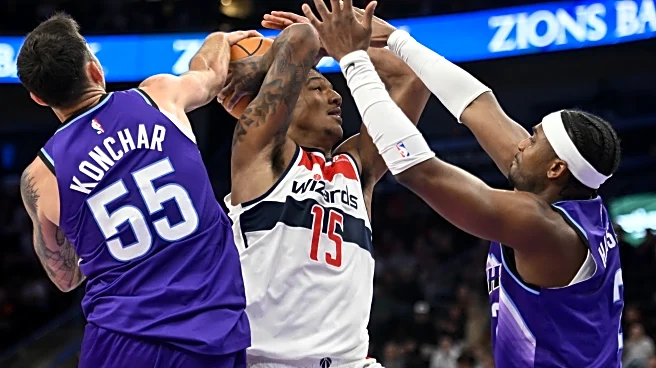



The Washington Wizards ended their 16-game losing streak with a resounding 133-110 win over the people wearing Utah Jazz uniforms.
Sure, the Wizards and Jazz have been (and still are) engaged in strategic losing, both teams had many, many of their main players out with injuries and “injuries,” but it’s been 33 days since Washington’s last victory, so even beating a team that started an undersized wing at center was good to see.

The moment I felt Washington’s first win more than a month was highly likely
came during pregame introductions when I learned that Cody Williams was starting at “center” and someone named Bez Mbeng would be in the opening lineup.
No sleight towards Mbeng, who’s scrapping his way from Yale to the NBA and seems to have the requisite attributes to be on an NBA roster. There’s always a market for ballhawks. It’s fair to say he’s relatively obscure at this point in his journey.
In fairness, the Wizards had guys named Leaky and JuJu in the starting lineup.
While I want to be positive about what I saw last night, it’s good to keep in mind what I kept telling myself throughout the game: both teams were putting semi-glorified G-League lineups out there.
Utah’s most accomplished NBA performer was John Konchar. Ace Bailey is promising, though the best that can be fairly said of him is that he’s pretty good for a teenage rookie. Williams has improved to about replacement level in my metrics. Of the eight players Utah had available, maybe three will be part of an NBA rotation next season. I’d put the over/under at 2.5 — I doubt Williams will be in the rotation when Utah starts trying to win.
The Wizards lineup was similar, though Washington played three guys sure to be part of future rotations — Bilal Coulibaly, Will Riley, and Bub Carrington. Jamir Watkins and Jaden Hardy might be in the rotation when the Wizards hit the gas next season.
All that in mind, it’s better that Washington played well. The point I’m making is that it’s good to keep in mind the level of competition when evaluating, analyzing, and trying to find meaning for the future.
From the Notebook
- Throughout the night, I jotted multiple notes about Riley’s craft. He has good footwork and makes good use of extending horizontally to create space.
- One other note I’ve made throughout the season: Riley needs to hope officials don’t start enforcing carry rules. He gets a lot of mileage out of hesitation dribbles — multiple times per game, I think he’s picked up his dribble, the defender thinks he’s picked up his dribble, and then he turns his hand over and dribbles again.
- A drive at 10:55 of the first quarter is an example of the Coulibaly experience. He made a superb drive, beating his own man and speeding past the help defender, and then…nearly turned it over passing to the weakside corner instead of just attacking the rim.
- Brendan Haywood said Leaky Black was known at UNC for his strong defense, which is the same thing Mike Breen said during the game against the Knicks. My experience watching Black with the Wizards has been different, though he did make several good defensive plays (and several not so good) last night. The Wizards defense has been nearly five points per 100 possessions better in Black’s limited minutes so far this season.
- JuJu Reese once again dominated Utah. In their last game, he had 18 points and 20 rebounds. Last night: 26 points and 17 rebounds in just 30 minutes. As Haywood said, Reese was doing what a big is supposed to do when the opponent has no size. That said, the Wizards have a long history of not doing what they’re “supposed to do” based on opponent weaknesses.
- I think Jaden Hardy and Riley might be able to shoot better by controlling their legs on three-point attempts. Hardy tends to lean back — letting his legs drift forward asymmetrically. In other words, he fades and twists. Riley tends to scissor his legs together (he frequently clicks his heels while shooting). The unnecessary leg action introduces instability, which undermines accuracy.
- I watched the Wizards broadcast last night for two reasons: the Jazz broadcast is pretty bad, and Haywood is pretty good. If it was my call, I’d revamp the TV broadcast booth by making Haywood the full-time analyst and bringing in a new play-by-play guy.
- Last night, I laughed when Chris Miller cheered Reese for a bully-ball postup as a “grown man move.” Reese was being defended by Elijah Harkless — a guard giving up six inches and 45 pounds to Reese.
- G-League kind of defense: in the second quarter, Sharife Cooper drew three Utah defenders on a drive. He dropped a pass to a cutting Anthony Gill for a dunk. Gill came open because one of the two Utah defenders not helping on Cooper was watching Cooper instead of doing his job. In other words, the 6-0 Cooper drew the attention of four Utah defenders.
- Midway through the second quarter, Jamir Watkins did a great job of breaking up dribble handoff action. He got the steal and a breakaway bucket at the other end. Watkins and Coulibaly both have good defensive hands and long arms. Both guys had three steals, as did Black.
- Late in the second quarter (around 1:14 mark), Coulibaly and Gill ran a classic give-and-go — Coulibaly passed to Gill and cut hard, Gill made a nice pass, and Coulibaly dunked. Good basketball.
- Kind of amazing: Utah’s Cody Williams scored 24 points on 11-20 shooting and still had a below-average PPA and an offensive rating of just 90 (league average: 115.6).
- Same vein: Jaden Hardy scored 21 points in 27 minutes and had a NEGATIVE PPA. Aside from shooting okay, he did almost nothing positive while committing three turnovers and five fouls.
Four Factors
Below are the four factors that decide wins and losses in basketball — shooting (efg), rebounding (offensive rebounds), ball handling (turnovers), fouling (free throws made).
The four factors are measured by:
- eFG% (effective field goal percentage, which accounts for the three-point shot)
- OREB% (offensive rebound percentage)
- TOV% (turnover percentage — turnovers divided by possessions)
- FTM/FGA (free throws made divided by field goal attempts)
Stats & Metrics
PPA is my overall production metric, which credits players for things they do that help a team win (scoring, rebounding, playmaking, defending) and dings them for things that hurt (missed shots, turnovers, bad defense, fouls).
PPA is a per possession metric designed for larger data sets. In small sample sizes, the numbers can get weird. In PPA, 100 is average, higher is better and replacement level is 45. For a single game, replacement level isn’t much use, and I reiterate the caution about small samples sometimes producing weird results.
POSS is the number of possessions each player was on the floor in this game.
ORTG = offensive rating, which is points produced per individual possessions x 100. League average so far this season is listed in the Four Factors table above. Points produced is not the same as points scored. It includes the value of assists and offensive rebounds, as well as sharing credit when receiving an assist.
USG = offensive usage rate. Average is 20%. Median so far this season is 17.7%.
ORTG and USG are versions of stats created by former Wizards assistant coach Dean Oliver and modified by me. ORTG is an efficiency measure that accounts for the value of shooting, offensive rebounds, assists and turnovers. USG includes shooting from the floor and free throw line, offensive rebounds, assists and turnovers.
+PTS = “Plus Points” is a measure of the points gained or lost by each player based on their efficiency in this game compared to league average efficiency on the same number of possessions. A player with an offensive rating (points produced per possession x 100) of 100 who uses 20 possessions would produce 20 points. If the league average efficiency is 115, the league — on average — would produced 23.0 points in the same 20 possessions. So, the player in this hypothetical would have a +PTS score of -3.0.
Players are sorted by total production in the game.