


Today we’re counting down the top five prospects in the Cubs minor league system. Because of the requests of some of you, I’m going to do today’s in reverse order. I’ll try it this year. If I don’t like it, I’m going back to the other way next year.
If you want to look back, here are the other four entries:
Because I know some of you are going to ask, I had made up a preliminary list that I was working off of at the time of the Edward Cabrera trade. When
the deal was made, I had Owen Caissie as the Cubs’ number-three prospect. I was considering moving him up to two. It was a hard call. I can see the argument for making him the number-one prospect, but I don’t think I would have done that. So he would have been two or three.
I had Cristian Hernández at 20 when the trade went down, but I was really playing with the picks in the teens and I was strongly considering moving him up. Off the top of my head, I think putting Hernández at 15, give or take a place or two, would be the right call.
So with that said, here are my top five Cubs prospects.
5. Kevin Alcántara. OF. B:R, T:R. 7/22/2002. 6’6”, 188. Trade with Yankees (2021).
Alcántara has been around so long that it’s easy to forget he’s still only 23 years old. The scouting report on Alcántara is pretty much the same as it’s been the past five years. He’s a terrific athlete with great raw skills and a sky-high ceiling. He has plus raw power and plus speed. He’s a very good defensive center fielder with a strong arm who could be a Gold Glove right fielder. The only thing holding him back is a difficulty making consistent contact at the plate, particularly against breaking pitches from right-handers.
After making his major league debut at the tail end of the 2024 season, there were big expectations for Alcántara in 2025. Instead, he battled a nagging sports hernia for much of the season and seemed to be stuck in a holding pattern. Alcántara went through hot streaks and cold streaks in 2025 and finished with a line of .266/.349/.470 with 17 home runs and ten home runs over 430 plate appearances. That’s not bad, but we were all hoping for more.
There were some bright sides to that line. For one, Alcántara destroyed left-handed pitching in a way he had not done in previous years with a line of .320/.396/.588 versus southpaws. He also became slightly more selective at the plate and was able to draw a few more walks. And while it was a minuscule sample size, Alcántara didn’t look as overmatched in the majors in his brief cup of coffee with the major league team at the end of the season like he did in 2024.
The downside is that he still swings at too many pitches out of the zone, especially curve balls from right-handed pitching. His strikeout rate of 29.8 percent in Iowa last year is scary high for a top prospect. He will probably always strike out a lot with that big body and big strike zone, but major league pitchers will be merciless on those weaknesses unless he can demonstrate that he can either lay off those pitchers or do damage against them. Alcántara’s ground ball rates also increased last year and his fly ball rates decreased. Maybe that was because he was playing hurt. Maybe it wasn’t.
Despite the somewhat disappointing season, Alcántara did seem to make some progress in pitch recognition. Not enough, to be sure, but he was at least moving in the right direction.
Alcántara apparently got an extra option year, so that should give the Cubs the flexibility to let him build on the good parts of 2025 in Iowa, as well as work on eliminating the bad stuff. His defense and ability to hit left-handers would make him a good fourth outfielder right now, but the Cubs obviously have higher hopes for him than that. He has been around seemingly forever, so this is the year that Alcántara is going to have to prove to the Cubs that he can be their right fielder of the future.
Here are some highlights of Alcántara in Iowa for the first half of last season.
4. Ethan Conrad. OF. B:L, T:L. DOB: 07/05/2004. 6’3”, 220. Drafted 1st round (2025) Wake Forest.
I have to keep myself from getting too excited about Ethan Conrad. The Cubs first-round draft pick last year has yet to make his professional debut after a season-ending shoulder injury during his junior year at Wake Forest. So all I have is the video that I can find online about him and those highlights get me very excited about Conrad.
Ethan Conrad went to Marist College for two years where he was an elite talent in a small school. He hit .389/.467/.704 his sophomore season before going .385/.433/.486 in the wooden bat Cape Cod League that following summer. Those numbers had the the power four conference of Wake Forest and the ACC calling. Conrad was just as impressive there—.372/.495/.744 with seven home runs in 21 games before he suffered a season-ending injury to his left shoulder when he was diving for a ball. Unfortunately, the ACC regular season had just started when he suffered the injury, so those numbers were put up against non-conference competition that wasn’t much better than what he faced at Marist. In fact, two of those games were against Marist. Conrad did put up those good numbers in the competitive Cape Cod League and we know the Cubs place a lot of emphasis on results in the Cape. So it’s not like he has no experience with tough competition, but his resume is thin on that front.
Conrad is the kind of player that I fall in love with quite easily — the guy who is above-average but maybe not plus in every category. Maybe his arm rates out more as average, but the other four tools are in the 55 to 60 range on the 20-to-80 scale. Conrad has a simple left-handed stroke and features above-average contact skills. He only struck out 14 times in 97 plate appearances last season. He’s also getting better at identifying pitches and laying off stuff out of the zone. Conrad walked 18 times, which is more than he struck out.
With good loft in his swing, Conrad projects out to be a 20-to-25 home run player. Some think that he still has room on his 6’3” frame to add a little more weight, which might push up his power totals some more. However, that could come at the cost of his above-average speed, which is an asset both on the base paths and in center field, where he’s an above-average defender. The Cubs are hopefully set in center field for quite a while, but Conrad projects out to be a very good defensive right fielder. His arm isn’t his best tool, but it’s at least average and good enough to play right.
From all accounts, Conrad is fully healthy now and you can see video on social media of him working out in Mesa. He should make his professional debut in Myrtle Beach this March or, less likely, South Bend. There will be a lot of eyes on him in this season. There is always concern that his shoulder injury will linger and affect his swing, although that’s no more likely with Conrad than with any other hitter with a shoulder injury. His upside is a 25-25 above-average outfielder who will make a few All-Star Games. He has a very good chance to be the Cubs’ number-one prospect at this time next year.
Here are some highlights of Conrad playing for Wake Forest before he got hurt.
3. Jefferson Rojas. SS. B:R, T:R. DOB: 4/25/2005. 5’11”, 150. International Free Agent (2022) Dominican Republic.
On July 18, 20-year-old Jefferson Rojas was promoted to Double-A Knoxville. There he did something he’d never really done before: he struggled. Over 39 game in the Southern League, Rojas hit .164/.279/.205 with no home runs with the Smokies.
That’s not good, but I’m not overly concerned for several reasons. Rojas was promoted after having the best half-season of his career in South Bend. Over 67 games in the Midwest League, Rojas hit .278/.379/.492 with a career-high 11 home runs. He became a more selective hitter and drew walks at a career-high percentage of 12.7 with no real increase in his strikeout rate at 15.7 percent. Rojas also started to drive the ball much harder with more pulled contact in the air.
Rojas also suffered a from poor luck in Knoxville, hitting just .211 on balls in play. Also, it was just 39 games at a new level. I won’t argue that it’s a good thing that he struggled here so that he learns to deal with adversity, but it did give Rojas a good sense of what he needs to work on over the winter.
Rojas was also just 20 years old in Knoxville, which is very young for Double-A. In fact, throughout Rojas’ career he’s been either the youngest or one of the youngest hitters in the league.
So overall, I’m not worried. At least not yet. What makes Rojas an exciting prospect is his above-average contact skills and growing power profile. He pulled the ball in the air a lot more in South Bend, which is a very good sign. Rojas hit left- and right-handed pitching roughly equally in 2025. Rojas is a smart baserunner, which allows his average raw speed to play up. He stole 19 bases in 22 attempts between the two levels last year.
Defensively, Rojas has a strong arm and all the tools to stick at shortstop. He still makes some mistakes, which I chalk up more to inexperience than a lack of skills. Rojas could be a roughly average defensive shortstop, but he does have the arm to move to third base if necessary where he could be above average.
Rojas still doesn’t turn 21 until April, so he’s still quite young for his level. Obviously he has to demonstrate that the poor performance in Double-A last August was just a small speed bump on the road to Wrigley. If Rojas continues to improve like he did in South Bend last year, he’ll be a top 100 prospect at this time next year and he will be knocking on the door for his major league debut in 2027.
Some highlights of Rojas in South Bend.
2. Jaxon Wiggins. RHP. DOB: 10/03/2001. 6’6”. 225. Drafted 2nd round (2023) Arkansas.
Jaxon Wiggins is something the Cubs have not had in a long time — a big hard-throwing right-handed starter. Wiggins blew through three levels last year, starting the season in High-A South Bend and finishing the year in Triple-A Iowa. While he is not quite ready to make his major league debut to start the season, he certainly could be a fixture in the Cubs rotation down the stretch if he can stay healthy. That last caveat is certainly a big one, however.
Wiggins has one of the best fastballs in all of the minor leagues. It sits at 95-to-98 miles per hour and has touched 100 on more than one occasion. It also has good arm-side movement. His second pitch is an 88-90 mph cutter/slider that grades out as a second plus pitch. His upper-80s changeup is a solid third pitch that plays well off of his fastball. He also has a curve that he rarely throws and even more rarely throws for strikes. It does, however, have a real “fall of the table” movement when it’s right.
Wiggins has a very simple, whip-like pitching motion that should be easy to repeat. Of course, that didn’t stop him from getting hurt in college.
Despite blowing through three levels, Wiggins only threw 78 innings last season. The Cubs only let him make one start over a two-month period from mid-June to mid-August because of “arm fatigue” on his right arm, which is just two years removed from Tommy John surgery which cost him his junior season at Arkansas. They were also limiting his innings. After June 20, Wiggins did not make another start all season more than four innings and only one more than three innings.
Between the three levels last season, Wiggins went 3-4 with a 2.19 ERA. He struck out 97, which works out to 11.2 batters per nine innings. He walked 36 men, which translates to a too-high but not terrible 4.2 per nine. He does have some control issues, which limits his upside at the moment.
But that upside is still considerably high. With two plus pitches and a third solid one, Wiggins has number 2/3 starter potential. But there are some warning signs. Certainly his control, which abandons him at times, and his health give himself more reliever risk than a lot of pitchers with his talent. And then there is the possibility that I hate to mention, but the last Cubs prospect with a fastball this good was Brailyn Marquez. We hope history doesn’t repeat itself there, but it’s a possibility. Wiggins probably has as much upside as anyone in the system, but his downside should have us crossing our fingers.
Wiggins only made three starts and threw just 9.2 innings in Iowa last year, so he’s certainly ticketed for a return to Des Moines to start 2026. From there, his major league debut is up to him. Cade Horton only made 11 starts in Iowa, and six last year, before he forced his way up to Chicago. History could repeat itself with Wiggins this year.
Here are some highlights for Wiggins from last year.
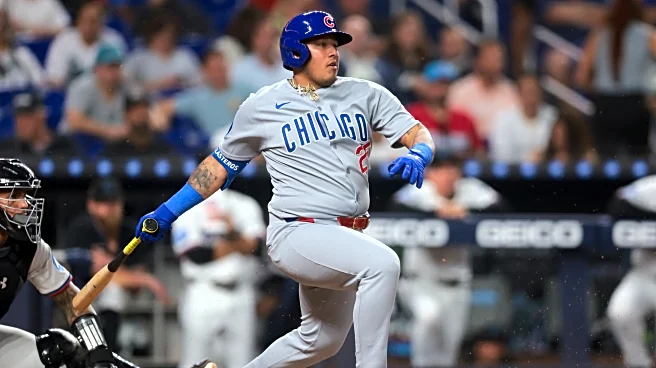
- Moisés Ballesteros. C/DH. B:L, T:R. DOB: 11/08/2003. 5’8”, 195. International Free Agent (2021) Venezuela.
Moisés Ballesteros can hit at the major league level and he can do it now. Of that, I have little doubt. Last year in Triple-A Iowa, Ballesteros hit .316/.385/.473 with 29 doubles, one triple and 13 home runs over 509 plate appearances. He struck out a minuscule 13.2 percent of the time and walked at 9.6 percent. That earned Ballesteros a September call-up to the majors, where he continued to hit to the tune of .298/.394/.474 with two home runs over 66 plate appearances over 20 games.
It wasn’t just last year that Ballesteros hit. He’s hit at every level he’s been at throughout his minor league career. He rarely even has a bad month. Ballestros has excellent bat-to-ball skills and the ability to drive the ball hard to all fields. He is an aggressive hitter who maybe swings at more pitches than he should, especially out of the zone, but he’s a good enough hitter that he often either fouls those pitches off or gets a base hit off of them. His level swing is geared more towards line drives than home runs, but he hits the ball hard enough that some of them are going to clear the fences. His swing is especially tailored to take advantage of the short power alleys at Wrigley, like the time he hit his first major league home run right at Anthony Rizzo in left center.
As far as a pure hit tool goes, Ballesteros is the best Cubs prospect since Starlin Castro. His power projects out to be more slightly above-average at the moment, but it’s not inconceivable that he’ll add more lift onto his swing as he ages and goes from a 15-to-20 home run a year player to a 30 home run guy. I wouldn’t count on it, but it’s possible. In any case, he’s likely to add a ton of doubles.
Of course, you’re familiar with the downside to Ballesteros. He simply isn’t a good defensive catcher. While his raw arm strength is good, he struggles to get out of the crouch and takes way too much time releasing the ball. Opposing teams tend to run wild on Ballesteros. He only threw out 13 percent of baserunners trying to steal on him in Iowa last year. He also doesn’t block the plate well and he’s slow even by catcher standards, although he always hustles the best he can. The one thing Ballesteros does well behind the plate is deciding which pitches to challenge on the Automatic Ball/Strike system. That could be a plus with the majors adopting this system this year, but it doesn’t make up for all the other minuses.
Most of you are familiar with Ballesteros’ body by now and while he’s definitely slimmed down a bit over the past two seasons, he’s still a big man and all that getting up and down as a catcher is going to be hell on his knees eventually. Conditioning is going to be a key for him going forward.
Keith Law of The Athletic wrote last week that he thought Ballesteros was “OK” as a first baseman, and that may be a way of getting him some more at-bats. Most likely, he’s a designated hitter who plays occasionally behind the plate and at first base. Fortunately, he’s got the kind of bat that they you have to find a way to get into the lineup.
Some minor league highlights for Ballesteros.
And because it’s too fun not to re-live, here is Anthony Rizzo muffing Ballesteros’ first major league home run.
Thanks for reading! Please follow along with the Minor League Wrap all season long.