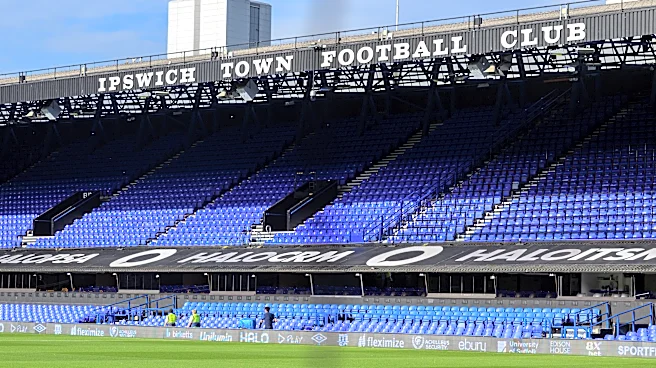





Last week’s ‘punch in the stomach’ result against Ipswich wasn’t the first time that the Lads had made the long trip to Suffolk on the opening game of the season. There was an exciting encounter back on this day in 1981 — a thrilling six-goal game that saw Sunderland return with a fine point.
Back in those days, I remember being full of hope and expectation on the opening day. It wasn’t beyond possibility that many teams had a chance of winning the league or a cup — and this was before the Premier
League and the ‘top six’ clubs became a closed shop.
Alan Durban was assembling a young and energetic team, and there was much to admire.
This season also saw the introduction of three points for a win and one point for a draw, which would take some time for people to get their heads around. We also had in our squad a maestro by the name of Ally McCoist, who would make his debut for the team.
For younger readers, Ipswich Town were a class act at that time. They were the UEFA Cup holders (much akin to today’s Europa League), so Bobby Robson’s men weren’t to be taken lightly.
In front of a crowd of just over 24,000, it was the home side that created the first clear-cut chance when a long kick downfield by goalkeeper Paul Cooper was latched onto by their half-decent attacker Paul Mariner. As the ball bounced, his header looped over Chris Turner, only for it to hit the crossbar.

It was Sunderland that actually took the lead, winning a free kick just before half time, and Mick Buckley’s fine kick found Tom Ritchie, who slotted home.
The two combined again just after the break — this time, the roles were reversed as Ritchie put a neat pass into the path of Buckley, who duly increased the Black Cats’ lead. It didn’t last for long though, as Ipswich’s tough-tackling Scottish international John Wark pulled one back almost immediately.
Cue the introduction of McCoist on sixty minutes, after Alan Brown had taken a knock, and it didn’t take long for him to make his presence felt, as on sixty minutes, he cleverly backheeled the ball for Mick Buckley to score his second goal and restore Sunderland’s two-goal advantage.

The Lads should really have been home and dry at that point, but Eric Gates (later to become partners with Marco Gabbiadini to form the ‘G Force’), had other ideas.
He pulled a goal back within a minute and this pulsating game still hadn’t finished as in the eighieth minute, Gates got his second of the game to draw the Tractor Boys level.
We could’ve lost the game at the death, but unlike last week, the man of the match display by our goalkeeper Chris Turner and a little help from the woodwork kept them at bay, preserving a valuable point against top European opposition.

Both managers had something to say about the new points system.
Alan Durban commented…
Three points for a win is an insult to the game. We are now two points behind other teams instead of one, after putting in a performance like that!
Bobby Robson was in agreement.
It was a great match, but instead of losing one point, we’ve lost two. But we must stick to the system.
With hindsight, following the change, I think public opinion and statistics showed that the three point rule was a good one, as it did alter the mindset of teams, that were now more eager and keen to go for a win and to grab that ‘extra’ point.
Ipswich would continue their impressive form, eventually finishing as runners-up to Liverpool that season. Sunderland avoided relegation by two points (that extra point?) just above relegated Leeds, Wolves and Middlesbrough.
Meanwhile, McCoist’s stay on Wearside was all too short. Two seasons later, he would return to Scotland, where he became a prolific scorer for Rangers.

Football League First Division
29 August 1981
Portman Road
Attendance: 24,060
Ipswich Town 3 (Gates (2), Mariner)
Sunderland 3 (Buckley (2), Ritchie)
Ipswich: Cooper; Mills, McColl, Thijssen; Osman, Butcher, Wark; Muhren, Wark, Mariner; Gates
Sunderland: Turner; Hinnigan, Munro, Buckley; Clarke, Hindmarch, Chisholm; Ritchie, Brown (McCoist 63’), Rowell; Pickering