



It’s Wednesday night here at BCB After Dark: the can’t-miss party for night owls, early risers new parents and Cubs fans abroad. We’re so glad you decided to stop by. Come on in out of the fall chill. There’s no cover charge. The hostess can seat you now. Bring your own beverage.
BCB After Dark is the place for you to talk baseball, music, movies, or anything else you need to get off your chest, as long as it is within the rules of the site. The late-nighters are encouraged to get the party started,
but everyone else is invited to join in as you wake up the next morning and into the afternoon.
Last night I asked you about considering a deal for Rangers pitcher MacKenzie Gore. You weren’t too keen on the idea, with sixty percent of you saying to stay away from Gore.
We’re going to take a little break here to listen to some music and talk movies. You’re more than welcome to join us. We’ll be back again on the other side.
Tonight in honor of us getting a new James Bond, we’re featuring the theme song “You Only Live Twice,” written by Joe Barry and originally performed by Nancy Sinatra. This is the Bill Frisell Trip in Berlin in 2025. Frisell is on guitar, of course, and he’ s joined by Thomas Morgan on bass and Rudy Royston on drums.
Dragonwyck is the 1946 film that is best-known as the first film directed by Joseph L. Mankiewicz, who would go on to win Academy Awards for directing A Letter to Three Wives and All About Eve. Mankiewicz also wrote the screenplay. Although modern audiences might think it’s a fantasy movie based on the title, it’s actually a gothic drama in which the best thing about it is a terrific performance from the villain of the piece, played by Vincent Price.
Dragonwyck is a pretty familiar setup to the gothic genre. An innocent girl/young woman gets plucked out of her poverty and gets caught up in a dangerous and mysterious world of wealth in an old castle. The twist in Dragonwyck is that the innocent young farm girl Miranda, played by Gene Tierney, is from Connecticut and the manor that she gets whisked off to is in New York.
The film starts in the 1840s with Miranda dreaming of getting out from the poor life as a farm wife that her very religious parents Ephraim (Walter Huston) and Abigail (Anne Revere) have planned for her. Salvation for her fate comes from a letter from Nicholas van Ryn (Price), a distant cousin through marriage to Abigail. Nicholas is a New York patroon, a descendant of the rich feudal-like landowners who were set up in New York’s Hudson River Valley by the Dutch crown when New York was a colony of the Netherlands. These men continued to rule over huge tracts of land in New York well into the 19th Century, with dozens or even hundreds of tenant farmers working the land and paying rent, either in money, crops or livestock, to the patroon. The patroon ruled over this land with similar rights to a European nobleman and this system continued well into the 1840s.
It turns out that van Ryn has a young daughter and a sick wife and he needs a nanny (although they don’t call her that). Miranda jumps at the chance to escape the dreary life that staying on the farm would mean. Ephraim isn’t so sure he wants her going to a place that he’s sure is full of sin, but he loves his daughter enough to at least meet with van Ryn to check it out. He agrees after Nicholas turns on all the charm that Price is capable of and he assures her that his intentions are nothing but honorable.
Miranda is blown away by the wealth of New York City and then even more awed as she travels up the Hudson as she sees the castle-like mansion that is Dragonwyck. Of course, once she gets settled, she quickly discovers that the democratic and egalitarian rules of Connecticut don’t apply in this nobility-like world of the patroons. Everyone looks down upon her for her humble origins other than van Ryn and the local doctor, Jeff Turner (Glenn Langan). Dr. Turner is taking care of van Ryn’s sick wife Katrine (Connie Marshall) but other than that, he really doesn’t like Nicholas and the feeling is mutual.
Dr. Turner doesn’t think Katrine has anything serious and that she’ll get better soon, but instead her condition takes a turn for the worse and she dies mysteriously. Nicholas immediately starts turning his romantic attentions to Miranda.
Obviously the mystery is how did Katrine die and why is Nicholas so interested in Miranda so quickly. Dr. Turner is suspicious of Nicholas’ intentions, but Miranda jumps in with both feet. Is this the worst mistake of her life?
So yeah, this is a pretty standard gothic story about an innocent girl from the country who gets swept up in the decadent world of the nobility. The twist is that it’s set in New York. There’s also the historical background of a farmer’s revolt that would end the patroon system in the 1840s. In this case, the revolt is lead by future M*A*S*H star Harry Morgan.
So all of that is fine but not anything particularly special. What is special is the performance of Price as Nicholas van Ryn. Price uses that unmistakable mid-Atlantic accent and all the winsome charisma that he had to make it convincing that people like Ephraim and Miranda would fall for his obviously evil intentions. He can also turn that charm off at a moment’s notice and let the evil underneath show through. It’s too bad that we can only watch Dragonwyck after being familiar with Price’s later career and that the moment that he appears on screen, we expect evil intentions. I think audiences in 1946 would be more torn on what kind of a character van Ryn is, although they’d also be more familiar with all those gothic stories that rarely turn out well. The Otto Preminger-directed film Laura (which also starred Tierney) better uses Price’s inherent creepiness and leading-man looks to keep audiences guessing about his motivations. But still, Price dominates the screen in Dragonwyck every time he’s there. He even stands as a looming force all the time he’s off-screen. If you want to know how really good an actor Vincent Price was, this a great place to start.
Tierney is, of course, fine in a role that really doesn’t challenge her much. She’s a pretty stock spunky Connecticut farm girl who has big dreams but is too innocent to realize the cost of those dreams. She’s so much better in Laura and especially in Leave Her to Heaven, but she had better material in those films. Huston is good as Miranda’s father but the rest of the cast is just there. The daughter, who was the whole plot device to get Miranda to Dragonwyck, is forgotten after a couple of brief scenes.
Obviously Mankiewicz would go on to bigger and better things. In addition to the Oscar-winning films mentioned earlier, he would direct such great films as The Ghost and Mrs. Muir, No Way Out, Julius Caesar, The Barefoot Contessa, Guys and Dolls and Sleuth. He also directed Cleopatra, which was such a disaster that his great-nephew Ben Mankiewicz did a entire podcast season on it. But as a start, Dragonwyck is fine. Maybe a bit better than “fine” thanks to Price’s fantastic performance.
Here’s the trailer for Dragonwyck. It immediately makes the connection to Rebecca and yeah, Rebecca is an earlier and better version of Dragonwyck. That’s not really an insult as the Alfred Hitchcock-directed Rebecca is a masterpiece and Dragonwyck is just good. But they are both examples of that gothic story that audiences seemed to eat up mid-century.
Welcome back to everyone who skips the music and movies.
The Cubs drafted outfielder Josiah Hartshorn out of high school in Orange County, California in the sixth round of the 2025 draft. They paid him second-round bonus money ($2 million) to get him to forego a college career at Texas A&M. This past year, Hartshorn made his professional debut and he rocketed through the system, playing for Low-A Myrtle Beach, High-A South Bend and finishing up in Double-A Knoxville. He hit a combined .284/.407/.518 with 23 home runs. Did I mention that he’s only 19?
This is what observers over at Baseball America said about him earlier today.
There has been a lot of speculation that Harsthorn could be ready for the major leagues sometime in 2027. Probably not to start the season (well, depending on when the season starts) but certainly sometime in the second half. That’s not definite, but it’s definitely a possibility if he stays healthy and continues to hit the way he has.
There’s a very good chance that Josiah Hartshorn is the Cubs right or left fielder of the future. The question then becomes, how much into the future?
If Hartshorn reaches the major leagues at 20 or even 21, that means he’s going to be a free agent at 26 or 27. (Assuming things don’t change after the lockout.) We know from past experiences that good players who reach free agency at that age are poised to get massive contract payouts. Juan Soto is the most obvious recent example, but there’s also Alex Rodriguez and Jason Heyward and other position players who reach free agency still in the prime of their careers.
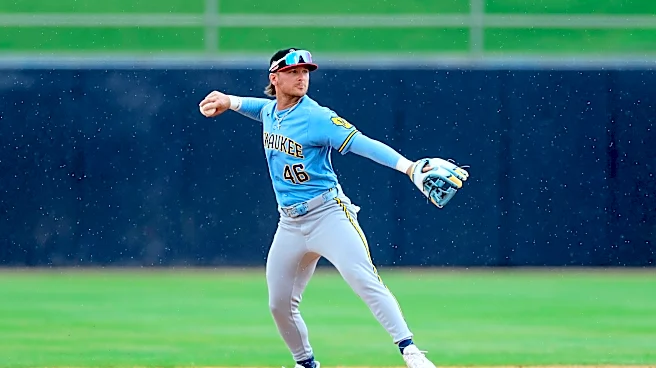
Teams know this and have recently been trying to lock up players even before they make their major league debuts. The Brewers locked up outfielder Luis Lara last year for seven years and $31 million and shortstop Cooper Pratt for eight years and $50.75 million. The Mariners got Colt Emerson locked up for eight years and $95 million. Rookie of the Year Kevin McGonigle got eight years and $150 million just three weeks into his major league career.
The reason why teams make the deals is clear. It gives cost certainty on a contract going forwards. Rather than have to deal with three years (or so) of arbitration, you know exactly what a player is going to earn before he reaches free agency. On top of that, these deals always buy out one or two years of free agency, when a player might not be expecting as much money on the open market, making it slightly easier to re-sign them should they choose.
The benefit for the player is obvious as well. They get life-altering money now without having to worry about what the future holds. Rather than making the major league minimum for their first three seasons, they get several times that. And if something goes wrong with their career and they don’t live up to the hype, they got paid as if they did anyway.
And that’s the downside of these deals for the teams. If a player busts, they’re still paying them a lot of money. That doesn’t happen very often, but it does happen. I can remember Jon Singleton signing a big deal before his major league debut and Singleton never amounted to anything more than an up-and-down player. (There was an off-the-field reasons the Astros signed Singleton early, but that doesn’t detract from the point. The Astros were stuck paying a good chunk of money to a minor leaguer.)
For the player, the downside is they will get less money than they probably would in arbitration if they end up as the star everyone thinks they’re going to be. Plus, they get free agency delayed by a year or two, which will definitely cost them money if they turn out to be pretty good.
So should the Cubs try to sign Hartshorn now? I think he’s a better prospect than either Lara or Pratt, but not nearly as good as McGonigle or Konnor Griffin, who signed a similar extension. I think the Colt Emerson deal of eight years and $95 million is about in Hartshorn’s range. Let’s add in $5 million and make it eight years and $100 million. Would you offer that to Josiah Hartshorn before the season starts?
Thank you for stopping by, tonight and all week. Please tell your friends about us. Please get home safely. Stay warm and dry. Don’t forget your coat. Recycle any cans and bottles. Tip your waitstaff. And join us again next week for more BCB After Dark.