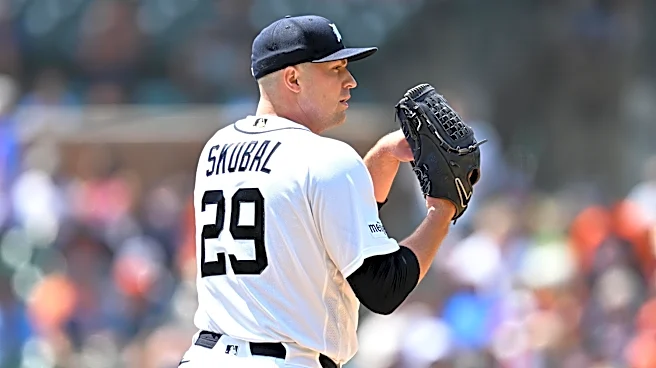



Last offseason, the Mets thought they’d fortified their rotation by adding projected frontline starter Freddy Peralta. Instead, the staff finished 22nd in innings pitched and 23rd in ERA, and Peralta was traded by the deadline. Now, the organization has made an even bigger splash by signing two-time Cy Young Award-winner Tarik Skubal to a record-setting nine-year, $450 million deal.
The move vaults the Mets’ rotation into another class, providing a premier ace and potential Hall of Famer to lead the young
core of Nolan McLean, Christian Scott, and Zac Thornton. With the Skubal signing now official, here is where the Mets’ projected rotation ranks among the National League’s best entering 2027.
5. Atlanta Braves
Any rotation headlined by the resurgent veteran Chris Sale is sure to appear near the top of a league-wide ranking. The problem for the Braves is the lack of reliable upside through the rest of their rotation. There’s high-end potential in 21-year-old fireballer Didier Fuentes, who impressed with a 2.45 ERA and 11.3 K/9 while used almost exclusively out of the bullpen in 2026, but he’s unproven as a starter at the major-league level. There’s also Spencer Strider, who will once again look to stay healthy and recapture his old All-Star form. But past Sale, it seems the only pitchers who can be counted on to make 25+ starts are Grant Holmes and Bryce Elder, who managed to put up above-average ERAs in 2026 yet sport less encouraging advanced metrics.
4. New York Mets
Surprised to see the Mets so high after putting up the fourth-worst ERA of any starting staff in the National League last season? That’s what signing a two-time Cy Young Award-winner like Tarik Skubal can do! New York also began to see flashes of excellence from their young trio of McLean, Scott, and Thornton down the stretch. Even if not all three pitchers can achieve their full potential in 2027, the Mets still appear in a strong position to have four quality options. If veteran Sean Manaea bounces back or prospect Jonah Tong figures out how to dominate at the major league level, the Mets’ staff could form a seriously dangerous postseason force.
Surprised to see the Mets this low after acquiring perhaps the best pitcher in baseball? One ace can’t do it all. For evidence of that, look no further than to the Mets’ previous three Cy Young Award-winning seasons (R.A. Dickey in 2012, Jacob deGrom in 2018 and 2019), as the team failed to make the playoffs in all three. Past Skubal, the rotation has high potential but little experience, and two pitchers (Scott and Thornton) who have never exceeded 150 innings in a season at any professional level. Skubal might be able to stop the type of 12-game losing streak the Mets suffered in April 2026, but he wouldn’t necessarily be able to prevent a losing season overall if the rotation can’t be counted on for quality outings past him and McLean.
3. Milwaukee Brewers
The Brewers’ young starters already have plenty of hardware to back them up, with 24-year-old ace Jacob Misiorowski boasting a unanimous Cy Young Award selection and all members of the Crew flashing a fresh World Series ring. Milwaukee’s starting pitching corps posted the second-best ERA (3.61) in the NL last season, and while The Miz was a big part of that, rookies Logan Henderson and Robert Gasser both emerged as front-end pieces and Kyle Harrison showcased sustained stretches of excellence. The Brewers’ rotation actually doesn’t look all that different from the Mets’ one: there’s an established ace at the top, and a collection of promising yet somewhat unproven candidates filling out the rest of the slots. The Brewers have the edge because Misiorowski, unlike Skubal, is coming off a Cy Young Award-winning season, and the young core now has the advantage of a championship to offset their lack of big-league experience.
2. Los Angeles Dodgers
Even with mid-season acquisition Tarik Skubal departing in free agency and the dominant unicorn Shohei Ohtani’s two-way status in question for 2027, the Dodgers still have one of the most formidable rotations in the sport after leading the NL with a 3.43 ERA last year. The leading trio of Yoshinobu Yamamoto, Blake Snell, and Tyler Glasnow feels simply unfair, especially in a playoff series (unless you’re the 2026 Brewers and will score four or more runs no matter who is on the mound). 25-year-old Roki Sasaki could be primed for a breakout season at the back of the rotation after finding his footing towards the end of 2026, while Justin Wrobleski and Emmet Sheehan provide L.A.’s patented layer of quality depth for when injuries inevitably strike. It’s a well-oiled machine, perfectly calibrated to win the Dodgers anywhere between 95 and 105 games by the regular season’s end and put them in position to contend for yet another World Series title.
1. Philadelphia Phillies
What big three could possibly be scarier than Yamamoto, Snell, and Glasnow? How about Zack Wheeler, Cristopher Sánchez, and Jesús Luzardo? Don’t let the Phillies’ early playoff exit fool you — their rotation is perhaps the most fearsome in baseball. It’s not just a matter of the staff’s dominance, but also its durability. They racked up 883.1 innings pitched last season, the most of any team in the NL, and in Wheeler, Sánchez, and Luzardo, they also had three qualified pitchers (162.0 IP or more) with an ERA+ of 150 or higher. There were only 12 such pitchers in MLB last season, and no other team had more than one. If Aaron Nola can continue to rack up innings with a near-league-average ERA and young Andrew Painter can build on his late-season success (3.65 ERA in the second half), the Phillies should have the best starting five in the sport in 2027.