




The 10-game losing streak and then 16-6 run under Don Mattingly have made the first 50 games of this season a roller coaster ride. After all of it, they’re 25-25 but might be heading in the right direction.
The first 50 games are the first benchmark for what to make of a team in an MLB season. There is still plenty of time for information to change but it’s enough of a sample size to at least have some takeaways. Even with that, there is a lot that can change over the next 112 games.
Given that they’re
down the middle with a .500 record, two of these takeaways will be positive and the other two will be negative. Seems fair.
Wheeler is BACK. Sánchez and Luzardo got better?
Zack Wheeler’s four-seam fastball sat 96.3 mph against the Pittsburgh Pirates on Sunday, which was slightly higher than his 2025 average. His fastball is still getting plenty of whiffs, he is generating chase, and limiting damage.
It hasn’t always been as smooth sailing as the 1.99 ERA would indicate. He is not striking out as many hitters or limiting hard contact like before but that is probably going to change if he maintains the stuff he showed against the Pirates.
Cristopher Sánchez has a 1.82 ERA over his first 64.1 innings and hasn’t allowed a run this month. He has made some slight tweaks but nothing super serious. Sánchez has tweaked his approach to right handed hitters by backing off the sinker by five percent to throw more changeups and sliders. As a result, he has the highest strikeout rate of his career against right handed hitters.
Sánchez also tweaked his slider, which has given it more drop and more of a true death ball shape. He doesn’t need much.
Jesus Luzardo has once again been snake bitten by poor BABIP luck and bad variance but is doing all of the things you want a front-line starter to do. He ranks 12th in K-BB%, gets groundballs, and limits hard contact. He projects to be a top 15 starting pitcher for the rest of the season because of these things. It has been trending in the right direction for Luzardo with a 2.86 ERA in his last five starts.
While he is throwing the sweeper 36% of the time, don’t think he’s just a one-trick pony. Luzardo tweaked his changeup and now gets roughly seven more inches of drop while only losing a tick in velocity. Hitters have whiffed on the changeup 42.9% of the time and are slugging .354. It’s a really good pitch.
The big difference between Don Mattingly’s tenure and Rob Thomson’s mostly boils down to this. Sánchez has been dominant, Wheeler has made four of his five starts under Donnie Baseball, and Luzardo’s results have started to match the underlying metrics.
Bryce Harper and Kyle Schwarber
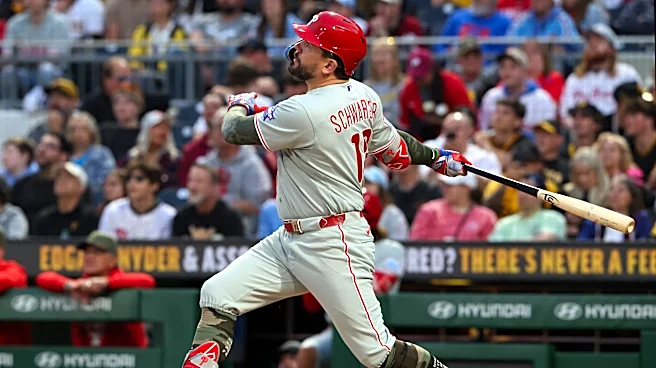
No one in the National League has a higher wRC+ than Kyle Schwarber. He has six more home runs than second place and has the highest ISO in the NL by over 60 points. It’s ridiculous.
I went into some of Bryce Harper’s adjustments last week and he has looked like the elite hitter Dave Dombrowski challenged him to be. Only two hitters in the National League have a higher xwOBA than Harper as he made adjustments to strikeout less while still hitting for power.
While the rest of the lineup generally has things to figure out (even Brandon Marsh to some extent), the Phillies have two of the ten best hitters in the National League that give them a decently high floor.
What to make of Aaron Nola, Trea Turner, and JT Realmuto
Each of these players might be reminders that this team is aging. Nola is 33, Turner will turn 33 in June, and Realmuto is 35. Each of them have taken significant steps back as players compared to pre-season expectations and are all under long-term contracts.
Aaron Nola has a 6.02 ERA over his last 145 innings in 2025 and 26. The fastball has been getting crushed to a .958 slugging allowed which seems impossible. The shrinking strike zone with umpire evolution and the challenge system probably hurts a pitcher like Nola more than others because throwing quality strikes is way harder.
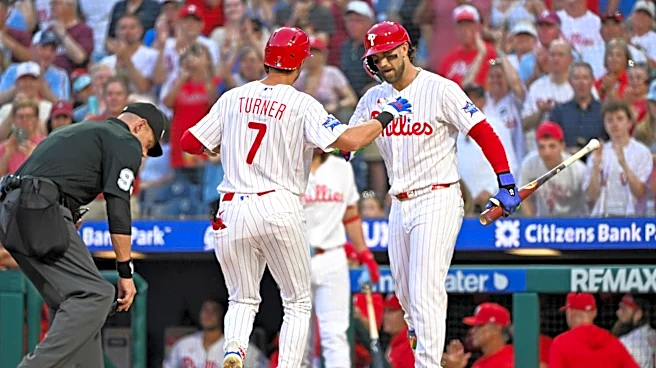
Trea Turner is the most promising player of these three to turn things around because it might just be a poor start. He had a nice series against the Reds with two extra base hits, three stolen bases, and a couple of walks.
His physical indicators don’t indicate he is cooked; his 90th percentile exit velocity, whiff rate against velocity, and average swing speed all look the same as last year. He is still very fast and the arm strength looks close to normal. With all of that being normal, why does he have a .652 OPS?
Turner’s BABIP is down considerably from his career norms, which is probably an indicator of poor luck but that doesn’t seem like an easy answer. He is striking out more and has taken a step back from an approach standpoint but that doesn’t fully explain it either.
The batted ball data might be hurting him the most. Turner’s line drive rate is down 4% from last season and his pull rate is down close to 5%. Both can hurt a player’s overall BABIP, especially for someone like Turner who has never possessed elite power.
But even with all of that, is it fair to lump him in a conversation about aging players? It’s hard to know.
JT Realmuto has seen significant steps back in key physical indicators. His 90th percentile exit velocity is down over four ticks from 2025 and he isn’t barreling the ball nearly as often as before. Some of this might be an adjustment to make more contact but none of it is working. With a .563 OPS in 116 PAs this year, there are some real red flags.
Each of them might not be heading in the same direction over the next 112 games but it still feels fair to lump them together. A bit of the Phillies’ future relies on at least one of them aging well.
Outfield Production
The Phillies outfield ranks 25th in fWAR, 23rd in wRC+, and 24th in Outs Above Average. It’s not great.
Brandon Marsh has produced far better than anyone else in the group. He cut his strikeout rate down by 5% from 2025 and it’s helped him hit .325 with a .814 OPS. However, there are some red flags moving forward.
Marsh’s ability to work walks has cratered. He is walking just 4.0% of the time this year and has a chase rate over 10% higher than last season.
There is a chance a lot of this should be written off as a small sample size. He walked 8.9% of the time in 2025, 10.5% of the time in 2024, and 12.5% in 2023. He has also been way more prone to strikeouts. Something might have to give here.
For someone in their rookie season who faced significant questions about short-term production while adjusting to major league pitchers, Justin Crawford has more than held his own from a results standpoint. He has a .703 OPS, gotten on base enough, and shows an ability to put the ball in play.
Assessing what this all means for Crawford’s long-term projection and short-term projection are different conversations. Because the Phillies are trying to win now, how the results look over the next four months matters even if it’s not always indicative for what the next 5 years of his career will look like.
With that in mind, the .703 OPS might not seem sustainable. He just doesn’t hit the ball very hard and at a negative launch angle on average, production against fastballs is probably going to come down, and he probably doesn’t make enough contact yet to overcome it. The defense has also been poor with some bad reads that the athleticism hasn’t fully made up for yet.
Adolis García cut his chase rate down by over seven percent and is walking more but it’s probably led to him being late on too many pitches. He is struggling to handle velocity and his batted ball direction is very poor. He has the lowest pull air rate of his career by over four percent which is a good way to kill BABIP. In order to work an approach like that, you probably need top-tier power output, which he doesn’t have.
While the right field defense is truly a joy to watch, he has been roughly a replacement level player because of a .606 OPS as their only right handed addition in the off-season that is still on the big league roster.
The Phillies initially had Otto Kemp get run as the fourth outfielder but he was sent down in the middle of April. Felix Reyes joined in the middle of their 10 game losing streak and hit a home run off Chris Sale. He didn’t do much after that and they’re back to Otto Kemp.
Dylan Moore also played center field in Rob Thomson’s final game as Phillies manager.