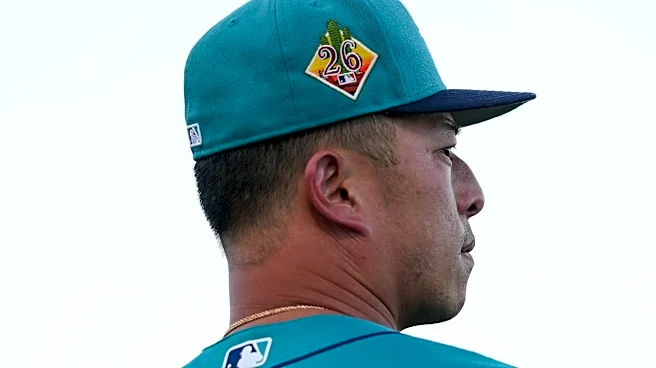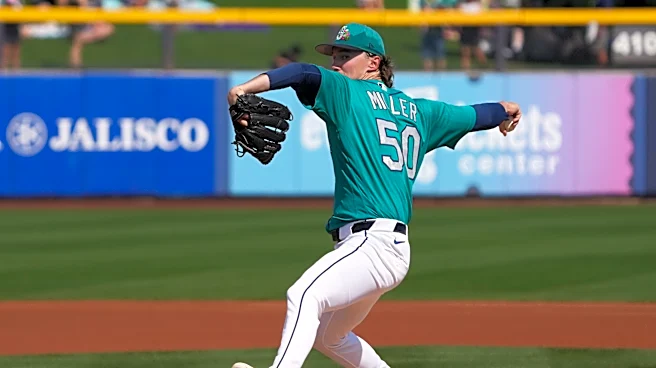




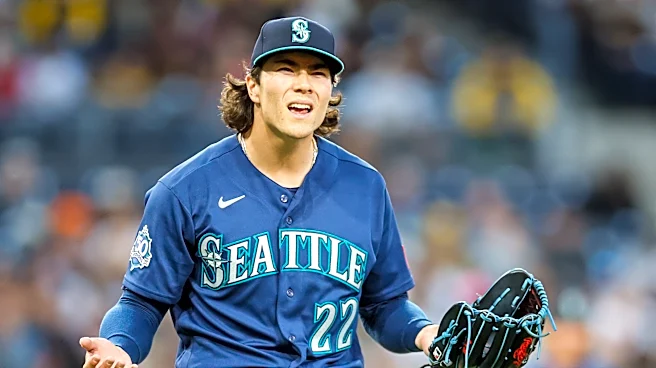
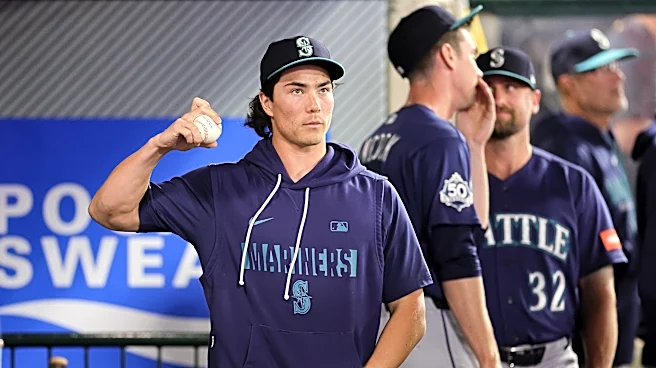
A familiar face was back at T-Mobile Park on Friday.
“Hello, hi, yes, it’s me, I’m back. Yes, hi, hello,” said Bryce Miller in his familiar Texas accent as he ambled down the clubhouse hallway, greeting the assembled media like a visiting dignitary in a receiving line.
It’s been a long layoff for Miller, who hasn’t pitched since February 26th, when he made his first start of spring and then promptly went on the IL with a left oblique injury. The injury is unrelated to the right elbow injury that kept
Miller out at times for last year, but it’s not less frustrating for the amiable Miller, who – as is typical – joked about his injury in a media availability prior to Friday’s game.
“I was on a 27 year streak without an oblique injury, so if I restarted it, that gives me another 27 or so.”
Miller said he didn’t learn a new pitch during his long layoff, despite “scouring” social media looking for one, but said he has been messing with his cutter and trying out a new grip on his slider that he picked up from Houston’s Bryan Abreu; he’s curious to see how the slider will play in Seattle’s colder air after it was really “depthy” in Arizona.
“I’m just trying to get some kind of breaking ball I can get more whiff on. That’s something I struggled with the last few years, so hopefully this is the one – I’ve tried every slider grip possible. This is one I think I’ll be able to throw in any count, and hopefully have a little bit of leeway if I do miss. The slider of the past kind of felt like if I missed it, it kind of got punished.”
Miller will have a chance to try out his new slider when he makes his first rehab start for Tacoma tomorrow, although he’ll only have about two innings and 30 pitches to work on it. His next start will progress to three innings and 45 pitches, and then on to four, five, and six innings and 60-plus pitches. Mariners GM Justin Hollander says Miller will be on an every-sixth-day schedule, allowing him to pitch once per series on the minor-league schedule.
The thing the Mariners have been monitoring with Miller is how quickly he’s been bouncing back after outings. What was slowing Miller earlier in the rehab process was lingering soreness for days after he’d thrown; that soreness abated and then eventually disappeared, at which point the team determined it was time to send him out on a rehab assignment.
“It was kind of a roller coaster of a rehab process,” said Miller, “because I’d get to a point where it felt really good, and then I’d throw a bullpen, it’d go really good, velo would be great, and then the next couple days I just wouldn’t recover quickly enough.”
But Miller said he finally has gotten to the point where he bounced back quickly after a bullpen, feeling “100% completely normal” in the days following his last outing.
“Over the last week, 10 days, we’ve gotten to the point where he feels great all the time,” said Hollander. “He doesn’t feel any aching or soreness while he’s throwing, and he doesn’t feel any soreness afterwards. So that’s the progression.”
While the team will be monitoring Miller’s mechanics over his rehab outings, making sure he’s not changing anything to compensate for any lingering injury, they probably won’t need to wThere’s been no downturn in Miller’s stuff, which was looking great in his lone spring training outing before he was shut down with the oblique injury. His fastball has been up – 98 and touching 99 – consistently through his bullpens.
Miller says the thing he’ll be focusing on is all the little details he didn’t get to do with no spring training or competitive games, things like pitching on a pitch clock, holding a runner, or doing pickoff moves, something he said Logan Gilbert—who completed his first successful big-league pickoff to first last homestand—has offered to help him with.
“I’ve seen him for ten minutes in there, he’s already brought it up,” said Bryce.
Miller also this recent spate of injuries, after a lifetime of being fortunate in that regard, has taught him the importance of controlling what he can control.
“I’ve just been really trying to make sure I do everything I can to take care of my body, make sure I’m ready to go, not skip anything on the prep side, nothing on the recovery side. And then if I do all that and something happens, then it’s out of my hands, but I can’t look back and be like, damn, if I would have just prepped a little more, maybe it would have been fine.”
The question hanging over all of this is: what does the team do when Miller is ready to return to the big-league club while his replacement Emerson Hancock has been so effective? Hollander, unsurprisingly, says that’s a bridge the organization will cross when it comes.
“There’s one thing that I never lie there at night, not able to sleep, thinking about, and that’s what if we have too many good starting pitchers. It’s just not a thing that happens to almost anyone. If we get to be a month from now and that’s what happens, we’ll figure it out. We haven’t made any decisions on that whatsoever.”
“And truthfully, God bless us if it’s a problem we have thirty days from now.”