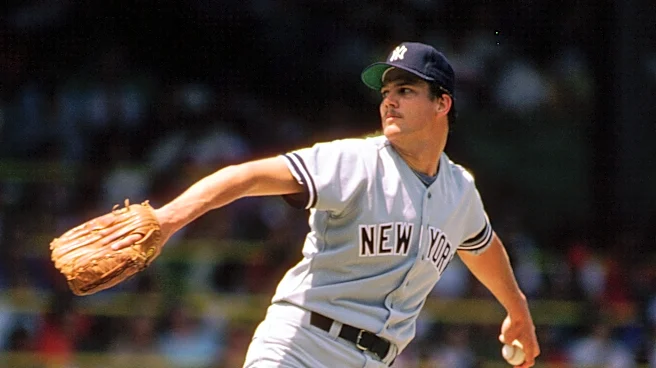





Of all the players who donned the pinstripes, Dennis Rasmussen was certainly one of them. If we’re only looking at the numbers, he was a pretty forgettable starter who was often competent but rarely dominant. And as he played for the good-but-not-good-enough Yankees of the mid-80s, he has no rings nor legendary postseason exploits to his name. However, one biographical detail elevates Rasmussen’s story from the humdrum to the sublime.
Dennis Lee Rasmussen Born: April 18, 1959 (Los Angeles, CA) Yankees
Tenure: 1984-87
Strictly sticking to baseball, Dennis Rasmussen’s biggest claim to fame may be being involved in three high-profile trades early in his career. The California Angels selected Rasmussen in the first round of the 1980 MLB Draft, only to ship him to the Yankees as part of a package for Tommy John following the 1982 season. Just the following year, the Yankees flipped him (along with another prospect) to the Padres for 1975 NL Rookie of the Year John Montefusco.
Rasmussen reached the big leagues with the Padres that year, posting a 1.98 ERA over four appearances and one start. However, San Diego would not be his forever home. Days before the start of the 1984 season, the Padres dealt Rasmussen back to the Yankees along with a PTBNL for Graig Nettles. Between John, Montefusco, and Nettles, that’s upwards of 160 total WAR entangled in the Dennis Rasmussen trade tree.
While Rasmussen did not quite match the production of the players he was traded for, he was a solid pitcher in his own right, especially during his time with the Yankees. Across four years and 103 appearances (96 starts), he compiled a 39-24 record with a 4.28 ERA (4.53 FIP). Not amazing, but firmly within “dependable fifth starter” territory. His best year in terms of traditional stats was 1986, when he went 18-6 with a 3.88 ERA (albeit with a 4.40 FIP). Rasmussen stood out in particular on NBC’s “Game of the Week” over the Fourth of July weekend, when he registered his first career shutout, blanking the White Sox on three hits.
Rasmussen was the de facto ace of the rotation, a feat made more impressive by the fact that he barely made the team out of spring training—George Steinbrenner had publicly declared that he would send Rasmussen to Triple-A following a spring start gone awry, but a series of injuries to the rest of the staff opened up a spot for Rasmussen, and he ran with it.
That 1986 campaign earned Rasmussen an Opening Day start the following year, the only one of his career, at Detroit against Jack Morris. He pitched seven innings of one-run ball as the Yankees won in extras 2-1. However, the rest of ’87 was not as kind to Rasmussen. After a particularly brutal stretch to start August, in which he allowed 21 earned runs over six starts, the Yankees traded him to the Reds for Bill Gullickson. This ended Rasmussen’s time in the Bronx.
To his credit, Rasmussen did not go quietly afterwards. He pitched well for the Reds down the stretch in 1987, posting a 3.97 ERA (3.44 FIP) and 1.0 WAR over seven starts to close out the year. And though he struggled mightily to start the 1988 season, prompting the Reds to ship him to the Padres, it was there that Rasmussen truly shone for the first, and only, time in his career, winning 14 of 20 starts with a 2.55 ERA (3.18 FIP). He would pitch six more seasons in the majors but would never replicate that level of success, instead bouncing around the league as a back-end starter. He retired as a Kansas City Royal in 1995, at the age of 36. He then spent a couple of years as a minor-league coach for the (then) Devil Rays and Red Sox before leaving pro baseball altogether to spend time with his family. He returned to coaching in 2021, and is currently an Indy ball pitching coach for the Billings Mustangs of the Pioneer League.
Rasmussen’s career was a fine one, if somewhat underwhelming for a first-round draft pick. But I’ve left out one crucial detail: Rasmussen accomplished all of the above with literally no cartilage in his left ankle. In fact, he nearly lost that foot altogether at the age of 14, when he was hit by a speeding car while riding a bike with his father. At the time of the crash, all that connected his foot to his leg was his Achilles tendon. Although his surgeon, a Vietnam vet, succeeded in reattaching his foot, no cartilage remained within, only bone against bone.
Even after he recovered from that horrific injury, the condition of his foot prevented Rasmussen from running for any extended amount of time without his ankle swelling to an ungodly size. However, he was not deterred. Electing to do his cardio by riding on stationary bikes rather than running, he worked hard, proved skeptics wrong, rose through the minor leagues, and achieved one of the hardest feats anyone could hope for: he made the bigs, and he stayed there for 12 years.
If that isn’t a story worth remembering, then I don’t know what is. Happy 67th, Dennis. I hope you have a good one.
See more of the “Yankees Birthday of the Day” series here