
The calendar year 2025 for the New York Islanders comes to a close in a jarringly different state compared to one year ago.
Instead of being a drifting, dull team guided by a GM that seemed…stuck in neutral,
they are now a more entertaining (if risky) team, with new life, in the thick of a playoff race with a conference that has helpfully descended to a similar level of okay-edness around them.
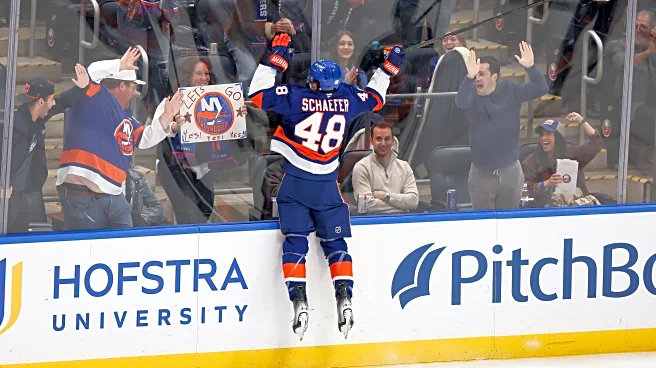
This year will always go down as the transition point from the league’s oldest GM to one of its youngest. It will always be remembered for the beginning of the Matthew Schaefer era.
But for posterity, here are the significant turning points from 2025 that have the next year looking far more interesting, to say the least.
Fare Thee Well, Brock
The first sign of a looming transition was one that Lou Lamoriello did not want, one that he fought until the end: Trading Brock Nelson instead of getting his agreement on a long-term extension. The details of whether the sticking point was money, term or setting were never revealed, but you have to wonder if Nelson knew in his heart that now — and elsewhere — was his best chance at contending. The aging roster and wheel-spinning that was becoming the norm under Lamoriello did not elicit hope for the near future.
He’s arguably the best Islanders forward of his era, and now he’s living his best life with Devon Toews on a Cup contender in Colorado. Winnipeg reportedly pursued him hard but was not a destination he fancied.
Fortunately, in what would become his final great act as GM, Lamoriello covered all the bases and fetched a top prospect — potential future Brock, Calum Ritchie, now a regular — and a (top-10 protected) first-round pick.
Lou Lamoriello Departs…Mostly
The bombshell that was sought by many fans but expected by few: Lamoriello’s contract “would not be renewed.” His time as GM would end. (His time with the franchise did not, as he was retained as an advisor to ownership — though that’s apparently something that was always in his exit plan for Toronto and Long Island.)
Former NHL exec and current ownership member John Collins, with all his connections, was set to lead the search for the new GM.
History may hold that Lamoriello’s best move was one of his very first: hiring Barry Trotz as head coach to bring his disciplined, structured approach, carrying an average-talented team to more playoff success than it had seen in more than two decades. The consecutive conference finals will be remembered most, but the way the roster brushed off the loss of John Tavares, made the playoffs and promptly swept the Pittsburgh Penguins was — in that moment at least — equally gratifying.
Anyway, that’s all in the past, and it wasn’t papering over two playoff misses and two first-round losses in the final four years of Lamoriello’s tenure. It was time.
Mathieu Darche (and Fun) Arrives
Apparently it could’ve been Ken Holland, if only he’d agreed.
Or maybe it would’ve been Marc Bergevin.
Whatever the case and the sequence, the Isles dodged at least one bullet when they landed Mathieu Darche instead. There would not be a much-rumored one-president, another GM setup. Just Darche, at the head.
Immediately, the team became more accessible. Behind-the-scenes video was possible again. Facial hair, non-military cuts and non 1-31 uniform numbers, too.
But more importantly, there was a fresh approach, a modernized/expanded staff and a realistic look at the roster and the near future.
Noah Dobson is Traded for Picks and a Guy You Don’t Trade
You don’t trade a guy like Emil Heineman…but the Canadiens did.
Okay, in truth, Heineman felt like a throw-in to Darche’s first major decision, that of trading Noah Dobson rather than give him the long-term top-dollar contract he sought.
But once he made that calculation, Darche got himself some serious assets, including Heineman, who’s a Swiss Army knife with a sizzling shot, producing 12 goals, 18 points and a couple of decisive shootout winners in his first 40 games as an Islander. Montreal’s two mid-first-round picks (16 and 17) were ammo to possibly trade down — alas, Boston wouldn’t bite — but ended up getting the Islanders a couple of very good prospects anyway.
Matthew Schaefer Changes Everything
Darche arrived already knowing the Islanders had won the lottery. John Collins had one job and he did it. {/tinfoil}
He and the staff didn’t overthink the pick, but Bossy almighty did the top prospect turn out better and sooner than anyone imagined. After a junior season shortened by illness and injury, Schaefer’s 17 games in 2024-25 gave some pause about what kind of first-overall pick he might be.
But immediately upon landing in training camp, his skating and decision-making had observers in awe. It wasn’t a question of whether he would make the opening roster, or if he’d stick around beyond nine games — it became a question of how big of a role he would grab and how much the Isles could lean on him in his rookie year.
Through the first half season, the answer is a lot. A lot. They started conservatively, pairing him with Scott Mayfield on the third pair. But he quickly escaped that, began logging key power play minutes and consuming all the minutes on a pairing with Ryan Pulock and Whoever Else is Fresh.
Honorable Mention: Fountain of Youth
Not a pivotal story for 2025, maybe not even a real one — or maybe heavily influenced by the presence of 18-year-old Schaefer: Several Islanders who are closer to the end than the beginning are having revival seasons.
Anders Lee (35) and J-G Pageau (33) are not lighting it up, but they are productive and {knock on wood} halthy through the first half of the season. Bo Horvat (30) is off to a blazing start that does not hint at imminent decline.
On the blueline, “the Cobra” version of Adam Pelech has returned as he logs minutes and gobbles up opponent passes.
And Ilya Sorokin — though managing a nagging injury as the calendar turns — has put in several sterling performances, no doubt aided by the Islanders’ ability to confidently put David Rittich (10-4-2, .918) into a regular backup rotation.
All of which has helped the Islanders be far more competitive than pretty much anyone though they could or would be in the second half of the year 2025. Whether that continues in 2026 and ends up in a wild card or even regular playoff (or even home-ice advantage??) spot is, of course, an unknown that is why we watch the games.
Fortunately, thankfully, right now it’s actually fun to do so.
***
Thanks, everybody for reading and commenting and sharing and joking along with us here at Lighthouse Hockey. Happy New Year!