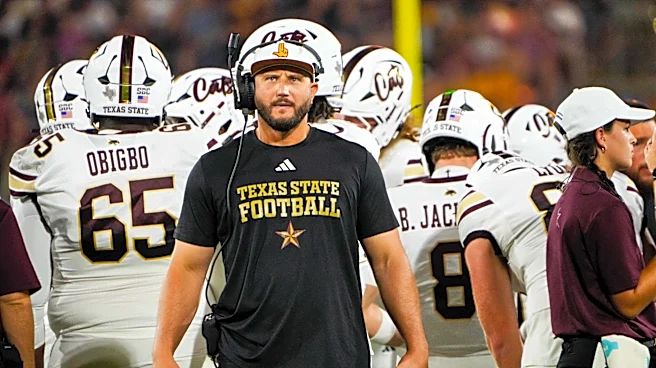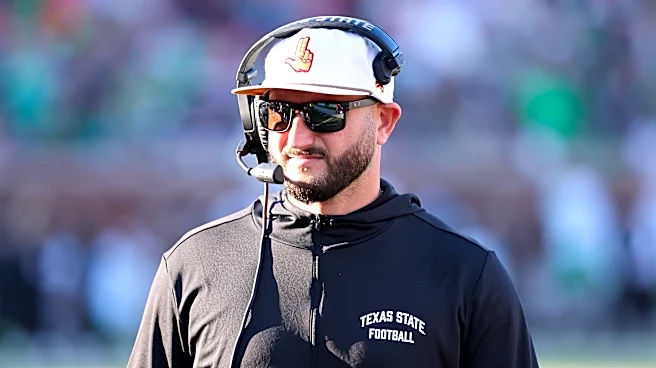

AUSTIN, Texas — On Saturday, Texas State Bobcats head coach GJ Kinne will have a full-circle moment in his career — stepping into the spotlight against the Texas Longhorns at Darrell K Royal-Texas Memorial Stadium almost 20 years after giving up his dream of playing on the Forty Acres.
As the son of Gary Joe Kinne, a standout linebacker at Baylor before a long career as a high school assistant and head coach, Kinne’s legacy ties were to Waco when he was a standout quarterback at Canton and then Gilmer,
but with the Bears mired in the mediocrity of the Guy Morriss era, the Longhorns were the state’s top program in the wake of the team’s national championship as Kinne’s recruitment unfolded as a member of the 2007 recruiting class.
“Any time you grow up in the state of Texas — at least for me — Texas was someone that you wanted to be recruited by,” Kinne told Inside Texas last week.
As one of the top dual-threat quarterbacks in the state, head coach Mack Brown and the Horns were interested in Kinne, who received an offer at a Junior Day in 2006, the most important recruiting events for Texas at the time with expectations set by the staff that most top targets would commit on the spot after receiving their offer from Brown.
“I wasn’t ready at the time, earlier in the process, to kind of buckle down,” Kinne said.
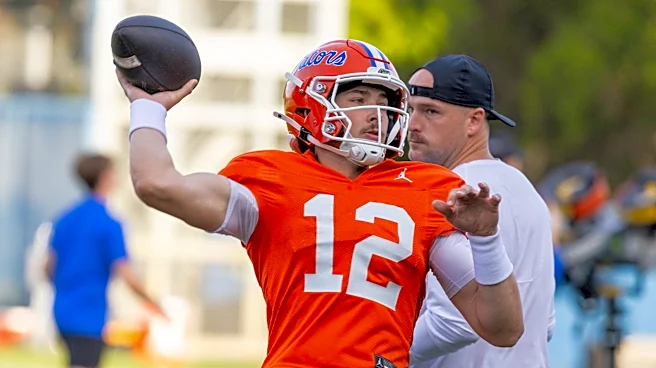
Texas moved on to other targets — Texarkana’s Ryan Mallett, one of the nation’s top players, and Florida product John Brantley, another elite national prospect. After Brantley committed to Texas in April, Kinne commited to Baylor in July after his father joined the program to coach the linebackers.
Ultimately, Kinne’s recruitment wasn’t over — late in the cycle, Brantley decided to stay close to home and sign with Florida, his father’s alma mater, forcing Texas to find another quarterback in the class. So Brown and running backs coach Ken Rucker, Kinne’s recruiter, circled back on the East Texas product, reaching out to Gilmer head coach Jeff Traylor and Gilmer cornerback Curtis Brown, a Texas commit, to ask about Kinne, who had transferred from Canton for his senior season.
Traylor and Brown convinced the Longhorns staff that Kinne was worth taking, and he flipped from Baylor to Texas days after Brantley’s decommitment, took a January official visit, and inked with the Horns on National Signing Day.
“Kind of one of those dream-come-true moments getting to sign with the University of Texas being an in-state kid, so a lot of fond memories going from Gilmer to Austin,” Kinne said.
The stay on the Forty Acres was short, however — as Kinne’s recruitment developed during 2006, redshirt freshman Colt McCoy took hold of the starting quarterback role by ably filling the big shoes of Vince Young, so after Kinne spent the 2007 season redshirting in Austin, he opted to transfer instead of sitting two more years behind McCoy.
Landing in Tulsa under offensive coordinator Gus Malzahn began to shape Kinne’s future trajectory as he learned Malzahn’s fast-paced power spread offense with its gap scheme roots in the old Wing T offenses. Although Kinne never helmed the offense for Malzahn, who left to become the Arkansas offensive coordinator before Kinne became the starter for Herb Hand and then Chad Morris, the former head coach at Stephenville and Lake Travis. Current Florida State head coach Mike Norvell served as the passing game coordinator for Tulsa when Kinne was the starter.
Kinne had received his first introduction to the spread offense when his father, whose background was on defense, decided to start running it after taking over at Canton in 2003 at the beginning of the spread revolution in Texas high school football, fueled by Todd Dodge’s success at Southlake Carroll and the productivity of standout quarterbacks like Graham Harrell at Ennis and Matthew Stafford at Highland Park.
Gary Joe Kinne didn’t really know how to run a spread offense, but he was committed to it, and so Canton ran about four or five plays, achieving some success despite the scheme’s simplicity. When Kinne got to Tulsa, Malzahn’s offense was “an eye-opening experience.”
Kinne’s stint in the NFL continued his offensive evolution playing for Chip Kelly, who was the head coach of the Philadelphia Eagles, before beginning his coaching career as a graduate assistant under Morris at SMU before following him to Arkansas as an offensive analyst.
Perhaps the most defining moment for Kinne as an assistant came after he reunited with Malzahn at UCF in 2021. The Knights had previously found success under offensive coordinator Josh Heupel running a variant of the Art Briles veer-and-shoot offense that was finally proliferating around college football.
Quarterback Dillon Gabriel had thrown for 3,600 yards and 29 touchdowns in that offense, so Malzahn dispatched Kinne to meet with his quarterback and see what Gabriel wanted to add to Malzahn’s attack.
“I’m like, ‘Man this is some really good stuff,’ and really fell in love with that. Obviously still incorporating a lot of stuff that Gus had done throughout the years and we added some of that stuff and had some success with it,” Kinne said.
Enough success for Kinne to land his first head coaching job at Incarnate Word the following year, where he could finally “do everything that I always wanted to do.” The offense Kinne ran with the Cardinals wasn’t without another input, though — from Mack Leftwich, the quarterbacks coach who identified and recruited Cam Ward.
After Kinne elevated Leftwich to offensive coordinator to keep him in San Antonio, the two began developing a offense drawing on their diverse influences, adding Air Raid elements that Mike Leach disciple Eric Morris used at UIW, combined with the wide splits of the veer and shoot and an evolved version of Malzahn’s gap schemes.
“Really just built this offense the way we want to, and every year it’s evolved,” Kinne said. “Feel like it puts a lot of pressure on the defense. It’s a quarterback-friendly offense — it’s really just a numbers game at all times. What are you trying to take away? How can we attack you? Combine that with tempo and some different wrinkles and it’s been been a pretty good offense, top-five offense, the last four years.”
The quarterback who benefits from the friendliness of Kinne’s offense is redshirt sophomore Brad Jackson. A San Antonio Reagan product whose recruitment was impacted by his listed 6’0 height, Jackson broke out last year with the Bobcats, throwing for 3,224 yards and 21 touchdowns on a 71.3-percent completion percentage, and adding 744 yards and 17 touchdowns running into the space created by the offense’s wide splits and the plus-one advantage Texas State creates on option plays against light boxes.
According to Kinne, Jackson is the closest quarterback to McCoy that he’s been around.
“Not just on-the-field play, I think it’s the off the field, too, the consistency, the person that he is, the work ethic, the leadership qualities, all that kind of goes into the intangibles of being a great quarterback,” Kinne said. “Then his on-the-field play is pretty similar as well. He’s super athletic. He’s got a great arm. He’s really accurate. Just an unbelievable quarterback… I think he’s primed to take that next big step.”
The return of two 1,000-yard wide receivers in Beau Sparks and Chris Dawn will help Jackson as Texas State’s tempo, which ranked just outside the top 20 nationally in seconds per play last year, puts alignment, assignment, and communication stress on the Texas defense.
“We need to own the tempo, right? I think that starts with communication, getting the call and getting lined up,” Texas head coach Steve Sarkisian said on Monday. “I think it’s imperative we get our cleats in the dirt, ready to play, and we’ve got our eyes in the right spot.”
To prepare for the Bobcats, the Longhorns have devoted extra periods to practicing against tempo.
“One of the keys is still striking people, still getting off blocks, still playing fast, and so that’s what we’ve been emphasizing, and I think Coach [Will] Muschamp’s done a really good job of that, of getting our guys ready,” Sarkisian said. “Now we’ve gotta make that come to life on Saturday, right? We’ve gotta put it on tape and prove us right that we think we’re ready to play.”
As a 29.5-point favorite on FanDuel, Texas has a major talent advantage over Texas State, but the Bobcats have enough talent offensively to make it difficult for the Longhorns defense as Kinne returns to the Forty Acres as a head coach shaped by his schematic football journey.